Showing posts with label FDA. Show all posts

Most of our common cold medicines don’t work

We still don’t have a cure for the common cold. In your local pharmacy, though, you can find many shelves filled with products that claim to treat the symptoms.

Well, it turns out that one of the most widely used ingredients, long believed to be effective at treating congestion, doesn’t work at all. The ingredient, phenylephrine, has been in use for decades, and it’s in many common cold medicines that are taken by millions of people each year, including Nyquil Severe, Sudafed PE, Robitussin CF, Tylenol Cold & Flu and others.

It turns out that phenylephrine was never properly studied for effectiveness. How can this be? It’s FDA approved, which usually means it has to be safe and effective, right? Not exactly, as I explain below.

As for phenylephrine: well, the studies have finally been done, and last month an FDA panel unanimously concluded, after reviewing the results, that phenylephrine is “useless and no better than a placebo.” It probably won’t cause you any harm, but it won’t have any effect on your stuffy nose.

To understand how this happened—and why it might be true of many other FDA-approved remedies that you can buy at the pharmacy—you have to know about how the FDA approval process has changed over the years. Pharmacists Randy Hatton and Leslie Hendeles, who worked for years trying to get phenylephrine properly reviewed, explained in a recent New York Times editorial that when the FDA was originally created, way back in 1938, it was only required to ensure that drugs were safe.

At the time, that was tremendous progress. Prior to 1938, drug manufacturers could claim pretty much whatever they wanted to.

But it wasn’t under 24 years later, in 1962, that Congress required the FDA to show that drugs were also effective. Therefore the thousands of drugs approved prior to 1962 were mostly safe, but they might not actually treat the disease they were intended to treat. After 1962, the FDA created a process to check those previously approved drugs, but they’ve never had enough staff or funding to check most of them. So phenylephrine was never properly reviewed, until now.

What’s next for phenylephrine? The FDA might ban it from the market, but that will take time, and it might not happen, because the FDA doesn’t have to follow the advice of its panels, although it usually does. Meanwhile, you can still buy cold remedies with phenylephrine, and they still claim to treat congestion.

And don’t even get me started on other treatments that are not only ineffective but that aren’t even subject to review by the FDA, such as homeopathic remedies. These include Zicam, which claims in large print on the front of its packaging that it “shortens colds.” It doesn’t, and Zicam’s manufacturer doesn’t even have to prove it, because it’s homeopathic. If you zoom way in one of the labels on the Zicam website, you’ll find the disclaimer that “Claims [are] based on traditional homeopathic practice, not medical evidence. Not FDA evaluated.” On some of the packages, I couldn’t even find the small print.

(Aside: Congress protected homeopathic preparations from FDA scrutiny way back in 1938, thanks to a homeopath who was also a U.S. Senator, and who helped write the original FDA legislation.)

I wrote about Zicam and other ineffective cold remedies in 2014 (”The Top Five Cold Remedies that Do Not Work”), and that advice still holds. Now we can add another one to the list.

We simply don’t have any drugs that work particularly well for the common cold, despite the many claims you can find online and on the labels of so-called cold remedies. The best thing you can do is just drink warm liquids such as tea or lemon-infused water, stay home and get plenty of rest.

Does Taurine Really Extend Life? Maybe.


 Readers of this column will know that I’m highly skeptical of dietary supplements. So you might imagine my reaction when I saw headlines a few days ago about “Taurine, the elixir of life?” (at CNN) and “Supplement slows aging in mice and monkeys” (NY Times).

Unlikely, I thought. But I read the scientific article behind these reports, and now I’m intrigued.

What is taurine? And could it really slow down aging? Well, it seems like it could, just maybe. A new study published last week in Science (one of the top journals in all of science) seems to show, for the first time, that taking large doses of taurine, an essential amino acid, might provide a host of benefits that include slowing down the aging process.

First question first: what is taurine? It’s an amino acid, but it’s not one of the 20 amino acids that comprise all the proteins in your body. It’s a slightly different one, and our bodies naturally produce it in small amounts. We need more than our bodies produce when we’re very young, but we get it from breast milk, and it’s added as a supplement to infant formula.

We also get extra taurine from our diet: the best foods for taurine are meats, especially shrimp and other shellfish, but also beef and the dark meat in chicken and turkey.

What did the new Science paper show? Well, first the authors (from Columbia University, India’s National Institute of Immunology, and the Sanger Institute in the UK) describe how taurine levels clearly decline with age in humans and other mammals. Now, just because taurine declines doesn’t mean that replacing it will reverse the aging process, but at least it establishes plausibility.

They then describe a series of experiments, mostly in mice but also in monkeys, where they fed the animals relatively large amounts of taurine each day, and the results were pretty darned impressive:

  1. Life span in the mice increased by 10-12%.
  2. In mice that started taurine supplements in middle age, life span increased by 18-25%.
  3. Bone density increased in female mice and osteoporosis seemed to be cured.
  4. Muscle strength increased in both males and females compared to mice who didn’t get taurine.
  5. The number of senescent cells–cells that don’t do much except emit damaging inflammatory signals–seemed to be reduced.

Of course, there’s always a big caveat with results in mice: they’re mice, not humans! And many, many times we’ve seen results in mice that just don’t carry over into humans. So the scientists also did a study (a smaller one) in monkeys, which are much closer to humans genetically. This also had some very good results:

  1. Bone density increased in the spine and legs.
  2. Body fat was lower than it was in monkeys that didn’t get taurine.
  3. Several measures of inflammation decreased.

Monkeys live a lot longer than mice, so the scientists don’t yet know if taurine increases the monkeys’ life span, but all the signs are promising. I was skeptical going into this article, but I couldn’t find any obvious flaws.

In an accompanying article in Science, U. Penn’s Joseph McGaunn and Joseph Baur point out that we don’t know for sure what the risks of long-term supplementation with taurine would be, but it is already widely taken as a supplement in baby formula and in energy drinks, with no known ill effects.

However, the amounts used in the Columbia study were very high, much higher than you’d get from energy drinks or even from standard taurine supplements. I looked up a few, and typical formulations offer 1000 or 2000 mg (which is 1-2 grams) per day. The doses given to monkeys in the study, if converted to a 150-pound person, is equivalent to about 5500 mg (5.5 grams) per day. That’s not very much by weight, and it would be easy enough to take this much taurine, but no one knows the effects in humans of such high doses.

The bottom line: this study is really intriguing. More studies are needed, especially to measure the effects of taurine on humans, but all the signs are positive. I’ll be watching closely to see if the effects in mice and monkeys carry over, and if they do, we may all be taking taurine supplements one day. And I just ordered some taurine powder for myself–why not?

Herbal extracts that cure an enlarged prostate? Not likely.

Saw palmetto, which is NOT effective for
treating enlarged prostates.

(Note: see the brief update at the bottom of this post for a response from the manufacturer.)

I haven’t looked at medical scams recently, and I thought I’d venture back into that world just a little bit this week, to see what is happening.

As always, the scams are everywhere, with products claiming to cure just about everything. What surprised me, though, is how blatant some of them have become. Some sites have no caveats or disclaimers at all, despite the fact that their claims are utterly false. They don’t even pretend that they are worried about a regulatory agency objecting to their false claims. The boldness can be startling–or, if you’re not sufficiently skeptical, convincing.

Let’s look at one site that strikes me as particularly egregious, which sells a dietary supplement called Prostoxalen as a cure for prostate problems. I was directed to this site by another site, ShopBodyVibes, that sells an even wider range of bogus cures (more on that below).

The marketers of Prostoxalen, which they sell for $40 for a bottle of 60 pills, are nothing if not direct. At the top of their website, they promise that Prostoxalen will “get rid of the constant pressure on the bladder, unpleasant pain and all other ailments related to prostate enlargement! Once and for all!

Nowhere do they provide even a shred of evidence for this claim.

And there’s more: they also claim that Prostoxalen will cure erectile dysfunction: “if you've noticed erection problems, our capsules will fix that issue as well,” the site states.

Again, no evidence at all.

I was expecting at least a citation to a poorly-done study published in a low-quality journal - after all, even homeopathic treatments, which are laughably ineffective, can find some bad science to support their claims.

But no, not for Prostoxalen. Maybe its marketers think that the testimonials alone (which appear to be fake) are sufficient.

So what on earth is in these pills? Well, it turns out that they’re just plant extracts and vitamins. The main ingredients are extracts of saw palmetto, pumpkin seeds, cranberries, tomatoes, nettles, and willowherb, along with a couple of common vitamins.

Great! So all you need is cranberries, tomatoes, and pumpkin seeds, and your prostate problems will go away. I’m surprised that anyone has an enlarged prostate, if this is all it takes to cure it.

But here’s the problem: there is no good scientific evidence that any of these ingredients will cure or relieve the symptoms of enlarged prostate. Not even a tiny bit.

(If you want to dig deeper, you can find multiple scientific studies of saw palmetto, which is widely marketed as a treatment for enlarged prostates. A carefully-done randomized trial out of Washington University, back in 2013, show that it simply doesn’t work, even at high doses.)

The name Prostoxalen sounds just a little bit like they might want you to think it’s a drug, doesn’t it? Maybe something to do with the prostate? Fortunately, the website answers this question in a FAQ list, which says: “No, Prostoxalen is not a drug. It is a food supplement in the form of capsules.”

Aha, that explains it. Dietary supplements aren’t regulated by the FDA, unless you claim that they’re a drug or that they can treat a medical condition.

What I expected to see on the website, but didn’t, was this disclaimer: “these statements have not been evaluated by the Food and Drug Administration. This product is not intended to diagnose, treat, cure, or prevent any disease.” That’s the small-print language that appears on thousands of websites and products, and that allows supplement makers to make all kinds of hints and suggestions while avoiding regulation. Typically they use phrases like “supports prostate health,” as one saw palmetto product puts it.

It appears that Prostoxalen is manufactured and sold by a company in Poland, identified on the website only as PLT Group. So I guess they just don’t care what the FDA thinks–even though they are marketing this in the U.S. (I contacted them through their website, but they didn’t respond.)

So no, there is no magic pill that cures or relieves the symptoms of enlarged prostates, and any such cure is almost certain to require more than a few plant extracts.

Finally, about that site that directed me to Prostoxalen: that was ShopBodyVibes, a site that sells products to “make the penis longer” (Eroxel), “cleanse the body of toxins” (BurnBooster), “reduce varicose veins” (Variforce), “eliminate knee pain” (Ortezan), and a “breast enlargement serum” called BooUp. I’m not making this up. Needless to say (but I’ll say it), none of these products works–and yet the site has no disclaimers, nor does it provide any evidence for the claims.

The ShopBodyVibes site repeats all the claims from the Prostoxalen website (see here), again with no disclaimers. If you wonder what is in this product, (as I did), ShopBodyVibes suggests that “Everyone who is interested in learning the detailed composition of the product can read the list of ingredients, which is available on the manufacturer’s official website.”

Perhaps unsurprisingly, the ShopBodyVibes site has no indication of where it is located. It appears to be outside the U.S., which explains its stunning lack of any attempt to qualify its many bogus claims. It also has enough similarity to the Prostoxalen site to suggest that both sites might be owned by the same group in Poland. They didn’t respond to my inquiries.

And if you’re wondering how I stumbled upon BodyVibes: they were promoted by an article on Goop (yes, that’s Gwyneth Paltrow’s lifestyle company) about “wearable stickers that promote healing.” Yes, BodyVibes sells those too. I wrote about these magic stickers back in 2017, and my advice then still applies: they still don’t work, but if you like stickers, you can get a sheet of 50 for a couple of bucks.

Update: the manufacturer of Prostoxalen replied to my inquiry after this post appeared. Their message, in full, said: “our product has passed all the required tests before being launched on the market. It has proven to be highly effective, safe and legally introduced. We are a Polish company - the product is on the list of the National Sanitary Inspectorate at the Ministry of Health in Poland.” They did not provide any evidence or citations to support these claims, particularly the “highly effective” claim.

Why the new COVID vaccine boosters are safe and likely very effective

In case you haven’t heard, there’s now a new set of vaccine booster shots that protect against the latest variant of Covid-19, BA.5. This new variant is highly infectious, and the original vaccine doesn’t protect people against it as well as it protected against earlier variants.

Now, before someone takes that last sentence out of context, let me emphasize that the original Covid-19 vaccines are still highly effective at preventing severe disease and hospitalization. Anyone who isn’t vaccinated would be well-advised to get one of those, if that’s their only option.

But the new vaccines protect against two different strains of Covid-19: the original strand and the latest Omicron variant, BA.5. BA.5 just emerged in August, and it’s spreading extremely fast–it now accounts for 88% of the cases in the U.S. The FDA authorized these “bivalent” boosters on August 31.

My main point today is to explain how this happened so quickly, and why it didn’t involve many months of clinical trials the way that the original vaccines did. Some people have expressed suspicion about the speed with which these boosters appeared, but those suspicions are entirely unfounded.

First of all, we do have data showing that the new vaccine boosters are safe: a study showing these data for the Moderna booster just appeared in the New England Journal of Medicine. That study also showed that people generated robust antibodies against the BA.1, BA.4, and BA.5 Omicron variants after getting the new booster.

Second, to explain why that’s all the data we need, let me explain something about the flu vaccine. Many people are well aware that we have a new influenza vaccine every year–but what they might not know is that each year’s vaccine contains a different strain of the flu virus from the previous year. (Actually, it has up to four different strains, and any or all of them could be new.)

And yet we don’t run large, months-long clinical trials of the flu vaccine each year to measure it’s efficacy. Why not? Well, the basic designs of the flu vaccines (there’s more than one) have been tested in large clinical trials, and we know they’re safe. Replacing the vaccine strain with a new one doesn’t affect the safety of the vaccine, as decades of experience with the flu vaccine have now demonstrated. And because flu mutates quickly, we need to change the vaccine strain every year if we want the vaccine to work.

So that’s what we do: we change the flu vaccine strain to match whatever seems to be circulating, but everything else about the vaccine design remains the same.

This is exactly what scientists have done with the new Covid-19 booster shots from Pfizer/BioNTech and Moderna: they simply added a new strain, in this case to match the latest Omicron variant.

Both of the new boosters are mRNA vaccines, which means the vaccine contains a tiny bit of genetic code (mRNA) with instructions on how to make the “spike” protein from SARS-CoV-2, the Covid-19 virus. When you get the vaccine, your own cells follow those instructions to make a limited number of copies of the spike protein–but nothing else. The virus itself can’t be created without many other genes, and the spike protein alone can’t form a virus.

But your immune system recognizes that an invader is present–that spike protein–and it generates antibodies against it. After that, your immune system is primed to recognize and defeat Covid-19, if it ever infects you.

So the new boosters contain mRNA from the BA.5 spike protein as well as the original spike protein, and now you get protection from both old and new strains. Other than that, it’s the same vaccine as before.

The vaccine makers have produced safety data showing that the booster is just as safe as the original vaccine (see that NEJM article I mentioned above). But the FDA didn’t require them to prove that the booster really works better against BA.5, because that would require months of trials, and by that time the virus could mutate again. So while it’s possible that the boosters won’t help against BA.5, it’s very, very likely that they will.

One of the big advantages of mRNA vaccines is precisely this: we can swap out the mRNA easily, allowing us to respond quickly to mutations in circulating viruses. That’s a good thing, and it might be our only path to controlling Covid-19.

The bottom line is that the new boosters should be very safe, and they will likely provide much better protection against the current strains of the Covid virus. I’ve already gotten my booster, and I hope everyone else will too.

For Pete's Sake, Stop Taking Vitamin D Supplements!

Way back in 2014, I wrote a column about vitamin D supplements, explaining that they don’t work. I added vitamin D to my previous list, the Top 5 Vitamins That You Should Not Take, to create a list of 6 useless vitamin supplements.

Together, these two columns had well over 1,000,000 views. And yet it seems the message didn’t get through. Well, now a massive new study published in the New England Journal of Medicine reports that I was right all along: taking vitamin D pills isn't good for you. Let’s review the findings, shall we?

In 2014, I wrote about two studies, both published in The Lancet. The first paper, a massive review of 462 other studies, concluded that taking supplemental vitamin D did not help to prevent heart disease, weight gain, mood disorders, multiple sclerosis, and metabolic disorders, all of which had been linked to lower vitamin D. Nope, they said: it appears that low levels of vitamin D are a result of bad health, not the cause.

Ah, you might be thinking, but vitamin D is mostly about bone health, right? Well, the second study that I wrote about in 2014 looked precisely at that question. That paper concluded that vitamin D supplements do not improve bone density, and they do not reduce the risk of osteoporosis.

In other words, vitamin D supplements are a complete waste of money.

Nonetheless, people keep taking vitamin D, and doctors in the U.S. continue to recommend it (based on published guidelines that urgently need revision), on a very large scale.

So now we’ve spent millions of dollars on a huge new trial, which followed nearly 26,000 men and women for more than 5 years, to see if vitamin D supplements would do anything to prevent bone fractures. (And by “we” I mean U.S. taxpayers, who funded this study through grants from the National Institutes of Health.)

The result: people who took vitamin D had exactly the same risk of bone fractures as those who didn’t. It didn’t matter how much vitamin D they took, nor did it help if they also took supplemental calcium at 1200 mg per day. And it didn’t help people who had relatively low levels of vitamin D either. Taking vitamin D supplements just didn’t make any difference to anyone.

So we should stop taking vitamin D–but there’s more. In an editorial accompanying the new study, Steven Cummings and Clifford Rosen point out that “More than 10 million serum 25-hydroxyvitamin D tests are performed annually in the United States.” These tests add costs to our already exorbitant health care system, and they don’t provide patients with any benefit.

Cummings and Rosen put it bluntly: “providers should stop screening for 25-hydroxyvitamin D levels or recommending vitamin D supplements, and people should stop taking vitamin D supplements to prevent major diseases or extend life.” Or as my Hopkins Eliseo Guallar, Lawrence Appel, and Edgar Miller wrote back in 2013, “Enough is enough: stop wasting money on vitamin and mineral supplements.”

At the top of this article I mentioned that my list of useless vitamin supplements has 6 vitamins on it, so here they are:

  1. Vitamin C
  2. Vitamin A and beta carotene
  3. Vitamin E
  4. Vitamin B6
  5. Multi-vitamins
  6. Vitamin D

If you want to know the science behind the other 5, take a look at my column on The Top Five Vitamins You Should Not Take.

Finally, I should point out that although routine supplementation is worthless and megadoses of vitamins can be harmful, if you think you have a vitamin deficiency, consult with your doctor. Serious vitamin deficiencies might be the result of other health problems that your doctor can help you address, and treatments for specific conditions or diseases may include vitamins.

An amazingly effective new hair loss treatment for alopecia areata


Today I’m writing with a bit of good news. A new treatment for hair loss seems to work miracles, at least for some patients. But for starters, let me be clear that this treatment doesn’t work for ordinary, age-related hair loss, where people (men especially) gradually lose the hair on their heads. It only treats alopecia areata, a far less common but much more damaging condition.

Alopecia areata is an autoimmune disease that causes dramatic and devastating hair loss. It’s nothing like normal age-related hair loss. In severe cases of alopecia areata, people can lose all their hair, often very rapidly, even their eyebrows and eyelashes. Sometimes they even lose the hairs in their nose and ears, which can lead to sinus infections and hearing problems. In milder cases, people develop bald spots on their scalp, and for some people the hair will grow back. In other cases, though, hair loss is permanent.

Alopecia affects about 300,000 Americans, and in addition to the physical symptoms, it often causes severe emotional distress. As a doctor explained to the New York Times this week, it “robs a person of their identity.”

The good news is that just a few days ago, the FDA approved the first-ever systemic treatment for alopecia areata, one that is genuinely effective, even if it doesn’t work for all patients. The new drug, called Olumiant, was developed by Eli Lilly and approved 4 years ago for treatment of rheumatoid arthritis. Its use for alopecia is an unexpected benefit.

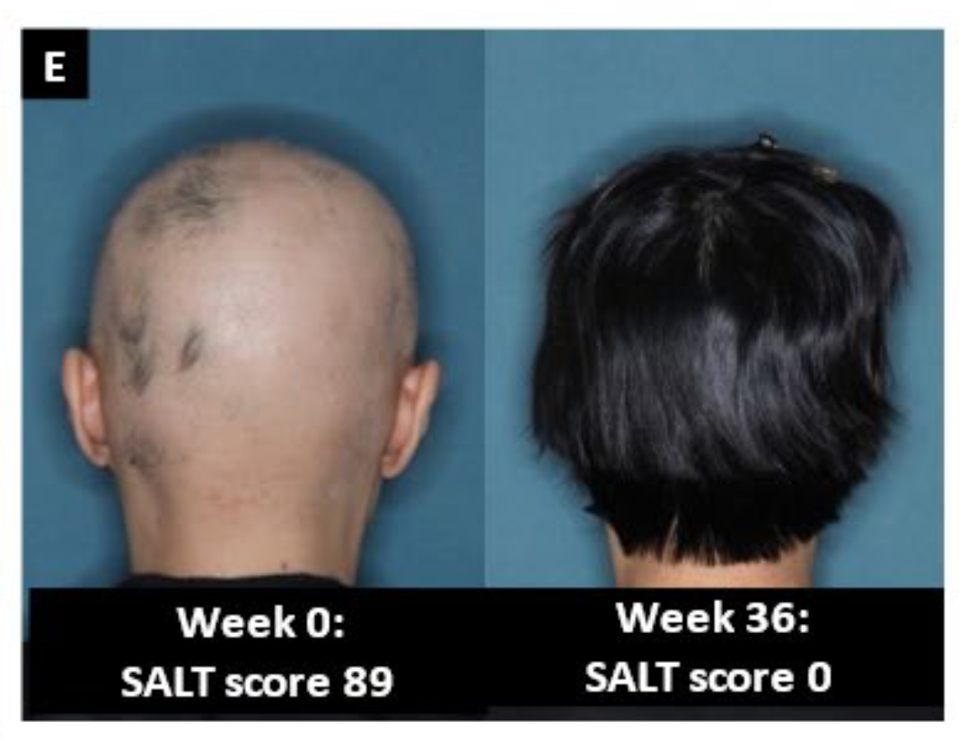
The best way to illustrate the success this new drug is to look at a photo of one of the patients from the clinical trials, which were published on May 5 by an international group of doctors and scientists in the New England Journal Medicine. Below is one of the patients after 36 weeks of treatment:

The NEJM article included photos of 6 patients, all of them just as dramatic as this one. Over the course of eight or nine months of treatment, many of the patients had virtually all their hair grow back.

How does the new drug work? In patients with alopecia areata, their immune system attacks their own hair follicles, for reasons that aren’t fully understood. It may be caused by both genetic and environmental factors. Olumiant (also called baricitinib) blocks the action of a protein called Janus kinase (JAK), which is one of the genes involved in the disease. This apparently allows the follicles to heal, and hair just starts growing again. As far back as 2014, a different JAK inhibitor was reported to induce dramatic hair re-growth in an alopecia areata patient, a young man who had lost all the hair on his body. That report and others like it were the motivation for conducting the just-reported clinical trials.

An important caveat is that not all patients responded equally well. Both studies had a low-dose and high-dose option, and the higher dose clearly worked better, with 36% of patients in one study and 39% in the other study experience dramatic re-growth of hair during an 8-month period. Most side effects were mild, but the studies will continue to monitor patients for longer-term side effects.

Even if it only works for some patients, this is clearly a dramatic breakthrough for alopecia areata. One downside is cost: as with many drugs in the U.S., Olumiant is really expensive. The NY Times reports that the cost is currently $2500 per month, which means an 8-month course of treatment will cost $20,000. Thanks to the FDA’s approval, insurance will probably cover it, but no drug should cost that much.

Four reasons why approving the new Alzheimer's drug was a disaster

A few months ago, the FDA approved a new drug, aducamumab, to treat Alzheimer’s disease. This was the first time in 20 years that the FDA approved a drug for Alzheimer’s, and while that may sound hopeful, many experts have already pointed out that it was a colossal mistake, and a looming tragedy for Alzheimer’s patients. Here are 4 reasons why the approval of aducamumab (also called Aduhelm) is such a disaster.

1. The new drug just doesn’t work. The biggest problem is that Aduhelm doesn’t slow down or reverse the progress of Alzheimer’s. More than a year ago, I wrote about the failure of two trials of aducamumab. The two trials, designed to be identical to one another, were halted in March 2019 by the drugmaker, Biogen, due to a “futility analysis” that showed it just wasn’t working.

In other words, there was no point in continuing the trials. So Biogen halted them.

But then Biogen tried to rescue the drug. In what can only be described as torturing the data to try to find a result that they really, really wanted, they went back and looked at a subset of patients in one of the two trials, called EMERGE, and claimed that the higher-dose patients actually did get a benefit.

But the patients didn’t benefit. All that Biogen could argue was that some patients had lower levels of amyloid plaques in their brains. An independent group of scientists also looked again at Biogen’s data, and published a report saying that their analysis still didn’t support any benefit for patients.

It’s true that plaques do indeed accumulate in the brains of Alzheimer’s patients, and aducamumab does seem to reduce plaques. However, despite 30 years of research, no one has been able to show that reducing these plaques has any effect on the progress of the disease.

More to the point, the two trials run by Biogen, which measured clinical signs of disease, found that aducamumab didn’t affect the patient’s illnesses. It didn’t slow down or reverse the inevitable course of Alzheimer’s disease.

The FDA’s own outside panel of experts evaluated the evidence and strongly rejected aducamumab. (10 of 11 voted to reject it, and one panelist was uncertain.) The panel found that not only was there no clinical benefit, there was also a significant risk of harm, including dangerous swelling in the brain. About one-third of patients experienced these risks, and 10% of patients had to stop treatment because of adverse side effects.

And yet in July of 2021, in a nearly unprecedented action, the FDA approved the new drug. Three of the committee members resigned in protest.

Somehow, Biogen convinced the FDA to approve aducamumab based on the drug’s effect on a surrogate endpoint: the level of amyloid plaque in the brain. One could argue that this is similar to approving statins based on their effect on cholesterol levels: by reducing cholesterol, we can reduce the risk of heart disease. The analogy might be apt, but there’s a huge difference: we have data showing that lowering cholesterol does indeed reduce the risk of heart disease. In contrast, despite decades of study, we still don’t have any data showing that reducing the levels of amyloid plaques slows down or reverses Alzheimer’s.

2. A failed hypothesis. This leads to the second reason why the FDA’s action is such a disaster. For 30 years now, the Alzheimer’s community has pursued the “amyloid hypothesis,” which asserts that the buildup of amyloid plaques in the brain is the primary cause of Alzheimer’s. This was considered a huge breakthrough when John Hardy first proposed it back in 1991, and hundreds (perhaps thousands) of papers have been published since that time, exploring this hypothesis.

Over 100 drugs have been developed and tested for their ability to reduce plaques, and some of them (like aducamumab) do indeed reduce plaque levels. Unfortunately, none of them slowed down the course of the disease, so they never obtained FDA approval.

After 30 years of effort, it’s clearly time to recognize that the amyloid hypothesis is a failure. And yet the Alzheimer’s research community continues to cling to it, despite all the evidence that targeting plaques simply doesn’t work to treat the disease.

The FDA’s approval, over the objection of its own experts and a big outcry from the biomedical research community, will only breathe new life into this failed hypothesis. Even more unfortunate is that, by approving a treatment based on a surrogate endpoint, the FDA is now encouraging drugmakers to keep focusing on plaques, which will starve any efforts to find other causes–and other potential treatments–for this devastating disease.

This leads me to the third reason why the FDA’s approval of aducamumab is a disaster.

3. Greed wins. Why did Biogen work so hard to find some shred of evidence that they could use to convince the FDA to approve their new drug? The answer can be found in the price that Biogen set for the drug: $56,000 per year. As the editors of JAMA Internal Medicine have pointed out, if even one-sixth of Alzheimer’s patients in the U.S. alone were to take this drug, the annual cost would be $57 billion, which is far greater than the cost of all Medicare part B drugs combined in 2018.

In other words, aducamumab’s costs could bankrupt Medicare. Or to put it another way, Biogen doesn’t seem to care if Medicare goes bankrupt, as long as they can grab some massive profits.

What is still mysterious is why the FDA decided to overrule its own advisors. The FDA’s defense seems to be that they will require Biogen to continue collecting data “to verify the drug’s clinical benefit.” But they are giving Biogen 8 years to collect this data. That’s 8 years during which Biogen will reap massive profits, Medicare might collapse under the strain, and Alzheimer’s patients will continue to suffer.

In October, the FDA announced an investigation of its own approval process for Aduhelm. This seems rather bizarre: if the FDA suspects there was “improper contact” between Biogen and its own internal staff, then it should simply withdraw approval for the drug until the investigation is complete.

4. This whole affair is taking cruel advantage of a vulnerable, desperate group of patients. Finally, perhaps the worst aspect of this whole fiasco is how cruel it is to Alzheimer’s patients. As Dr. Jason Karlawish explained in JAMA Neurology, even though he disagrees with the FDA’s decision to approve this drug:

I must preserve and protect each patients’ autonomy. One way I do this is by being teacher to patients and their caregivers so they can make choices about how to live well with this disease. I cannot deny them the choices the health care system gives them. Aducanumab is now a choice.

Karlawish goes on to write that he will explain to patients that the benefits are uncertain, and the risks of brain swelling and other bad side effects are very real. But if the patients choose to try it, he will reluctantly prescribe Aduhelm.

We don’t have any effective treatment for Alzheimer’s, and it is a devastating illness. Patients and their families are likely to be desperate, and the mere fact of FDA approval will give them hope. I’ve no doubt that many will want to try Aduhelm, despite the risks. Giving them false hope is simply cruel.

And don’t forget that Biogen halted its own trials of Aduhelm due to “futility.”

The FDA made a huge mistake in overruling its expert panel and approving an Alzheimer’s drug that just doesn’t seem to work, that is outrageously costly, and that might cause serious harm to some patients. Let’s hope that this decision can be reversed. The world needs a safe and effective treatment for Alzheimer’s, and for now, we simply don’t have one.