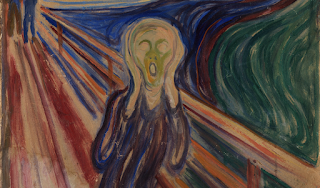
Last week the Biden administration was criticized for making some harsh statements about those who refuse to be vaccinated. “For the unvaccinated, we are looking at a winter of severe illness and death — for themselves, their families and the hospitals they'll soon overwhelm. But there's good news: If you're vaccinated and you have your booster shot, you're protected from severe illness and death,” said Biden.
That statement came in for much criticism on social media, especially by those who took the statement out of context. “You’re not going to convince anyone to get vaccinated with such harsh language,” some scientists complained.
Well, true. But as someone who’s been fighting the anti-vaxxers for years, I recognized the Biden team’s statements as Stage 3 of what I’m calling the Five Stages of Anti-Vax Angst. I understand their frustration, because I’ve been there myself. Let’s go through these stages, shall we?
Stage 1: Disbelief. I first encountered the anti-vax movement, in the early 2000s, when I was leading a research project on sequencing the flu virus (here’s one of our papers), and a reporter asked me, quite seriously, if the flu vaccine could cause autism. Huh? I thought. “Well no,” I reassured him, “where’d you get that idea?” I soon traced the source of his concern back to a now-notorious Lancet paper by Andrew Wakefield, which turned out to be fraudulent and was eventually retracted.
Surely, I thought, the solution is simply to educate people better, and to explain that vaccines are the single greatest medical advance in the history of medicine. With better education, the anti-vax movement will quickly fade.
In Stage 1, vaccine advocates simply can’t believe that significant numbers of people believe stuff about vaccines that simply isn’t true. Alas, though, they do.
Stage 2: Frustration. Unfortunately, merely writing articles explaining the benefits of vaccines is not nearly enough. Officialdom (government agencies like the CDC and NIH) constantly issues statements about the benefits and safety of vaccines, such as this CDC website. Scientists and physicians have written hundreds of articles and countless books explaining how beneficial vaccines are, to no avail. For example, renowned vaccine expert Paul Offit wrote an outstanding book warning of the dangers posed by the anti-vaccine movement, called “Deadly Choices: How the Anti-Vaccine Movement Threatens Us All.” That book appeared all the way back in 2010, and yet look where we are now.
Just a year after Offit’s book, journalist Seth Mnookin published “The Panic Virus,” an excellent exposé of the fraud behind Wakefield’s original paper, and on how the anti-vax movement has been aided (often unwittingly) by popular media personalities.
What these books and others reveal is that the anti-vaccine movement is loud, committed, and (unfortunately) highly influential. For every article or book written by a clear-headed vaccine advocate (and there are many!), there are multiple articles and books promoting wildly inaccurate claims that vaccines cause harm. Trying to refute these claims is like playing whack-a-mole.
Scientific bloggers have learned that no amount of patient explanation can get through to some people, and the anti-vaxxers just won’t quit. Eventually, some of them move on to Stage 3.
Stage 3: Anger. This is where the Biden administration finds itself. After months or years of explaining, pleading, and even begging people to get vaccinated, the crazy, irrational, and often angry opposition of anti-vaxxers (or the “vaccine hesitant,” to use a kinder term) can be just too much.
Some people take a long time to reach this stage. Dr. Anthony Fauci, director of NIH’s infectious disease institute (NIAID), has been the public face of the government effort to get people vaccinated for all of the past year. He’s been subjected to inexcusable vitriol, including death threats towards him and his family, and he continues to try to convince people that vaccines are safe and effective. It’s a tough and thankless job. Dr. Peter Hotez, a vaccine expert at Baylor College of Medicine, has been tirelessly explaining the benefits of vaccines throughout the pandemic, and he too has been subjected to awful, hateful attacks. (Dr. Hotez also wrote a highly personal book a few years ago, explaining why vaccines didn’t cause his daughter’s autism.)
Neither Dr. Fauci nor Dr. Hotez has reached Stage 3, but I wouldn’t blame them if they did. Some public-health experts have, though, and one can see why: after trying for months to get people to do something that reduces their own risk of deadly disease, only to meet defiance, one might say “I’m done. You all can just go ahead and get sick.”
Or, as the FDA’s Twitter account responded in exasperation a few months ago, to the never-ending insistence that ivermectin, can cure Covid-19: “You are not a horse. You are not a cow. Seriously, y'all. Stop it.” (Ivermectin is a de-worming agent for horses. It does not work against any virus, including the one that causes Covid-19.)
The comments on Twitter can be far, far harsher. So when Biden warned that the unvaccinated “are looking at a winter of severe illness and death,” I can’t blame him. After all, he’s right.
Stage 4. Persistence. For those who get past Stage 3 (or skip it entirely), there’s a realization that even though some anti-vaxxers are simply beyond reasoning with (I’m looking at you, Robert F. Kennedy Jr. and Joseph Mercola), that doesn’t mean we can’t fight back. We have to recognize that misinformation is out there, and that some people will continue to spread it no matter what we might say. But there are strategies that work to convince others to get vaccinated, and we have to keep trying. That’s persistence.
For example, a study early this year showed that just a dozen people were responsible for a large majority of the vaccine misinformation across most of social media, including Facebook, Twitter, YouTube, and Instagram. I and others have called for social media companies to de-platform these harmful individuals, which could go a long way towards slowing down anti-vax propaganda. Let’s keep trying.
Another strategy, illustrated by Paul Offit’s 2010 book, is to reveal how anti-vaxxers often profit from their misinformation. Some anti-vaxxers have gotten wealthy selling supplements and “alternative” medicines, promoting them with bogus claims that the supplements can substitute for vaccines. If we raise awareness that these quacks are profiting from the spread of misinformation, that can help raise skepticism about their claims. Getting someone to ask questions themselves–to think critically, in other words–is often the best way to get them to reject the arguments of anti-vaxxers.
And even though I might seem critical of the efforts by government agencies to educate the public, I still think they should do it. Indeed, they should do far more than they are doing: in addition to providing facts about vaccine safety and effectiveness, the CDC and NIH could work harder to directly counter the myths and misinformation that are constantly circulating.
I’ve been blogging about the anti-vax movement since 2008, even before I started writing for Forbes in 2010 (see here and here, for example). I’ve long ago lost count of how many articles I’ve written, trying to point out the harm caused by anti-vaccine misinformation, and I’ll keep trying. So I’d say I’m still in Stage 4.
Stage 5. Surrender. In the face of stubborn opposition, and sometimes virulent and personal attacks, some people eventually just give up. It’s easier, of course, to stop fighting people who just don’t want your help, and I can’t blame anyone who does. When I call this stage “surrender,” I don’t mean to suggest that pro-vaccination and pro-science advocates ever accept the wildly misinformed views of the anti-vaccine movement. Of course not. It’s just that some people decide they can no longer spend time on what seems an endless battle.
I’m not advocating that we should ever give up. We can’t, because infectious diseases don’t care if we stop vaccinating ourselves.
So those are the 5 stages of anti-vax angst, as experienced by countless medical and scientific professionals who are fighting misinformation.
And here we are, in the midst of another huge peak in Covid-19 infections, with a significant portion of the U.S.–and of other countries as well–refusing to get vaccinated. The unvaccinated may indeed be facing a “winter of severe illness and death,” even though no one wants that. I don’t blame anyone for pointing out what is very likely to happen. And if the winter ahead is indeed bad, then I place much of the blame on a small number of very loud voices, such as the Disinformation Dozen, who irresponsibly continue to promote harmful untruths about vaccines.
Vaccines are the single greatest public health advance in the history of medicine. Vaccines have eliminated smallpox from the planet, nearly eliminated polio, and made many other previously-feared childhood illnesses a thing of the past. We can do the same to Covid-19, if everyone will just get vaccinated.
