Showing posts with label CDC. Show all posts

Are there two sides in the vaccine debate?

from December 2020.

I keep getting into debates with people about the safety and efficacy of vaccines. I’m not talking about anti-vaxxers (though I’ve encountered plenty of them), but level-headed, rational people who genuinely have doubts.

Usually their doubts about vaccines come from dubious sources, but there’s so much misinformation out there, often coming from people with the letters M.D. or Ph.D. after their names, that I can understand why it’s confusing.

So let me engage in what is sometimes called “both-sides-ism” (a disparaging term, of course) and consider, briefly, the pluses and minuses of vaccines. While I’m at it, I’ll include some points specific to the Covid-19 vaccines.

Let’s start with the pluses, shall we?

  1. Vaccines are the single greatest public health innovation in the history of medicine. They’ve saved millions of lives.
  2. Vaccines completely eliminated smallpox from the planet. They have nearly (but not quite, due to anti-vax resistance) eliminated polio.
  3. The new mRNA vaccines for Covid-19 are remarkably effective, have very few side effects, and are easy to modify as the virus itself mutates over time.
  4. Vaccines protect us so thoroughly against childhood infections that many formerly common infections–including measles, mumps, and Haemophilus influenza–have almost disappeared.
  5. Child mortality from infectious has plummeted in countries with robust early childhood vaccine programs.
  6. The vaccine against human papillomavirus (HPV) will prevent many thousands of cases of cervical cancer, throat cancer, and other cancers, saving lives for decades to come.
  7. Vaccines train our immune system to recognize and fight off infections, in many cases stopping the infection before we even have symptoms.

I could go on, but the bottom line is that vaccines continue to save millions of lives every year. They also dramatically reduce non-fatal illnesses, sparing people a great deal of suffering as well as long-term harms caused by some infections. (For example, mumps can cause permanent hearing loss.)

Given all of these benefits, you might wonder why everyone doesn’t get every vaccine available. Well, some people do, and part of the answer is simply that we don’t have enough vaccines for everyone, and many countries lack the public health infrastructure to deliver vaccines. But there are a few very small minuses, so let’s consider the downsides of vaccines:

  1. The shot (or “jab”) hurts a little bit, and your arm might be sore for a day.
  2. In very rare cases with some vaccines, some people might have allergic reactions. One example is that some flu vaccines are manufactured in chicken eggs, and people with egg allergies might react to those.
  3. In a few rare cases, the live polio virus vaccine has caused some people to get polio. This vaccine was discontinued in the U.S. decades ago.
  4. In rare cases, some people might have an immune response to a vaccine that causes ongoing inflammation. This includes the Covid-19 vaccine. However, the risk is much smaller than the risks associated with an actual infection.

That’s pretty much it. I hope it’s clear that the pluses far outweigh the minuses, but I imagine that some people looking at this list are wondering why I didn’t include a host of other supposed harms of vaccines, such as an increased risk of autism.

That’s because vaccines don’t cause autism or any other neurological disorder, as I’ve written before. Studies involving hundreds of thousands of people have been done to investigate this possibility, starting in the early 2000s, and all of the science points the same way: vaccines do not cause autism.

This supposed risk, and others like it, are inventions of the modern anti-vaccine movement. I won’t go into the history of the anti-vax movement here (I’ve done that before, many times), except to point out that many people promoting anti-vax misinformation are making lots of money selling “cures” for problems that don’t exist in the first place.

Anti-vaxxers continue to invent new harms caused by vaccines, and spread these claims on social media. Even with no evidence whatsoever, some of these claims catch on, because - well, the Internet.

Now back to the title of this column: are there really two sides to the vaccine debate?

Well, no.

Among doctors, scientists, and public health professionals, virtually everyone agrees with my first point in the “pluses” list above. However, we all recognize that when a foreign substance (a vaccine) is injected into one’s body, it’s possible that something unexpected might happen, and we must continually monitor vaccines so that we’ll know if something goes awry.

Let me end with an analogy. Seat belts in cars have been around for decades, and they’ve prevented millions of injuries and deaths. And yet people have argued (and probably still do) that it’s possible that wearing a seat belt might cause harm, for example if the belt jams and one cannot escape a burning car after an accident. (This seems to happen all too often in movies.) Thus you can’t argue that wearing a seat belt is 100% risk-free. Even so, wearing a seat belt is a really good idea, because the benefits are so much greater than the risks.

The same is true of vaccines. There might be some very, very small risks, but the benefits vastly outweigh them. And modern vaccines are safer than ever. There’s no serious debate about that.
The 5 Stages of Anti-Vax Angst: A guide


Last week the Biden administration was criticized for making some harsh statements about those who refuse to be vaccinated. “For the unvaccinated, we are looking at a winter of severe illness and death — for themselves, their families and the hospitals they'll soon overwhelm. But there's good news: If you're vaccinated and you have your booster shot, you're protected from severe illness and death,” said Biden.

That statement came in for much criticism on social media, especially by those who took the statement out of context. “You’re not going to convince anyone to get vaccinated with such harsh language,” some scientists complained.

Well, true. But as someone who’s been fighting the anti-vaxxers for years, I recognized the Biden team’s statements as Stage 3 of what I’m calling the Five Stages of Anti-Vax Angst. I understand their frustration, because I’ve been there myself. Let’s go through these stages, shall we?

Stage 1: Disbelief. I first encountered the anti-vax movement, in the early 2000s, when I was leading a research project on sequencing the flu virus (here’s one of our papers), and a reporter asked me, quite seriously, if the flu vaccine could cause autism. Huh? I thought. “Well no,” I reassured him, “where’d you get that idea?” I soon traced the source of his concern back to a now-notorious Lancet paper by Andrew Wakefield, which turned out to be fraudulent and was eventually retracted.

Surely, I thought, the solution is simply to educate people better, and to explain that vaccines are the single greatest medical advance in the history of medicine. With better education, the anti-vax movement will quickly fade.

In Stage 1, vaccine advocates simply can’t believe that significant numbers of people believe stuff about vaccines that simply isn’t true. Alas, though, they do.

Stage 2: Frustration. Unfortunately, merely writing articles explaining the benefits of vaccines is not nearly enough. Officialdom (government agencies like the CDC and NIH) constantly issues statements about the benefits and safety of vaccines, such as this CDC website. Scientists and physicians have written hundreds of articles and countless books explaining how beneficial vaccines are, to no avail. For example, renowned vaccine expert Paul Offit wrote an outstanding book warning of the dangers posed by the anti-vaccine movement, called “Deadly Choices: How the Anti-Vaccine Movement Threatens Us All.” That book appeared all the way back in 2010, and yet look where we are now.

Just a year after Offit’s book, journalist Seth Mnookin published “The Panic Virus,” an excellent exposé of the fraud behind Wakefield’s original paper, and on how the anti-vax movement has been aided (often unwittingly) by popular media personalities.

What these books and others reveal is that the anti-vaccine movement is loud, committed, and (unfortunately) highly influential. For every article or book written by a clear-headed vaccine advocate (and there are many!), there are multiple articles and books promoting wildly inaccurate claims that vaccines cause harm. Trying to refute these claims is like playing whack-a-mole.

Scientific bloggers have learned that no amount of patient explanation can get through to some people, and the anti-vaxxers just won’t quit. Eventually, some of them move on to Stage 3.

Stage 3: Anger. This is where the Biden administration finds itself. After months or years of explaining, pleading, and even begging people to get vaccinated, the crazy, irrational, and often angry opposition of anti-vaxxers (or the “vaccine hesitant,” to use a kinder term) can be just too much.

Some people take a long time to reach this stage. Dr. Anthony Fauci, director of NIH’s infectious disease institute (NIAID), has been the public face of the government effort to get people vaccinated for all of the past year. He’s been subjected to inexcusable vitriol, including death threats towards him and his family, and he continues to try to convince people that vaccines are safe and effective. It’s a tough and thankless job. Dr. Peter Hotez, a vaccine expert at Baylor College of Medicine, has been tirelessly explaining the benefits of vaccines throughout the pandemic, and he too has been subjected to awful, hateful attacks. (Dr. Hotez also wrote a highly personal book a few years ago, explaining why vaccines didn’t cause his daughter’s autism.)

Neither Dr. Fauci nor Dr. Hotez has reached Stage 3, but I wouldn’t blame them if they did. Some public-health experts have, though, and one can see why: after trying for months to get people to do something that reduces their own risk of deadly disease, only to meet defiance, one might say “I’m done. You all can just go ahead and get sick.”

Or, as the FDA’s Twitter account responded in exasperation a few months ago, to the never-ending insistence that ivermectin, can cure Covid-19: “You are not a horse. You are not a cow. Seriously, y'all. Stop it.” (Ivermectin is a de-worming agent for horses. It does not work against any virus, including the one that causes Covid-19.)

The comments on Twitter can be far, far harsher. So when Biden warned that the unvaccinated “are looking at a winter of severe illness and death,” I can’t blame him. After all, he’s right.

Stage 4. Persistence. For those who get past Stage 3 (or skip it entirely), there’s a realization that even though some anti-vaxxers are simply beyond reasoning with (I’m looking at you, Robert F. Kennedy Jr. and Joseph Mercola), that doesn’t mean we can’t fight back. We have to recognize that misinformation is out there, and that some people will continue to spread it no matter what we might say. But there are strategies that work to convince others to get vaccinated, and we have to keep trying. That’s persistence.

For example, a study early this year showed that just a dozen people were responsible for a large majority of the vaccine misinformation across most of social media, including Facebook, Twitter, YouTube, and Instagram. I and others have called for social media companies to de-platform these harmful individuals, which could go a long way towards slowing down anti-vax propaganda. Let’s keep trying.

Another strategy, illustrated by Paul Offit’s 2010 book, is to reveal how anti-vaxxers often profit from their misinformation. Some anti-vaxxers have gotten wealthy selling supplements and “alternative” medicines, promoting them with bogus claims that the supplements can substitute for vaccines. If we raise awareness that these quacks are profiting from the spread of misinformation, that can help raise skepticism about their claims. Getting someone to ask questions themselves–to think critically, in other words–is often the best way to get them to reject the arguments of anti-vaxxers.

And even though I might seem critical of the efforts by government agencies to educate the public, I still think they should do it. Indeed, they should do far more than they are doing: in addition to providing facts about vaccine safety and effectiveness, the CDC and NIH could work harder to directly counter the myths and misinformation that are constantly circulating.

I’ve been blogging about the anti-vax movement since 2008, even before I started writing for Forbes in 2010 (see here and here, for example). I’ve long ago lost count of how many articles I’ve written, trying to point out the harm caused by anti-vaccine misinformation, and I’ll keep trying. So I’d say I’m still in Stage 4.

Stage 5. Surrender. In the face of stubborn opposition, and sometimes virulent and personal attacks, some people eventually just give up. It’s easier, of course, to stop fighting people who just don’t want your help, and I can’t blame anyone who does. When I call this stage “surrender,” I don’t mean to suggest that pro-vaccination and pro-science advocates ever accept the wildly misinformed views of the anti-vaccine movement. Of course not. It’s just that some people decide they can no longer spend time on what seems an endless battle.

I’m not advocating that we should ever give up. We can’t, because infectious diseases don’t care if we stop vaccinating ourselves.

So those are the 5 stages of anti-vax angst, as experienced by countless medical and scientific professionals who are fighting misinformation.

And here we are, in the midst of another huge peak in Covid-19 infections, with a significant portion of the U.S.–and of other countries as well–refusing to get vaccinated. The unvaccinated may indeed be facing a “winter of severe illness and death,” even though no one wants that. I don’t blame anyone for pointing out what is very likely to happen. And if the winter ahead is indeed bad, then I place much of the blame on a small number of very loud voices, such as the Disinformation Dozen, who irresponsibly continue to promote harmful untruths about vaccines.

Vaccines are the single greatest public health advance in the history of medicine. Vaccines have eliminated smallpox from the planet, nearly eliminated polio, and made many other previously-feared childhood illnesses a thing of the past. We can do the same to Covid-19, if everyone will just get vaccinated.

No, the COVID-19 vaccine doesn't change your DNA. But it does make some long term changes. And that's a good thing.

Cartoon by: Maki Naro, from
gene.com/stories/the-antibody

One of the common tropes among anti-vaxxers lately is that the Covid-19 vaccine “changes your DNA.” Oh, the horrors!

Do they even know what they mean by that? Almost certainly not. Anti-vaxxers generally have no idea how biology works; often they are so confused that I’m tempted to say they are not even wrong. Even when they are right about something, it’s for the wrong reasons.

Many articles have already been posted explaining that the vaccine can’t alter your DNA, including a wildly popular piece at Forbes and explainers by the CDC and UNICEF.

So let’s dig into this strange notion that the vaccine changes your DNA. First, let’s look at what the CDC has to say:

“Will a COVID-19 vaccine alter my DNA? No. COVID-19 vaccines do not change or interact with your DNA in any way. Both mRNA and viral vector COVID-19 vaccines deliver instructions (genetic material) to our cells to start building protection against the virus that causes COVID-19. However, the material never enters the nucleus of the cell, which is where our DNA is kept.”

I see what they’re getting at here. They’re partly right, but in an attempt to give a simple “no” answer, the CDC got it wrong. It’s true that Covid-19 vaccines don’t directly alter your DNA, and it’s true that they don’t invade the cell nucleus, where your DNA resides. But that’s not the full story.

(The UNICEF article is more accurate and more nuanced, writing instead that “the information regarding harmful effects of the vaccine against COVID-19 on human DNA is unfounded and untrue.”)

Remember that the whole point of a vaccine is to prevent future infections. That means that something in your body has to change, right? So what is different?

Okay, take a deep breath and we’ll dive in. Whenever your body is invaded by a foreign cell–whether it’s a bacteria, a virus, a fungus, or some other pathogen–your immune system starts selecting from among millions of specialized proteins called antibodies, each one a little different. The way it does this is really rather extraordinary: many little pieces of your DNA are cut and pasted together, in millions of combinations, each making a different antibody. Eventually, one of these antibodies “recognizes” the pathogen (by binding to it).

What’s even more amazing is that the successful antibodies are “remembered” by the immune system, in the form of special cells called B-cells that have slightly different DNA! The DNA in these B-cells encodes just the right antibody to recognize the invader–the Covid-19 virus, that is. Once you recover from the infection, some of those immune cells (B-cells and T-cells–it's complicated) persist in your lymph nodes, constantly looking for any reappearance of the virus.

Or, as Ed Yong more colorfully explained:

“Picture the lymph nodes as bars full of grizzled T-cell mercenaries, each of which has just one type of target they’re prepared to fight. The messenger cell bursts in with a grainy photo, showing it to each mercenary in turn, asking: Is this your guy? When a match is found, the relevant merc arms up and clones itself into an entire battalion, which marches off to the airways.”

(For a deeper dive into how the immune system works, see Ed Yong’s feature article on this topic in The Atlantic from August 2020.)

The DNA in these special "memory B-cells is a little bit different from the DNA in all of your other cells. The vaccine itself doesn't stay around, but it "shows" the immune system a few copies of the spike protein from SARS-CoV-2, the Covid-19 virus, and the immune system remembers. And, I should note, a similar change to your DNA happens if you’re infected by the Covid-19 virus itself.

But B-cells are just a tiny, tiny portion of your body. Every other cell type, from skin to heart to lungs to brain, is completely unaffected by the vaccine. And if we didn’t have any way of “remembering” how to fight off infections, then we’d never become immune to anything, in which case the human race would quickly go extinct.

Finally, let me mention one other bit of misinformation. Early in the pandemic, some very well-known biologists at MIT published a paper claiming that the SARS-CoV-2 virus could, through an elaborate and highly implausible mechanism, integrate into the DNA of cells that were infected. This would indeed be worrisome! Many others quickly pointed out that this result could also be explained by more mundane mechanisms (experimental artifacts, essentially), and in the subsequent year and a half, with hundreds of millions of infections, no one has reported a single case where the virus actually did this. So not only is this event (reverse transcription of viral RNA into a human genome) really, really implausible, it also doesn’t even apply to vaccines, which only contain a small fragment of the viral mRNA.

(As an aside, that study by the MIT biologists was highly irresponsible. They were basically showing off their technical skills, saying “look what we can get the virus to do!” without considering how their work might be twisted, once anti-vaxxers got their hands on it. And the CDC response that I quoted above appears to be a direct response to misinterpretations of the MIT study.)

So back to our original question: does the Covid-19 vaccine change your DNA? Not directly, no. But yes, thanks to your own immune system, the overall mixture of DNA in your body is a tiny bit altered after you get any vaccine. Your DNA is also changed every time you recover from an infection, including the common cold. But the only change is in the DNA of a tiny number of immune cells, which hang around as guardians against future infections. And that’s a good thing.

Sorry Tucker, ivermectin still doesn't work

Who knew that Tucker Carlson was a fan of science from Iran, Iraq, and Egypt? It turns out that much of the evidence supporting Tucker’s favorite Covid-19 treatment relies on deeply flawed studies from those countries.

But let me back up for a minute first.

I wasn’t planning to write about ivermectin again. Just two months ago, I explained in some detail that ivermectin simply doesn’t work. I also pointed out that prescriptions for ivermectin have exploded, largely due to relentless promotion of it by conservative media hosts including Tucker Carlson, Sean Hannity, and Laura Ingraham.

Official sources including the FDA and the CDC have been trying to explain that ivermectin is useless, but they have been far too timid, as I explained before, issuing press statements that, while clear enough to trained scientists, sound very wishy-washy to the general public.

So what’s new? Well, two new articles have appeared that explain a bit more about where all the confusion comes from. The first is a scientific paper, still in preprint form (not yet peer-reviewed), by the scientists who published one of the recent studies that initially reported positive results about ivermectin.

In their preprint, Andrew Hill, Manya Mirchandani, and Victoria Pilkington re-analyze the studies that went into their recent meta-analysis–which, I should add, they have already retracted. Let’s look at their new analysis.

In their original study–one that promoters of ivermectin often cite in support of their arguments–Hill and colleagues looked at data from 24 different studies of ivermectin, and concluded that, on average, it did seem to reduce mortality from Covid-19.

But then they found that some of these studies were fraudulent, and others were so heavily biased that they didn’t trust their own findings. They retracted their own study just a month after it was published. Kudos to them!

Now they’ve gone even further. They went back and re-graded those 24 studies based on how biased or otherwise flawed they were. Their new report explains that there’s a very strong correlation between the amount of bias and the apparent benefits of ivermectin. In other words, the more biased the study, the greater the benefit. When they excluded the biased studies, the benefits simply disappeared.

In other words, the data from the high-quality studies show that ivermectin doesn’t work.

The lowest-quality studies were conducted in Iran, Turkey, and Iraq, and the worst of all were two potentially fraudulent studies out of Egypt and Lebanon. (In the Egyptian study, it was revealed that “79 participants were duplicates, some deaths were recorded on dates before the trial had started and instances of plagiarism were identified in the text.”)

So apparently Tucker Carlson, Fox News’s biggest promoter of ivermectin, prefers studies from Iran, Iraq, Egypt, and Lebanon over much higher-quality studies out of, for example, Colombia (Lopez-Medina et al., published in JAMA), India (Ravikirti et al.) or Brazil (Bermejo Galan et al.).

But why the heck is anyone getting medical advice from Tucker Carlson?

The second new article appeared in The Atlantic last week, written by James Heathers, a data scientist who has uncovered flaws in multiple studies of ivermectin. Heathers’ summary of the problems is terrific, and I highly recommend that readers check it out, but I’ll share a few tidbits here.

Heathers describes the process of digging into the details of these studies, which is difficult and thankless. He’s not paid to do this; he’s just a good scientist who cares about the integrity of the literature, and it obviously bothers him when he sees shoddy science that has passed through peer review. “We do it because we feel it should be done,” he writes.

One of his main points is that bad studies get published all the time, and they simply remain out there, because who has time to go through all of them? Most of them don’t matter, and they are quickly forgotten.

In the case of ivermectin, Heathers found flaws in study after study. More tellingly, he observed the same phenomenon that Hill, Mirchandani, and Pilkington found: the biggest benefits of ivermectin appeared in the worst studies. As Heathers explains:

“the studies we are certain are unreliable happen to be the same ones that show ivermectin as most effective.”

Why did this happen with ivermectin? In retrospect, it’s not surprising: some doctors and scientists really wanted it to work, they let that bias creep into their studies. Maybe they ignored the patients who got sicker after ivermectin treatment, or maybe they made sure the sicker-looking patients got the placebo. (These would be big red flags if they happened.) Or maybe they had outside motivations–political pressure, for instance–to produce a positive study about ivermectin.

The peer-review process is supposed to catch these problems, and it’s slowly catching up now, as reflected in the new review from Hill et al. But as Heathers points out,

“Publishing science is slow; highly contagious diseases are fast.”

Meanwhile, the data pretty clearly show that ivermectin is useless against Covid-19. We desperately need effective treatments, and we should stop looking up this blind alley.

Before concluding, I’d be remiss if I didn’t point out (again) that ivermectin is a genuine drug, used to treat infections by two parasites: a nematode called Onchocerca volvulus that causes river blindness, and an intestinal nematode called Strongyloides stercoralis. It’s highly effective against these nematodes, which are sometimes called worms because they are worm-shaped, even though they are microscopic.

Unfortunately, people continue to take ivermectin, so let me say it again here: ivermectin does not work. It doesn’t treat Covid-19, it doesn’t prevent Covid-19, and it doesn’t reduce your risk of severe illness from Covid-19.

Oh, and one more thing: if you’re looking for medical advice, don’t get it from Tucker Carlson.

Ivermectin doesn't work for treating or preventing Covid-19, even if your favorite FoxNews host says it does

Recently the world has been treated to a flood of misinformation about ivermectin, an anti-parasitic drug that some people thinks can treat or prevent the Covid-19 virus.

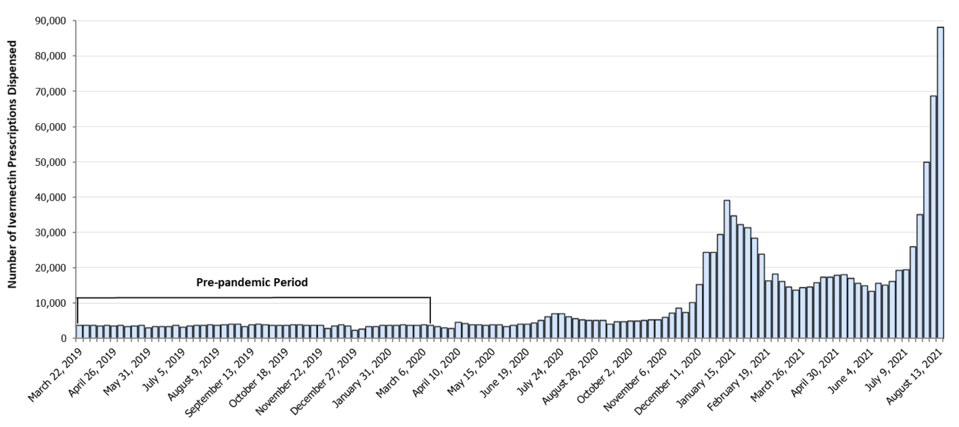
It can’t, but that hasn’t stopped a variety of Fox News hosts, including Sean Hannity, Tucker Carlson, and Laura Ingraham, from pushing it for months. As a result, prescriptions for ivermectin have increased like crazy. Here’s a chart just released by the CDC, showing the weekly number of prescriptions over the past two years:

As you can see, the numbers shot up at the beginning of this year, to 40,000 prescriptions per week, and this past month they shot up again, to over 80,000 per week. All this ivermectin has had no effect at all on Covid-19 infections, which have continued to rise, but that hasn’t stopped people from desperately trying to get ivermectin.

Ivermectin doesn’t work. It doesn’t prevent Covid-19, nor does it treat it. Unfortunately, the official government response to this misinformation has once again failed to be blunt enough, with a few exceptions. More on that below, but first let’s review what the heck ivermectin is.

Ivermectin is used to treat two relatively rare (in the U.S.) parasites: a nematode called Onchocerca volvulus that causes river blindness, and an intestinal nematode called Strongyloides stercoralis. (Both of these are sometimes called worms, but they are microscopic in size, and unrelated to the worms that most people are familiar with.) Nematodes are not even remotely similar to viruses, and there’s no reason to think that a treatment for nematode infections will cure a virus–unless, apparently, a popular talk show host claims that it will.

Ivermectin also used for de-worming livestock such as cows and horses, which means that veterinarians carry supplies of ivermectin, often in very large doses. The veterinary form is available in a paste that you can feed to animals. This has resulted in a number of people buying and consuming large amounts of ivermectin–or, as one person put it, “eating horse goo from the tractor store.” This does not usually end well.

Here’s an example from the CDC’s latest health advisory:

An adult drank an injectable ivermectin formulation intended for use in cattle in an attempt to prevent COVID-19 infection. This patient presented to a hospital with confusion, drowsiness, visual hallucinations, tachypnea [abnormally rapid breathing], and tremors. The patient recovered after being hospitalized for nine days.

So: not good. This case and others prompted the FDA to tweet, in a rare instance of bluntness: “You are not a horse. You are not a cow. Seriously, y'all. Stop it.”

The FDA also issued a news release explaining why people should not use ivermectin to treat or prevent Covid-19, and especially not to use doses designed for large animals. It’s dangerous, as the case cited by the CDC illustrates.

Where did this interest in ivermectin begin? Just a couple of days ago, NBC News reporter Ben Collins put together an excellent Twitter thread explaining some of the recent history. One of the main sources was a sketchy group called America’s Frontline Doctors, which was founded by an anti-vaxxer named Simone Gold, who as Collins explained “spent the last year barnstorming churches and schools, insisting COVID vaccines cannot be trusted.”

Despite its name, America’s Frontline Doctors is most definitely not working on the “front lines” treating patients, but instead is a right-wing political organization known primarily for spreading Covid-19 misinformation. Last year they promoted hydroxychloroquine as a Covid-19 treatment, which didn’t work. More recently, they have been offering online consultations to people who wanted ivermectin. The consultations cost $90, which didn’t include the cost of the medicine, but they’d connect you to a pharmacy that would deliver it.

(Aside: in an interesting twist, Simone Gold has been indicted and is now awaiting trial for her role in the January 6 insurrection at the U.S. Capitol in Washington, D.C.)

So here we are: 80,000 prescriptions per week for a drug that doesn’t work for treating or preventing Covid-19. Above, I wrote that the government isn’t responding clearly enough to this misinformation: here’s what I mean by that.

Scientists and doctors are trained to speak very carefully and precisely to one another. So rather than saying “X is false” or “Y doesn’t work,” we say “we don’t have evidence that X is true,” or “the evidence doesn’t support the effectiveness of Y.” That’s all well and good when you’re speaking to another scientist, but the general public hears these statements as something more like “X might work but we are still looking at the evidence.”

Uh uh. Not a good way to talk to the public.

Now, there actually have been several studies of ivermectin as a treatment for Covid-19, and here’s where the story might get confusing–but I’m going to try to keep it really clear. Virtually all of the studies showed that ivermectin simply doesn’t work, but one study out of Egypt (by Elgazzar et al.) seemed to show that it worked quite well. That was really surprising, but the story collapsed pretty quickly: it turned out the data was falsified, and parts of the paper were plagiarised. About a month ago, the study–which was still an un-reviewed preprint, was retracted by the publisher, Research Square.

Making things more confusing, several meta-analyses have already been published that relied on the flawed Egyptian study, and some of those papers report that ivermectin is effective. But a meta-analysis doesn’t contain any original data; instead, it’s an analysis that combines the results from a bunch of other studies. Those positive findings from meta-analysis papers rely heavily on the falsified Egyptian study, and (it turns out) on another very flawed study. For a deeper dive into those, see this excellent breakdown by the epidemiologist (and journalist) Gideon Meyerowitz-Katz (@GidMK, aka HealthNerd), who posted a long Twitter thread detailing the reasons why these meta-analyses, and some of the studies they include, cannot be trusted.

So the scientific picture is already clear: multiple studies show that ivermectin does not work. But rather than saying that in simple, direct English, here’s what the CDC states in their August 26 Health Advisory:

“there are currently insufficient data to recommend ivermectin for treatment of COVID-19”

“Clinical trials and observational studies to evaluate the use of ivermectin to prevent and treat COVID-19 in humans have yielded insufficient evidence for the NIH COVID-19 Treatment Guidelines Panel to recommend its use”

“Be aware that currently, ivermectin has not been proven as a way to prevent or treat COVID-19.”

The FDA isn’t much better (except for that one tweet). In a consumer advisory with the title “Why You Should Not Use Ivermectin to Treat or Prevent COVID-19”, they write:

“The FDA has not reviewed data to support use of ivermectin in COVID-19 patients to treat or to prevent COVID-19; however, some initial research is underway.”

See what I mean? This is how you’d explain things to another scientist, but the general public needs much more direct language.

So I’m saying it here: ivermectin doesn’t work in any way for Covid-19. It doesn’t prevent infection, it doesn’t cure the disease, and it doesn’t reduce your risk of anything.

Or, as the FDA’s Twitter account so eloquently put it, “You are not a horse. You are not a cow. Seriously, y'all. Stop it.”