Showing posts with label NASA. Show all posts

Ted Cruz is not as smart as Galileo, whatever he claims

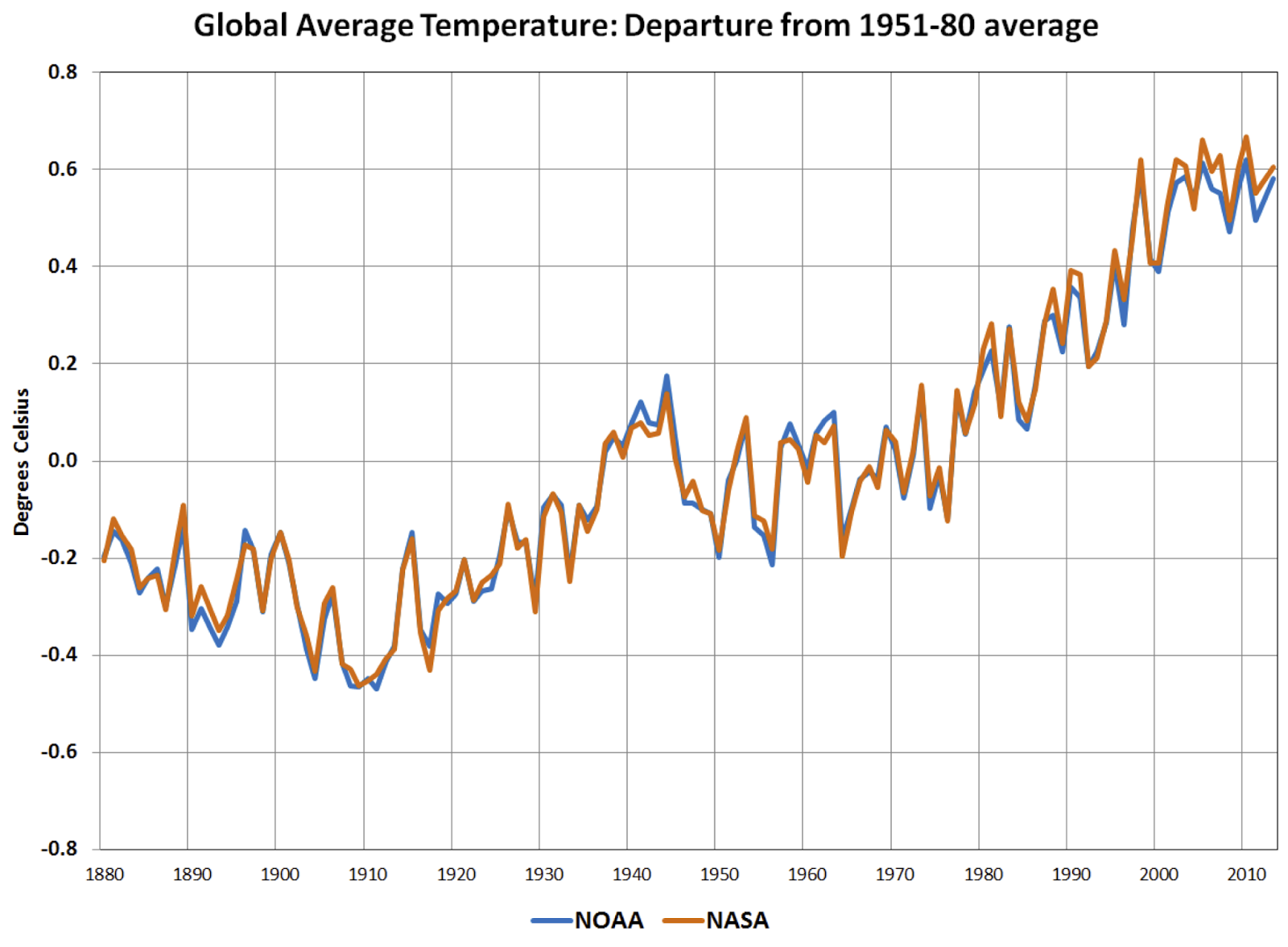
Global temperatures for the past 125 years. It's getting hot!
The word in Washington lately is that Senator Ted Cruz–who just announced that he’s running for President–is supposed to be a very smart guy. Some of this comes from Harvard Law professor Alan Dershowitz, who said last year that Cruz was “clearly among the top students” at the prestigious Harvard Law School. Dershowitz is very liberal, while Cruz is very conservative, so one assumes that Dershowitz wouldn't say this if it weren't true.

Perhaps Cruz was an excellent law student. But when it comes to science, Cruz is no whiz kid. On the contrary, he seems to be woefully ignorant. We know this because despite his lack of expertise, he doesn’t hesitate to make sweeping pronouncements about scientific matters.

In just the past week, Cruz has weighed in on two major science issues, and he's been wrong on both. First, in an interview a few days ago with the Texas Tribune, Cruz stated that global warming isn’t happening. This wasn’t the first time he’s made that claim, but this time he threw in what’s known in skeptical circles as the "Galileo gambit," a well-known ploy of conspiracy theorists. He compared his global warming denialism to Galileo thusly:
Today, the global warming alarmists are the equivalent of the flat-Earthers. It used to be [that] it is accepted scientific wisdom the Earth is flat, and this heretic named Galileo was branded a denier.”
Cruz managed to get at least two things wrong in a single sentence here. 

First, Galileo did not become famous for arguing against flat-Earthers: he argued that the Earth revolved around the sun (the heliocentric model of the solar system) rather than the sun revolving around the earth (the geocentric or Ptolemaic model, after the Greek philosopher Ptolemy).

Second, Galileo was not a denialist, nor was he called one. He was not denying a vast array of scientific data to make his point–just the opposite, in fact. The data showed that the Earth and other planets revolved around the sun, and the Catholic church (among other institutions) didn’t want to believe it, and therefore they forced him to recant. The Church didn't call Galileo a "denier."

Cruz's statement is not just wrong: it's also arrogant. Cruz is comparing himself to Galileo, one of the greatest scientists in history, as if he (Cruz) were making a brave scientific stand against a dogmatic opponent. This is the crux of the Galileo gambit: the speaker claims to take a heroic stand against a powerful foe while defending the truth. Sorry, Senator Cruz: you’re no Galileo. Not even a little bit.

And let's not ignore Cruz’s scientific claim: that the Earth isn't getting warmer. Here's one of his quotes:
"And many of the alarmists on global warming, they’ve got a problem cause the science doesn’t back them up. And in particular, satellite data demonstrate for the last 17 years, there’s been zero warming. None whatsoever."
Oh good. Ted Cruz has evaluated the satellite data and figured this out. Who knew that he was not only a lawyer but also a scientist? Real climate scientists–who understand this issue far, far better than Cruz–disagree. For example, NASA and NOAA recently announced that 2014 was the warmest year on record. They also explained that 
“The 10 warmest years in the instrumental record, with the exception of 1998, have now occurred since 2000. This trend continues a long-term warming of the planet, according to an analysis of surface temperature measurements by scientists at NASA’s Goddard Institute of Space Studies.” (See the Figure.)
There’s no mystery about why Cruz and others deny global warming: the oil and coal industries have conducted a vigorous campaign for years now, primarily targeting Republicans, to cast doubt on the science. The reason is simple: fossil-fuel companies are worried that if we take global warming seriously, we might burn less fossil fuel. Their lobbying campaign is working: Cruz has certainly fallen into line.

Meanwhile, coastal areas are fighting rising sea levels, and the Arctic and Antarctic are melting. Lobbying might change the minds of politicians, but the planet doesn't care.

Now let’s look at the second bit of dodgy science that Senator Cruz endorsed this week. He announced his candidacy at Liberty University, a Christian fundamentalist college in Virginia that was founded by Jerry Falwell, an evangelical Southern Baptist minister. Liberty University’s Center for Creation Studies teaches students that the the Earth is only a few thousand years old and that all species were placed here by an all-powerful god, exactly as described in the Bible. Not surprisingly, students and faculty at Liberty University deny the facts of evolution. To a scientist, Cruz's appearance at Liberty University is an in-your-face endorsement of creationism.

I should be clear that Ted Cruz didn’t explicitly embrace creationism and deny evolution when he announced his candidacy, but he did choose Liberty University, and he must know its views about evolution. I wrote to Senator Cruz to see if he believed in young-Earth creationism, or if he believed that species evolved over millions of years, as science has demonstrated. He didn’t reply.

Virtually all of modern biology and medicine has its basis in evolution. No serious scientist disputes that evolution is by far the best explanation for the species around us, and for a thousand other phenomena that scientists study every day. The debate about the fact of evolution is long over. As a scientist, I find it just embarrassing to have prominent U.S. politicians publicly deny evolution.

Actually, I suspect that Ted Cruz isn’t really a creationist. I find it hard to believe that a guy who went to Princeton and Harvard, and apparently did quite well at both schools, can really believe the Earth was created 4,000 years ago. I also wonder if he truly believes that the world's leading climate scientists are just making stuff up about the Earth warming. Maybe he’s just pandering to his right-wing audience and his campaign donors.

Do politicians need to make decisions about science? Of course they do. But science can be incredibly complex and specialized. A good president (or prime minister, or governor) will identify experts–independent ones, without conflicts of interest–and seek their advice. Ted Cruz is no scientist, as his recent comments demonstrate, but I predict he won't be the only U.S. presidential candidate to make misguided remarks about science.

What do the Presidential candidates think about science?


ScienceDebate.org recently posed 14 questions to President Obama and Republican presidential nominee Mitt Romney, and just a few days ago, the candidates answered all 14.  Can we learn what they actually think about science from these answers?  Well, maybe just a little bit.  

My first inclination, on going to the ScienceDebate2012 website, was to look for the candidates' positions on the two biggest scientific topics in the political arena today: evolution and global warming.  Somehow, ScienceDebate2012 only asked about one of these, which I'll get to in a minute.

The ScienceDebate2012 organization calls its list "the top American science questions: 2012", but the questions themselves are a disappointment.  They're what you'd expect from a committee: lots of nice-sounding, polite questions, but nothing that really challenges the candidates.  I guess SD2012 was afraid that the candidates might get all offended, or maybe that fewer scientists would sign their petition.  But if you read the answers, you'll see that the candidates just answered the question they wanted to hear, as politicians love to do.  Most of the answers describe policies we already know (for those who are paying attention to the campaigns), but an interesting surprise popped up: Mitt Romney has no fondness for NASA.  Jump to the bottom to learn more.

Most of the questions are big fat softballs, starting with the first one: "What policies will best ensure that America remains a world leader in innovation?" http://www.sciencedebate.org/debate12/   Good tough question, guys!  We only have 14 questions, and you waste one on this?  Unsurprisingly, the answers to this one just repeated campaign talking points.

Before looking at some real answers, let's start with the howlingly obvious question that ScienceDebate2012 failed to ask.  
The Un-asked Question: do you believe that evolution should be taught in public schools, and that it should be presented as the only explanation for how species arose?  
This question has only one right answer, as any biologist worthy of the name knows.  Evolution is the foundation of all of modern biology, genetics, infectious disease research, you name it.  And the U.S. is one of the few advanced countries where a significant number of its citizens don't accept evolution, opting instead for an archaic religious position that claims Earth is only a few thousand years old.  

We should know the candidates' answers.  In 2008, ten Republican presidential candidates were asked if they believe in the theory of evolution.  Only 7 said yes--but one was Governor Romney.  Back in 2007, he told the New York Times that "the science class is where to teach evolution," and that intelligent design was "for the religion class or philosophy class."  President Obama also supports evolution, and opposes teaching creationism in the science classroom. 

So the candidates agree on this one - at least they did in the past.  But Romney's fellow Republicans don't all agree. In particular, we need to ask Governor Romney: do you support the crazy religious extremism of your fellow Republican, Congressman Paul Broun from Georgia, who just announced that evolution, embryology, and the Big Bang theory are
 "lies straight from the pit of hell"?  
And Broun also stated that the Bible - and his wacko interpretation of it - should be used to run our government.  Any candidate for president should denounce this call for theocratic rule.

And by the way, if a Democratic Congressman said anything like this, I'd throw the same question at President Obama.

Now on to one of the real questions, on global warming. ScienceDebate2012 posed the question this way:
"The Earth’s climate is changing and there is concern about the potentially adverse effects of these changes on life on the planet. What is your position on cap-and-trade, carbon taxes, and other policies proposed to address global climate change—and what steps can we take to improve our ability to tackle challenges like climate change that cross national boundaries?"  
Obama's short answer acknowledges that "climate change is one of the biggest issues of this generation," and goes on to say he will "continue efforts to reduce our dependence on oil and lower our greenhouse gas emissions."  Vague generalities, and nothing he hasn't said before, but consistent at least.

Romney's answer, though, tries to have it both ways.  He first says that global warming is indeed happening and then says, basically, we need more research because it's controversial.  Here's how his lengthy answer begins: 
"My best assessment of the data is that the world is getting warmer, that human activity contributes to that warming, and that policymakers should therefore consider the risk of negative consequences."  
But then he pivots in the very next sentence and claims 
"there remains a lack of scientific consensus on the issue ... and I believe we must supported continued debate and investigation within the scientific community."  
So there you go: yes, global warming is a problem, but let's study it rather than do something.  At the end of his answer, Romney recovers a bit by saying he supports "robust government funding for research on efficient, low-emissions technologies."  So it appears he would support some action on global warming.  But his answer offers a troubling false claim about a lack of scientific consensus: the consensus is rock solid.

Now, I promised one surprise: a bit of new information.  Question 12 covers space exploration and is another softball: 
"What should America's space exploration and utilization goals be in the 21st century and what steps should the government take to help achieve them?" 
I expected some vague answers about how great America is (and both candidates did indeed deliver on that), but Romney surprised me with his answer.

Here's the surprise: Romney comes right out and says he will probably cut the NASA budget.  What he actually said in his answer was: 
"A strong and successful NASA does not require more funding, it needs clearer priorities."
In Washington-speak, this means "NASA has too much money and I will probably cut it."

So at least we know where Romney stands on space exploration.  He wants to downsize it and, apparently, outsource it to other countries.  Here's how he puts it later in his answer: 
"Part of leadership is also engaging and working with our allies and the international community. I will be clear about the nation’s space objectives and will invite friends and allies to cooperate with America in achieving mutually beneficial goals."  
If I worked for NASA, I'd be worried.