Showing posts with label global warming denialism. Show all posts

Ted Cruz is not as smart as Galileo, whatever he claims

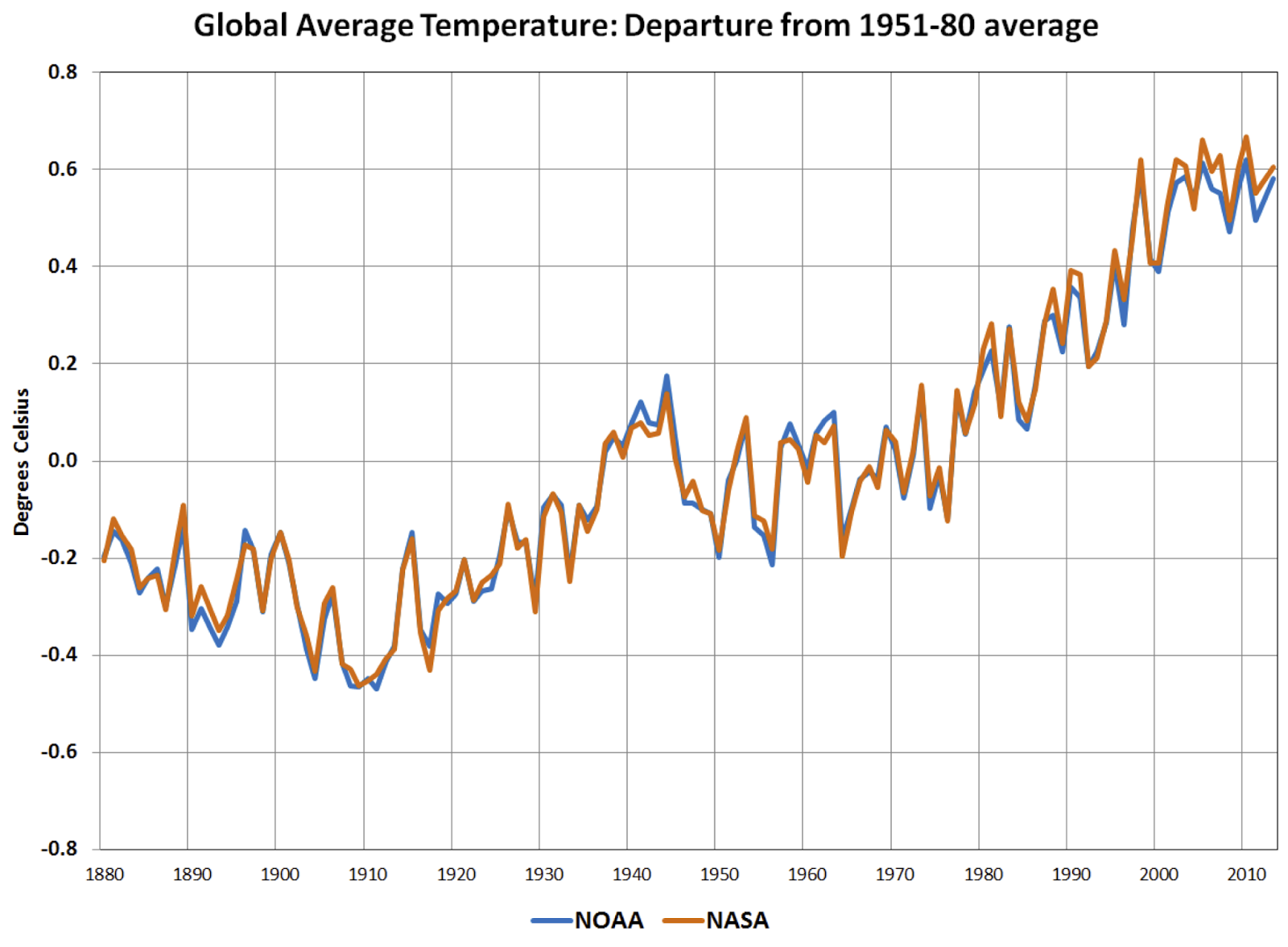
Global temperatures for the past 125 years. It's getting hot!
The word in Washington lately is that Senator Ted Cruz–who just announced that he’s running for President–is supposed to be a very smart guy. Some of this comes from Harvard Law professor Alan Dershowitz, who said last year that Cruz was “clearly among the top students” at the prestigious Harvard Law School. Dershowitz is very liberal, while Cruz is very conservative, so one assumes that Dershowitz wouldn't say this if it weren't true.

Perhaps Cruz was an excellent law student. But when it comes to science, Cruz is no whiz kid. On the contrary, he seems to be woefully ignorant. We know this because despite his lack of expertise, he doesn’t hesitate to make sweeping pronouncements about scientific matters.

In just the past week, Cruz has weighed in on two major science issues, and he's been wrong on both. First, in an interview a few days ago with the Texas Tribune, Cruz stated that global warming isn’t happening. This wasn’t the first time he’s made that claim, but this time he threw in what’s known in skeptical circles as the "Galileo gambit," a well-known ploy of conspiracy theorists. He compared his global warming denialism to Galileo thusly:
Today, the global warming alarmists are the equivalent of the flat-Earthers. It used to be [that] it is accepted scientific wisdom the Earth is flat, and this heretic named Galileo was branded a denier.”
Cruz managed to get at least two things wrong in a single sentence here. 

First, Galileo did not become famous for arguing against flat-Earthers: he argued that the Earth revolved around the sun (the heliocentric model of the solar system) rather than the sun revolving around the earth (the geocentric or Ptolemaic model, after the Greek philosopher Ptolemy).

Second, Galileo was not a denialist, nor was he called one. He was not denying a vast array of scientific data to make his point–just the opposite, in fact. The data showed that the Earth and other planets revolved around the sun, and the Catholic church (among other institutions) didn’t want to believe it, and therefore they forced him to recant. The Church didn't call Galileo a "denier."

Cruz's statement is not just wrong: it's also arrogant. Cruz is comparing himself to Galileo, one of the greatest scientists in history, as if he (Cruz) were making a brave scientific stand against a dogmatic opponent. This is the crux of the Galileo gambit: the speaker claims to take a heroic stand against a powerful foe while defending the truth. Sorry, Senator Cruz: you’re no Galileo. Not even a little bit.

And let's not ignore Cruz’s scientific claim: that the Earth isn't getting warmer. Here's one of his quotes:
"And many of the alarmists on global warming, they’ve got a problem cause the science doesn’t back them up. And in particular, satellite data demonstrate for the last 17 years, there’s been zero warming. None whatsoever."
Oh good. Ted Cruz has evaluated the satellite data and figured this out. Who knew that he was not only a lawyer but also a scientist? Real climate scientists–who understand this issue far, far better than Cruz–disagree. For example, NASA and NOAA recently announced that 2014 was the warmest year on record. They also explained that 
“The 10 warmest years in the instrumental record, with the exception of 1998, have now occurred since 2000. This trend continues a long-term warming of the planet, according to an analysis of surface temperature measurements by scientists at NASA’s Goddard Institute of Space Studies.” (See the Figure.)
There’s no mystery about why Cruz and others deny global warming: the oil and coal industries have conducted a vigorous campaign for years now, primarily targeting Republicans, to cast doubt on the science. The reason is simple: fossil-fuel companies are worried that if we take global warming seriously, we might burn less fossil fuel. Their lobbying campaign is working: Cruz has certainly fallen into line.

Meanwhile, coastal areas are fighting rising sea levels, and the Arctic and Antarctic are melting. Lobbying might change the minds of politicians, but the planet doesn't care.

Now let’s look at the second bit of dodgy science that Senator Cruz endorsed this week. He announced his candidacy at Liberty University, a Christian fundamentalist college in Virginia that was founded by Jerry Falwell, an evangelical Southern Baptist minister. Liberty University’s Center for Creation Studies teaches students that the the Earth is only a few thousand years old and that all species were placed here by an all-powerful god, exactly as described in the Bible. Not surprisingly, students and faculty at Liberty University deny the facts of evolution. To a scientist, Cruz's appearance at Liberty University is an in-your-face endorsement of creationism.

I should be clear that Ted Cruz didn’t explicitly embrace creationism and deny evolution when he announced his candidacy, but he did choose Liberty University, and he must know its views about evolution. I wrote to Senator Cruz to see if he believed in young-Earth creationism, or if he believed that species evolved over millions of years, as science has demonstrated. He didn’t reply.

Virtually all of modern biology and medicine has its basis in evolution. No serious scientist disputes that evolution is by far the best explanation for the species around us, and for a thousand other phenomena that scientists study every day. The debate about the fact of evolution is long over. As a scientist, I find it just embarrassing to have prominent U.S. politicians publicly deny evolution.

Actually, I suspect that Ted Cruz isn’t really a creationist. I find it hard to believe that a guy who went to Princeton and Harvard, and apparently did quite well at both schools, can really believe the Earth was created 4,000 years ago. I also wonder if he truly believes that the world's leading climate scientists are just making stuff up about the Earth warming. Maybe he’s just pandering to his right-wing audience and his campaign donors.

Do politicians need to make decisions about science? Of course they do. But science can be incredibly complex and specialized. A good president (or prime minister, or governor) will identify experts–independent ones, without conflicts of interest–and seek their advice. Ted Cruz is no scientist, as his recent comments demonstrate, but I predict he won't be the only U.S. presidential candidate to make misguided remarks about science.

Virginia nominates extreme anti-science candidate for governor

Last week, the Virginia Republican party nominated Ken Cuccinelli for governor, in an election to be held later this year.  Just three years ago, in his current job as Attorney General of Virginia, Cuccinelli launched one of the most outrageous attacks on an academic scientist that I've seen in many decades.  His actions would not be out of place in a totalitarian state such as the Soviet Union, or perhaps in the 1950's McCarthyism era, when many Americans were blacklisted, denied jobs, and even fired because of their political views.  But in a country where the freedom to speak is a fundamental right, Cuccinelli's actions are frightening.

Cuccinelli used the power of government to intimidate a scientist with whom he disagreed.  Not just one scientist, but 40 scientists and their colleagues, all working at the University of Virginia.  His message was clear: if you disagree with me, I will come after you.  Now Cuccinelli is running for governor, and in a state fairly evenly split between Republicans and Democrats, he has a good chance of winning.

Ken Cuccinelli is a climate change denialist, one of many U.S. politicians who think that the Earth is not warming, or if it is, that the warming is unrelated to human activities.  The science is completely against Cuccinelli on this, but if he were simply scientifically ignorant I wouldn't be writing about him.  After all, he's not the only politician who ignores science when he finds it inconvenient.

Cucinelli goes further - much, much further.  In 2010, he used the power of his office as Attorney general to launch a major legal attack on climate scientist Michael Mann, who was a professor at the University of Virginia from 199-2005.  Never mind that Mann had left UVA five years earlier; Cuccinelli wanted to make a public statement, and he chose his victim carefully.  (Mann is now at Penn State, where he holds the title Distinguished Professor of Meterology.)  

Michael Mann is the author of a famous paper that reconstructed temperatures in the Northern Hemisphere over the past 1,000 years. Man showed that we are experiencing an unprecented warming trend over the last century, shown in this figure from the IPCC report

Plot of temperature over the past 1,000
years, showing a dramatic rise in the past
century.  From the Intergovernmental
Panel on Climate Change report, 2007.
Did Cuccinelli try to find scientific evidence refuting Mann's data?  No.   He simply accused Mann, with no concrete evidence, of fraudulently manipulating data.  He then served formal legal orders on UVA, demanding all emails and other corresponding to or from Michael Mann and 39 other climate scientists, plus their research assistants and administrative staff, from 1999 through 2010.  They also demanded all "computer algorithms, programs, source code or the like" created by Mann and others. Cuccinelli's paper-thin legal justification for this attack was that Mann had violated a Virginia law called the Fraud Against Taxpayers Act, and that because Mann had request grant funding from the state, Cuccinelli could go after him and everyone associated with him.

UVA showed some backbone and refused to cave.  Hundreds of professors across the U.S. signed a petition organized by the Union of Concerned Scientists. The editors at Nature published an editorial saying that "The University of Virginia should fight a witch-hunt by the state's attorney general."

Two years later, after many court hearings and countless wasted taxpayer dollars, Virginia's Supreme Court threw out Cucinelli's charges and the case was over.


But just last week, Virginia Republicans nominated this modern-day McCarthyite to be their candidate for governor.  You can be sure that if he wins, Cuccinelli will use the heavy hand of government to intimidate anyone who disagrees with him.  His past actions show that he doesn't care about free speech or free inquiry, and he seems eager to go after anyone who might discover facts that he doesn't like.  I'd hate to be a professor at any of Virginia's universities if Cuccinelli takes over the reigns of power.

Virginia's war on science and academic freedom

The attorney general of Virginia, Ken Cuccinelli, is waging a war on science. Earlier this week, a federal judge dismissed Cuccinelli's lawsuit against the University of Virginia, but Cuccinelli has already announced that he will appeal the decision. This battle threatens not just climate researchers, but any scientist working in the state of Virginia.

Cuccinelli is a disturbingly right-wing politician whose primary actions since taking office have all been designed, seemingly, for his own political gain. He doesn't seem to mind wasting the tax dollars of Virginia's citizens as long as he can get his own name in the headlines.

His current battle is against global warming. Back in May, he announced with great fanfare that he was suing the University of Virginia over the work of climate scientist Michael Mann, a professor at Pennsylvania State University. It appears that Mr. Cucinelli disagrees with Prof. Mann over his findings about global warming. Prof. Mann is one of the world's leading experts on global warming, and he co-authored the study that produced the "hockey stick graph" showing a dramatic increase in temperature in recent decades:

The conclusions that the Earth is warming up, and that humans are one of the main causes, are no longer controversial within the scientific community, especially after the UN's Intergovernmental Panel on Climate Change (the IPCC) issued its report a few years ago. Nonetheless, many global warming denialists, including Mr. Cucinelli, continue to dispute them.

But Cucinelli isn't just a global warming denialist. He's also the attorney general of Virginia, which gives him quite a bit of power within that state. He's not a scientist, but that didn't stop him from suing the University of Virginia. His legal "trick" - what allowed him to use his power to go after Prof. Mann - hinges on the fact that Prof. Mann formerly was a professor at UVA, and while working there, he received a small grant from the state to support his work. (Never mind that the vast majority of his funding came from the federal government.) This was enough for Cucinelli to sue UVA, claiming that Prof. Mann had committed fraud by misusing state funds.

Cucinelli demanded that the University release all documents related to Prof. Mann's work, including all emails, laboratory notes, and any other correspondence since 1999. (This was a classic "fishing expedition: he didn't say what he was looking for.) To its credit, UVA refused, citing academic freedom, and challenged Cucinelli in court. The judge who dismissed the case pointed out that Cucinelli's suit was so vague that it didn't even specify how it was that Prof. Mann committed fraud. Apparently Cucinelli was unable to come up with a single concrete example of fraud.

Academic freedom is often cited in defense of questionable behaviors, but this case goes to the very heart of what academic freedom is all about. University professors - scientists, economists, historians, all of us - should be free to pursue the evidence wherever it takes us, and to write about our findings without fear of retribution. Even if his lawsuit fails on appeal, Cucinelli's lawsuit threatens to cast a chill over research in Virginia. Will scientists at UVA or other state universities, perhaps concerned about lawsuits, word their findings more carefully in the future? Will they simply avoid research on controversial topics, even if those topics are important to society?

The Virginia attorney general's groundless lawsuit, based on his purely political views and ambitions, is clearly intended to intimidate academic scientists at Virginia universities. Prof. Mann himself called the case "criminal harrassment." This kind of political threat is reminiscent of the oppressive regimes of the Soviet Union, whose scientists only published findings that met with the approval of their political masters. Political threats are a recipe for bad science.

UVA is a great university, but I'm glad I don't work there right now. If I did, I'd probably be looking to move.