Showing posts with label global warming. Show all posts

Let the 2010s be the end of the post-truth era


The 2010s are over, and the double-20s are about to begin. One phrase that I'd like to never hear again is "post-truth era," an idea that has gained prominence during the past decade, especially the last few years.

One dominant theme of post-truthery is that every person has a right to his/her own interpretation of the facts, and that these alternative interpretations–or "alternative facts," as Trump adviser Kellyanne Conway famously called them–deserve to be taken seriously. They don't.

And yet, like most of the pseudoscience that I've been writing about for years now, we have to continue calling out nonsense for what it is, because some of it is harmful, and even deadly. Politics is a never-ending font of post-truthery (or truthiness, as Stephen Colbert defined it in 2005), but here I'm concerned about science. Today I'll highlight three anti-truth campaigns that have caused great harm over the past decades, in the hope that they will soon fade away.

Among serious scientists, truth is not being questioned. Indeed, the essence of science is the search for objective truth. Sometimes, though, a scientific discovery threatens to undermine the power or profits of an influential industry, and that's when industry resorts to denialism (which is essentially the same thing as post-truthiness).

Perhaps the most well-documented example of organized science denialism dates back to the 1950s, when accumulating evidence made it clear that smoking causes cancer. The tobacco industry didn't want to admit this, even though their own internal research supported it, because it meant that their main product was killing their customers, which in turn was terrible news for their business. In response,
"the tobacco companies helped manufacture the smoking controversy by funding scientific research that was intended to obfuscate and prolong the debate about smoking and health." (Cummings et al. 2007).
Eventually, after decades of lawsuits and literally millions of smoking-related deaths, the industry was forced to admit the truth and pay out billions of dollars in settlements in the U.S. Nonetheless, many people still smoke, and even as recently as 2016, the largest tobacco company in the U.S., Philip Morris, was still trying to deny the science about cigarettes.

My second example is more recent, and potentially even more harmful to the human species. You might have already guessed it: I'm talking about climate change denialism. For several decades, the evidence has been building that the planet is getting warmer. A series of reports from the Intergovernmental Panel on Climate Change (IPCC) warned, in increasingly confident terms, that humans were the primary cause of recent warming, mostly due to our use of fossil fuels and the carbon they emit into the atmosphere.

The current IPCC report states unequivocally that humans have already caused 1° C of warming, and that the warming will increase rapidly over the next several decades.

Scientifically, these facts are not in dispute. The world is already experiencing more severe storms, unprecedented floods and droughts, and die-offs due to warming oceans (such as the massive and tragic die-off of coral in Great Barrier Reef).

However, the fossil fuel industry sees global warming as a threat to their profits. Rather than invest in new, cleaner forms of energy, large companies such as Exxon-Mobil and billionaire coal magnates such as the Koch brothers have poured countless millions of dollars into disinformation campaigns to cast doubt on the science of climate change. Prominent among these efforts is The Heartland Institute, a fossil-fuel-funded organization whose main mission is to cast doubt on the science of climate change. (Heartland has also worked to cast doubt on the link between smoking and cancer.)

Climate change denialists learned from the tobacco companies that it was possible to delay government action by decades, simply by casting doubt on the science. Unfortunately, their campaigns have been working. For years, many U.S. politicians denied that the planet was getting warmer. As that argument has become increasingly harder to make with a straight face, they've changed their strategy, and now they might admit that the planet is heating up, but deny that human activities are responsible. They're still wrong.

The goal of this denialism is, simply put, to protect the profits of fossil fuel industries. However, truth doesn't care if you believe it or not. The world is getting hotter. Australia just had its four hottest days in recorded history. The unprecedented heat wave has led to hundreds of fires through much of the country, threatening every major city on the continent. There's no reason to think this won't keep happening.

Climate change denialists are only fooling themselves–after being duped by oil and coal companies.

My third and final example is one that has frustrated me for 15 years now, and it's one that just won't go away: the anti-vaccination movement. This is one of the most frustrating examples of post-truth wrongheadedness, in part it seems so unnecessary, and because so many children have been harmed as a result.

First, let's be clear about the facts: vaccines are one of the greatest boons to human health in the history of science and medicine. People used to die by the millions from smallpox, polio, and a dozen other infections that are now almost completely preventable by vaccines.

Smallpox was 100% eliminated from the planet in 1980, in one of humankind's greatest public health triumphs. Polio has now been eradicated from nearly all countries, and a campaign that started in 1988 has now reduced polio to just a few countries and fewer than 100 cases worldwide. Both of these successes are due to vaccines.

Many other diseases, including measles, chicken pox, and bacterial meningitis, have been reduced so dramatically by vaccines that physicians in the U.S. and Europe almost never see a case. This graph shows the dramatic effect of the measles vaccine, which was introduced in the U.S. in the early 1960s:
Measles cases in the United States by year, 1954-2008. Source: CDC.
The graph shows the number of reported cases, but actual cases were much higher, likely around 4 million cases per year by one estimate. These are the facts.

So what happened? The modern anti-vax movement, led by a small number of extremely vocal, extremely self-confident individuals, began in 1998 with the publication of a fraudulent study (later retracted when the fraud was uncovered) claiming that vaccines caused autism. The study was led by former physician Andrew Wakefield, who later lost his medical license because of his fraud, which included misleading his co-authors and mistreating patients.

Nonetheless, this study was picked up and amplified by several celebrities with large followings, including former Playboy model and MTV host Jenny McCarthy and political activist Robert F. Kennedy Jr, the nephew of former US President John Kennedy. RFK Jr.

Anti-vax activism is all over the web today, despite many efforts to quash it. Countless claims of "my child got sick after his vaccine jab" are presented as proof that vaccines cause harm, and under post-truthism, we're supposed to take such claims seriously.

These stories can be especially difficult to respond to, because many parents are dealing with children who have genuine health problems–including autism–and the parents often truly believe what they are saying. Thus it won't do to tell them to be quiet and go away: their children really do need medical care. They're simply wrong in believing that vaccines have anything to do with their childrens' problems. Their beliefs are amplified by Facebook groups and websites whose sole purpose is to echo and amplify the mistaken claims of anti-vaxxers.

Even though there was never any good evidence that vaccines cause autism, scientists have conducted dozens of studies involving literally millions of children to answer precisely that question, and the evidence is very, very clear: vaccines do not cause autism, nor do they cause any other systematic neurological or behavioral problems. Vaccines do prevent diseases, though, and unvaccinated children can and will get sick. Recent experience has also given us, tragically, many examples of children who died from entirely preventable infections, because their parents didn't vaccinate them. These tragedies didn't have to happen.

Every era is the age of truth. The idea that we're in a "post-truth era," despite being repeated thousands of times in articles, essays, and op-eds over the past decade, is a commentary on people's ability to fool themselves, not on the state of the world. Truth describes the world as it is, and those who choose to deny it might win a short-term argument, but in the long term, they will always lose.

Finally, on a more positive note, I'm somewhat heartened by efforts to educate college students on how to recognize and counter bogus ideas, such as the University of Washington course, Calling Bullshit, created by Carl Bergstrom and Jevin West. (Yes, that really is its title.) As the professors wrote,
"The world is awash in bullshit.... We're sick of it. It's time to do something, and as educators, one constructive thing we know how to do is to teach people." 
If you're interested, they've made the lectures available as free videos on YouTube.

Labelling an era as post-anything has always, to me, suggested a lack of substance, as if the era is defined only by what came before it. The use of "post-" also ignores that fact that the next era will need a name too. Should we expect "post-post-truth" to come next, and what would that look like? Let's hope that the 2020s will give us a return to simple respect for truth. The future of civilization might very well depend on it.

The loneliest word, and the extinction crisis

We're in the midst of an extinction crisis. Just two months ago, an international committee known as IPBES released a report, compiled over 3 years by 145 experts from 50 countries, that said 1,000,000 plant and animal species are threatened with extinction, many within the next few decades.

Martha, the very last passenger
pigeon, shown when she was
still alive.
Before getting to that report, I want to introduce a word that I only just learned: endling. An endling (the word was coined in 1996) is the last surviving member of a species. One example was Martha, the very last passenger pigeon, who died in the Cinncinnati Zoo in 1914. Passenger pigeons numbered in the billions in the 19th century, but humans wiped them out.

In 2012 we lost another endling, Lonesome George–the very last Pinto Island tortoise from the Galapagos Islands–who died at around age 100.

If you want to see a particularly poignant example of an endling, watch this rare and heartbreaking video of Benjamin, the very last Tasmanian tiger (or thylacine), pacing around his cramped enclosure in Hobart, Tasmania. This film from 1933 is the last known motion picture of a living thylacine. Benjamin died in 1936.
Two Tasmanian tigers in the Washington, D.C. zoo, in a photo
taken around 1904. Photo credit: Baker; E.J. Keller. from the
Smithsonian Institution archives

We have records of other endlings too: the last Caspian tiger was killed in the 1950s in Uzbekistan, and the last great auks were killed for specimen collectors in 1844.

Unfortunately, we're likely to see more and more endlings in the years to come. The causes of extinction are varied, and many of them are related to human activities. The IPBES ranked the culprits, in descending order, as:

  1. changes in land and sea use,
  2. direct exploitation of organisms,
  3. climate change,
  4. pollution, and
  5. invasive alien species.

In response to the IPBES report, the House of Representatives held a hearing in May to discuss the findings. Republicans on the committee took the opportunity to display a new form of denialism: extinction denialism. As reported in The Guardian, Representatives Tom McClintock and Rob Bishop used their time to attack the reputations of the report's authors, rather than addressing the very serious consequences of large-scale extinction. They called two climate-change deniers as witnesses, who also used their time to attack the authors.

This is a classic strategy used by deniers: attack the messenger, rather than dealing with the substance of the report. Let's consider just a few of the report's main findings (see much more here):

  • Across the planet, 75% of the land and about 66% of the marine environments have been significantly altered by human actions.
  • Up to $577 billion in annual global crops are at risk from pollinator loss (bees and other insects)
  • In 2015, 33% of marine fish stocks were being harvested at unsustainable levels; 60% were maximally sustainably fished.
  • Plastic pollution has increased tenfold since 1980, 300-400 million tons of heavy metals, solvents, toxic sludge and other wastes from industrial facilities are dumped annually into the world’s waters, and fertilizers entering coastal ecosystems have produced more than 400 ocean ‘dead zones’, covering a combined area greater than that of the United Kingdom.

The report is a call to action. It explains that transformative change is needed to protect and restore nature, and collective action is needed to overcome special interests such as the fossil fuel industry, which donates heavily to politicians. The Congressional hearing was a vivid demonstration of how effective the anti-environmental lobbyists have been.

Endling is the saddest word in any language. If we humans continue to treat nature as we've done in the past, we're going to see many more videos like the one of Benjamin, the last Tasmanian tiger. Let's hope we can do better.

Climate change is making us sneeze

Allergy sufferers are having a rough time of it this spring. If you're among them, and if you think it's getting worse, you're right–and climate change is at least partly to blame.

Admittedly, warming climate has far more severe consequences, such as the eventual flooding of entire coastal cities. On a personal level, though, pollen allergies make people pretty miserable. (I write this as a lifelong sufferer myself.) When springtime comes and trees burst into buds, some of us shut all the windows and huddle inside.

I hadn't thought that climate change would affect the pollen season until I read a newly published study in a journal called The Lancet Planetary Health. (Aside: yes, there really is a journal with that name, a specialty journal created two years ago by the venerable publishers of The Lancet.)

The new study, by USDA scientist Lewis Ziska and colleagues from 15 other countries, looked at airborne pollen data from 17 locations, spanning the entire globe, and stretching back an average of 26 years. The news isn't good for allergy sufferers:
"Overall, the long-term data indicate significant increases in both pollen loads and pollen season duration over time."
In other words, it's a double whammy: we getting more pollen than ever before, and the allergy season last longer. Okay, not that much longer, only an average of one day. But if you have hay fever, every day is one too many.

To be fair, not every location experienced a significant increase in pollen. Here are the 12 (of 17) that did:
  • Amiens, France
  • Brussels, Belgium
  • Geneva, Switzerland
  • Kevo, Finland
  • Krakow, Poland
  • Minneapolis, USA
  • Moscow, Russia
  • Papillion, USA
  • Reykjavik, Iceland
  • Thessaloniki, Greece
  • Turku, Finland
  • Winnipeg, Canada
Perhaps not coincidentally, the pollen season this spring is making headlines in the U.S. As the NY Times reported this week, "extreme" pollen has blanketed the middle of North Carolina this week. It's so bad that the air has taken on a yellowish tinge, as shown in this unaltered photo, one of several taken by photographer Jeremy Gilchrist and shared last week on social media.
A yellow haze caused by pollen over Durham, North Carolina
in April 2019. Photo credit: Jeremy Gilchrist via Facebook.

According to Ziska et al.'s study, more pollen-filled springs are the new normal. Their projections indicate that pollen seasons will continue to get longer in the future, and that the amount of pollen in the air will also increase during the spring and again in the fall, when ragweed pollen is at its peak.

What can you do about spring allergies? I wrote about this last year: for some people, over-the-counter antihistamines help, although they only treat the symptoms. Allergy shots can provide long-term relief, if you have the time to go through the months-long regimen. Other than these options, the best you can do is stay inside and wait for pollen season to end. You can always catch up on your reading of The Lancet Planetary Health.

You Think It's Hot Now? Just Wait.

Figure from Steffen et al.: a global map of potential
tipping cascades. The individual tipping elements are
color-coded according to estimated thresholds in global
average surface temperature (tipping points).
It's getting hotter all over the planet.

This week the temperature in Bar Harbor, Maine, reached 91° F (32.8° C). In my 20 years vacationing here, this is easily the hottest weather I've ever experienced.

Up and down the U.S. east coast, cities are sweltering, and temperatures out west are even hotter, with California seeing all-time high temperatures, including the hottest July on record in some areas, which has fed damaging fires across the state. Death Valley is always hot, but this week has been crazy, with temperatures on August 7 reaching 122° F (50° C).

At the same time, Europe is baking under a "heat dome" that has brought unprecedented high temperatures, including 45° C (113° F.) in Portugal. It's so hot that people aren't even going to the beach.

Global warming is here, folks. I know we're supposed to call it "climate change," because it's much more complex than simply warming, but warming is one of the most obvious consequences.

And yes, a single heat wave doesn't prove anything, and weather is not the same as climate. I know. But a just-released study from Oxford University found that climate change made this summer's heat wave in Europe twice as likely.

And now, a new study published last week in the Proceedings of the National Academy of Sciences, says it could get much, much hotter if we don't do something about it. In this paper, an international team of climate scientists led by Will Steffen and Hans Joachim Schellnhuber explain that, thanks to human activities, the planet is well on its way to a "Hothouse Earth" scenario.

In a Hothouse Earth, global average temperatures would rise 4–5° C (7–9° F) and sea levels will rise 10–60 meters (33–200 feet) above today's levels. This would be catastrophic for many aspects of modern civilization. Many agricultural regions would become too hot and arid to sustain crops, making it impossible to feed large swaths of humanity. Low-lying coastal areas would disappear or become uninhabitable without massive engineering efforts, displacing hundreds of millions of people. As Steffen et al. put it:
"The impacts of a Hothouse Earth pathway on human societies would likely be massive, sometimes abrupt, and undoubtedly disruptive."
That's putting it mildly.

One reason this scenario is happening, as the study explains, is that we are very close to "tipping points" beyond which certain changes cannot be stopped. (We may have already passed some of them.) These include losing the Arctic ice cap in the summer, and losing the Greenland ice sheet permanently: because they are basically white, these massive expanses of ice serve as giant reflectors to send much of the sun's heat back into space. Without the ice, the darker planet surface absorbs far more heat, creating a positive feedback effect. Another example is the melting of the permafrost, land that has been frozen for thousands of years and that contains a great deal of carbon in the form of methane. Once that methane is released, it will create further warming.

We are also likely to lose the Amazon rainforest, all of our coral reefs, and huge swaths of boreal forests. (See here for a global map of these tipping points.)

If this seems grim, Steffen and colleagues point out that we still have time to avoid it. They propose that societies must act collectively to create a "Stabilized Earth" at no more than 2° C above pre-industrial levels, which is possible but not easy:
"Stabilized Earth will require deep cuts in greenhouse gas emissions, protection and enhancement of biosphere carbon sinks, efforts to remove CO2 from the atmosphere, possibly solar radiation management, and adaptation to unavoidable impacts of the warming already occurring."
None of this is beyond our abilities. We know what we need to do, but it requires large-scale, coordinated action that many governments must agree on if it's to have an impact. Unfortunately, humans (and our governments) tend to do nothing until faced with an emergency, and the tipping points leading to a Hothouse Earth may not look like emergencies, not at first. For example, Arctic sea ice has been declining steadily for 25 years or more, but because few people are aware of this (and even fewer experience it first hand), it doesn't seem urgent. Yet it is.

So perhaps this summer's heat wave can serve as a wake-up call that we need to pay more attention to our planet's health. Otherwise it's going to get a lot hotter.

How not to respond to the EPA's science denialism

You would think that the editors of the top science journals in the world would know how to write clearly. But if you read their joint statement in the journal Science last week, you might be forgiven for wondering what the heck they are talking about. It's not that complicated, really. Let me explain.

EPA Administrator Scott Pruitt, when he's not busy taking expensive trips, renting rooms at a deep discount from coal lobbyists, or building $48,000 soundproof booths for his office, is doing his best to make the U.S. a friendly place for fossil fuel industries. As part of his pollution-friendly mission, Pruitt denies the scientific consensus that climate change is real and is caused in part by human activities, especially by carbon dioxide emissions.

Pruitt has devised a clever new strategy to make science denialism part of official EPA policy, while pretending otherwise: he's issued a new proposed rule that requires the EPA to use only "transparent" science. (The official Federal Register entry is here.) In his press release, Pruitt stated
"The era of secret science at EPA is coming to an end. The ability to test, authenticate, and reproduce scientific findings is vital for the integrity of rulemaking process."
The press release, which is titled "EPA Administrator Pruitt Proposes Rule To Strengthen Science Used In EPA Regulations", seems to be all about science and openness. One thing I've got to give them credit for: the PR people at the EPA know how to obfuscate.

It turns out this is just a ruse. As Pruitt certainly knows, many of the EPA's rules are based on studies of human subjects, which are governed by strict privacy rules–which are necessary not only to get people to participate in the studies, but also because violating people's privacy can be highly unethical. This means that many studies showing the harms of pollution–for example, this massive study, which found that fine-scale particulate matter from coal plants increases the risk of lung and heart disease–are not "transparent" enough for the EPA, because the identities of the participants as well as all their health records are confidential.

In other words, the new EPA policy isn't about scientific transparency. It's a transparent (!) attempt to ignore the negative health effects of pollution, so that Pruitt can put in place new rules allowing polluters to dump more pollutants into our air and water. See how that works?

In response, the Editors-in-Chief of Science, Nature, the Public Library of Science, and the Proceedings of the National Academy of Sciences issued a joint statement. Alas, their statement is anything but clear. They spend about three-fourths of it explaining about how they support data sharing, and finally, in their last sentence, they write this:
"Excluding relevant studies simply because they do not meet rigid transparency standards will adversely affect decision-making processes."
That's it. Even the most sophisticated reader could be forgiven for not understanding what the issue is, not from this statement alone.

Here's what they should have said: the EPA wants to ignore the health consequences of pollution when creating policy. The EPA administrator, Scott Pruitt, has announced a new policy that pretends to be about scientific transparency, but is nothing of the sort. Instead, this policy is designed to undermine the EPA's mission, which is (and you can read this right on the EPA's website "to protect human health and the environment."

Since the EPA's creation in 1970, the U.S. has made tremendous strides in cleaning up our air and water. Let's not start backsliding just to enhance the profits of a few polluters.

[Note: I have written the EPA and asked for comment. I will update this article if they respond.]

Houston, we have a problem. It's called global warming, whether you admit it or not.

Hurricane Harvey poured more rain on Texas and Louisiana last week than this country has ever seen from a single storm. The city of Houston is now suffering from historic flooding, with many calling this a "1000-year flood." Congress is likely to pass a huge bailout bill in the coming days, starting with a $14.5 billion "down payment," suggesting much more is to come.

The storm's eventual costs could rise even higher than the costs of 2005's Hurricane Katrina, which cost $160 billion according to NOAA.

Let's not dance around the issue: Hurricane Harvey was a direct consequence of global warming, which in turn is a direct consequence of human activities.

It's ironic that Texas (and Houston in particular) has an economy that is dominated by on oil and fossil fuels. Burning these fuels is what got us in this mess.

It's also ironic that Texas Senator Ted Cruz, who is now at the front of the line asking for a federal government rescue package, is a scientifically illiterate climate change denier. As I wrote shortly after he announced his candidacy for President in 2015, Cruz not only denied that global warming was happening, but he then went on to compare himself to Galileo, as if he were taking a brave and bold scientific position. Right.

A few facts: the Gulf of Mexico is 4 degrees warmer than normal this year, and it has been getting worse. Back in March of this year, the Washington Post's Jason Samenow reported that the Gulf was "freakishly warm, which could mean explosive springtime storms." Warm water feeds hurricanes, and Harvey feasted on it, sucking up energy and using it to dump ridiculous amounts of water onto south Texas.

Noted climate scientist Michael Mann, writing in The Guardian, took the slightly more nuanced position that "climate change made Hurricane Harvey more deadly." True enough: if you want to be strictly accurate, we can't prove that warming temperatures are the sole cause of Harvey. Maybe with cooler temperatures, we'd have had a hurricane anyway–but it would have been a far smaller one, and the damage would have been far less severe.

Mann also pointed out that global warming has already caused sea levels to rise over half a foot, which made the flooding in Houston significantly worse than it would have been otherwise.

Now it's time to rebuild, which raises a dilemma. The U.S. can't just abandon Houston, one of our country's largest cities, even if most of its residents deny the reality of global warming (and perhaps they don't). But given that global warming is well under way, with rising sea levels and warming oceans, more catastrophic flooding events like Harvey are highly likely. Should we pay to rebuild the city exactly as it was, basically ignoring the problems of floodwater management as Houston has done until now? Or should we use the government bailout funds to reduce the risk from future flooding?

Actually, it might do even more good to impose a simple requirement, before Texas gets any of our bailout funds. Let's require U.S. senators Ted Cruz and John Cornyn, and Texas governor Greg Abbot, to state publicly that global warming is real, that humans are making it worse, and that they will work in the future to mitigate the risks posed by continued climate change. Wouldn't that be something? A simple statement, nothing more, to unlock billions of dollars in aid.

If we just rebuild everything like before, then Houston will continue to have a problem.

(*Note about the title of this article. The original quote was "Houston, we've had a problem," famously utterly by Apollo 13 astronaut Jim Lovell. In the movie Apollo 13, actor Tom Hanks (playing Lovell) instead said, "Houston, we have a problem.")

The new EPA Chief is a climate denier: why are you surprised?

On Thursday, newly appointed EPA chief Scott Pruitt said he doesn't think human-driven carbon dioxide emissions cause global warming. The internet exploded with outrage.

Why so surprised? We already knew that Scott Pruitt was a climate change denialist.

Donald Trump is also a climate change denialist. Why is anyone surprised that Trump is appointing other denialists to top posts in his administration?

During his campaign, Trump claimed that climate change was a "hoax" perpetrated by the Chinese. Mr. Trump just made that up: it's complete nonsense, and he would be laughed out of the room in a serious discussion of climate science. Unfortunately, he now has too much power for us to ignore him.

The Secretary of Energy, former Texas governor Rick Perry, has also been a climate change denier, although he "softened" his position during his confirmation hearings. At those hearings, Perry said
"I believe the climate is changing. I believe some of it is naturally occurring, but some of it is also caused by man-made activity." [Secr. of Energy Rick Perry]
How refreshing! What really matters, though, is whether Perry's newfound awareness will be reflected in actual policy or it will turn out to be just a pose he adopted for the hearings.

Scott Pruitt, though, is unreprentant. Pruitt has spent much of his recent career suing the EPA on behalf of oil companies (despite the fact that he worked for the state of Oklahoma, not for those companies). Oil companies, coal companies, and others who make their money from fossil fuels–notably the Koch brothers and their fake-science-pushing Heartland Institute–have devoted millions of dollars and years of effort to climate change denialism. We already knew Scott Pruitt was one of them.

On CNN, Hawaii's Senator Brian Schatz commented:
"If there was ever any doubt that Scott Pruitt is a climate denier, this settles it."
Sen. Schatz is correct, of course–but there wasn't any doubt in the first place.

The New York Times couldn't have been surprised. Just two days before Pruitt's on-air denial, they ran a story headlined "E.P.A. Head Stacks Agency With Climate Change Skeptics." The Times pointed out that Pruitt's chief of staff and top deputies are former staffers of Senator James Inhofe, one of the Senate's leading climate change deniers.

I do have a major disagreement with The Times, though: stop calling these people "skeptics." They are not skeptics. A skeptic is someone who insists on solid evidence before accepting claims about science, medicine, or other fact-based issues. Once evidence is produced, a good skeptic acknowledges the evidence and changes his/her views, if necessary.

Denialists, in contrast, stick to the same rigid narrative regardless of the facts. When evidence contradicts their views, they have no choice but to deny, deny, deny. When pushed, they obfuscate and delay, often arguing that the evidence is not yet clear and more studies are needed. This is precisely what EPA head Scott Pruitt and his boss, Donald Trump, have been doing with climate change. Pruitt argued on Thursday that "we need to continue the debate and continue the review and the analysis." No, we don't. The evidence is overwhelming that the planet is warming, that rising CO2 emissions are a major contributor to that warming, and that human activities are causing much of it.

The Intergovernmental Panel on Climate Change (IPCC), summarizing the work of thousands of scientists from around the globe, has concluded with very high confidence that human activities are the primary driver of climate change. They've also explained (hello, Scott Pruitt?) that carbon dioxide is the most important human-driven cause of global warming, and that it has increased 80% since 1970.

Because Scott Pruitt is a denialist–not a skeptic–he will simply deny these facts.

The New York Times and other media need to stop calling Pruitt a skeptic. Skepticism can be healthy; all good scientists are skeptics. Denialism, on the other hand, can lead to great harm. Cigarette companies were not being skeptical when they denied, for decades, that cigarette smoking causes cancer. They too called for more research. They were protecting their profits, and millions of people died while the companies denied and delayed.

Oil and coal companies are now playing exactly the same game, sowing doubt in order to preserve their profits. Scott Pruitt demonstrated this when he claimed, on CNN, that "there's tremendous disagreement about the degree of impact [of human CO2 emissions]." No, there isn't. Quite the opposite is true: there's remarkable agreement among climate scientists that humans are causing global warming. The only source of disagreement is the profit-driven fossil fuel industry, which cares far more about its short-term profits than about the world that future generations will inherit.

So let's not be surprised when Trump and his minions deny climate change, or deny that human activities are causing it. Perhaps it would be better to consider what the harms will be, and whether we can prevent them. Just don't expect any help from the government.

Government scientists go rogue. What a great idea!

Government scientists are very worried, apparently with good reason, that their new boss wants to muzzle them. They've just come up with a brilliant strategy to circumvent this attempt at censorship.

Donald Trump and his minions have already made moves to suppress science within the government, with word going out that government employees cannot say anything to the public without the prior approval of political appointees. This has the marks of Stalinist (or should I say Putinist?) repression of free speech, not the sort of thing any of us ever expected to see in the United States. However, after running a campaign marked by outrageous anti-science claims on climate change and vaccine safety, Trump appears on track to use the enormous power of the federal government to suppress basic scientific facts.

Vladimir Putin has done the same thing. Most Russians think that Malaysia Airlines Flight 17, which was shot down in Ukraine in 2014, killing all 298 passengers, was shot down by Ukraine–despite the overwhelming evidence that the plane was shot down by a Russian missile provided to Russian-backed separatists by Russia. Putin had a record of suppressing, threatening, and even murdering those who speak out against him. Yet Donald Trump seems to find him the most admirable of all world leaders. And one of his closest advisors, Newt Gingrich, has said that he wants to fire all federal workers who didn't vote for Trump.

In just the past few days, though, government scientists have come up with a devilishly clever–and entirely legal–strategy to oppose the Trump administration's efforts to suppress their speech. Using Twitter, the same vehicle that Trump himself used so effectively throughout his campaign, they have created a set of "rogue" and "alt" accounts that have already started tweeting the real news about science, medicine, and the environment.

All of these accounts are run by non-government employees with no government sponsorship, but government scientists, in their off-hours time, can't be prevented from sending them information. In just a few days, these accounts have over 3.3 million followers, a number that is rising fast. Here's are some of the account with their total followers as of January 29:
Here are just a few of the tweets from these accounts so far:


As one tweet already pointed out, quoting the ACLU, "the First Amendment still protects workers' ability to speak in their own private capacities, on their own time, about matters that concern the public."

We might not be able to trust any official statements from the government for the next few years, but perhaps we'll still be able to find accurate science through the alt-gov Twitter accounts. So when you hear the Secretary of Health and Human Services (far right Congressman Tom Price, if he's confirmed) making claims about health care, check out @AltHHS to find out the real story. And when you hear Secretary of Big Oil Energy Rick Perry claim that global warming is a hoax, go to @NotAltWorld or @RogueNasa to find out the real story.

Why are we growing corn to fuel our cars? Three reasons why ethanol is a bad idea.

Most of us are driving around right now in cars powered by a combination of gasoline and ethanol. Ethanol is a fuel alternative produced from corn (mostly), and it has been touted for years as cleaner, carbon-neutral alternative to gas.

The problem is that ethanol’s benefits have been greatly exaggerated, leading to Congressional regulations that required ever-increasing amounts of ethanol in our gasoline supply. The government requirement goes back to 2005, when gas prices were much higher and the U.S. was in the midst of the Iraq war. Ethanol was supposed to be a clean way to reduce our dependence on foreign oil. The growing mandate for ethanol has instead created an enormous, artificial demand that has had unintended consequences, many of them bad.

Some background: Congress requires automakers to meet fuel economy (“CAFE”) standards for all their cars and light trucks. To encourage ever-greater use of ethanol, Congress modified the CAFE standards in 2005. As a result of that law, this year the EPA will require refiners to use 18.1 billion gallons of ethanol to fuel our cars.

Politicians still love ethanol. In the 2016 presidential campaign, several candidates came out in support of continuing the corn-based fuel program, hoping this position would win them votes in the Iowa caucuses. Iowa is a big corn state.

Unfortunately for the rest of us, mandating the use of ethanol is a terrible policy. Here are three reasons why.

1. Ethanol lowers your gas mileage–a lot. Ethanol only has about 2/3 the energy content of gasoline, meaning it simply cannot provide the same amount of power per gallon (or liter) as gas. E85 fuel, which uses 85% ethanol and 15% gasoline, is widely available, and some gas stations now offer no alternative. Consumer Reports put E85 to the test, and found that highway mileage decreased by 29% and city mileage by 22%. Car and Driver ran their own tests and found a 30% drop in mileage on E85. According to the Union of Concerned Scientists, nearly all gas sold in the US today has 10% ethanol–much less than in E85, but still providing lower fuel efficiency than straight gasoline.

Making things worse, ethanol attracts water and is more corrosive to some metals and rubber than gasoline. So it's bad for your car.

2. Using ethanol doesn’t reduce carbon emissions. The main argument for using ethanol is that because the carbon contained within it was recently put in the ground, burning ethanol (and releasing that carbon) is carbon neutral. Compared to extracting oil, which has lain in the ground for millions of years, growing corn and extracting ethanol puts far less carbon back in the atmosphere.

This argument makes sense, but only in a very narrow context. In an article published in Science in 2008, Timothy Searchinger and colleagues pointed out that previous analyses
“failed to count the carbon emissions that occur as farmers worldwide respond to higher prices and convert forest and grassland to new cropland to replace the grain (or cropland) diverted to biofuels.” 
When the scientists accounted for these land-use changes, they found that using corn to produce ethanol will double greenhouse emissions over a 30-year period. Switchgrass is only slightly better, increasing emissions by 50%. As the Union of Concern Scientists explains that “sustainable production is possible” only if we stop making ethanol from corn.

Admittedly this is a complex topic, but it seems that ethanol-from-corn simply doesn't reduce carbon emissions. Thus the entire justification for using ethanol to fuel our cars is unsound.

3. Increasing fuel efficiency means we’ll never be able to meet Congress’s mandated levels of ethanol usage, not unless we sacrifice even more gas mileage. Automakers have made great progress in producing more fuel-efficient cars, and the growing electric car market (Tesla!) mean that we’re using less and less fuel each year. This is terrific for reducing carbon emissions, but it means that Congress’s original mandate to use more ethanol becomes far harder to satisfy.

What happened was that back in 2005, Congress told us how to solve a problem (carbon emissions from our cars), instead of just encouraging us to solve it using innovative new ideas. Corn producers and their government representatives—governors, Senators, Representatives—all got behind the ethanol “solution” because they saw increased profits in it. Now we are stuck with a non-solution that, as the NY Times recently put it, is “a boon for Iowa and a boondoggle to the rest of the country.” It’s long past time to end the ethanol mandate.

Ted Cruz is not as smart as Galileo, whatever he claims

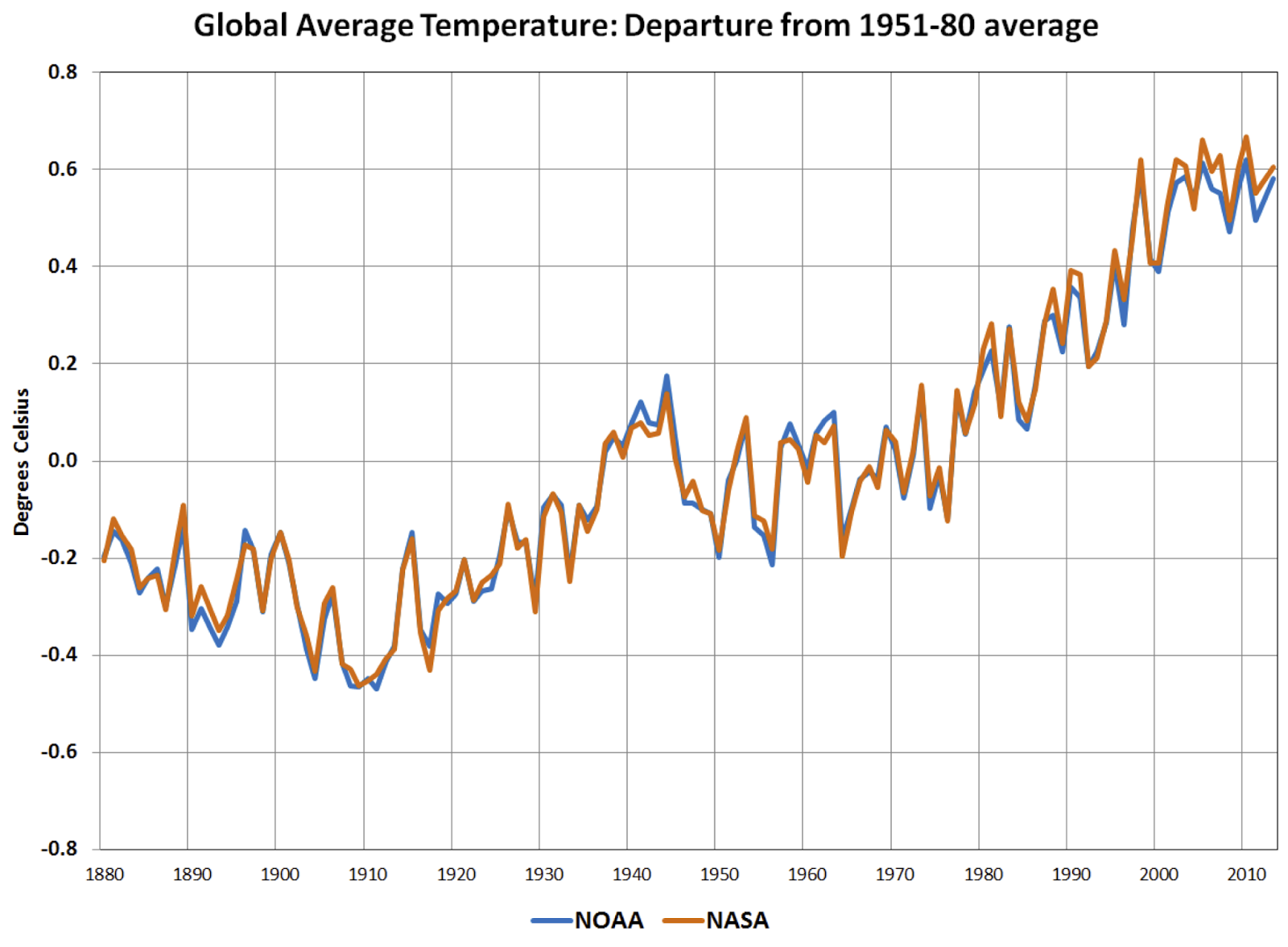
Global temperatures for the past 125 years. It's getting hot!
The word in Washington lately is that Senator Ted Cruz–who just announced that he’s running for President–is supposed to be a very smart guy. Some of this comes from Harvard Law professor Alan Dershowitz, who said last year that Cruz was “clearly among the top students” at the prestigious Harvard Law School. Dershowitz is very liberal, while Cruz is very conservative, so one assumes that Dershowitz wouldn't say this if it weren't true.

Perhaps Cruz was an excellent law student. But when it comes to science, Cruz is no whiz kid. On the contrary, he seems to be woefully ignorant. We know this because despite his lack of expertise, he doesn’t hesitate to make sweeping pronouncements about scientific matters.

In just the past week, Cruz has weighed in on two major science issues, and he's been wrong on both. First, in an interview a few days ago with the Texas Tribune, Cruz stated that global warming isn’t happening. This wasn’t the first time he’s made that claim, but this time he threw in what’s known in skeptical circles as the "Galileo gambit," a well-known ploy of conspiracy theorists. He compared his global warming denialism to Galileo thusly:
Today, the global warming alarmists are the equivalent of the flat-Earthers. It used to be [that] it is accepted scientific wisdom the Earth is flat, and this heretic named Galileo was branded a denier.”
Cruz managed to get at least two things wrong in a single sentence here. 

First, Galileo did not become famous for arguing against flat-Earthers: he argued that the Earth revolved around the sun (the heliocentric model of the solar system) rather than the sun revolving around the earth (the geocentric or Ptolemaic model, after the Greek philosopher Ptolemy).

Second, Galileo was not a denialist, nor was he called one. He was not denying a vast array of scientific data to make his point–just the opposite, in fact. The data showed that the Earth and other planets revolved around the sun, and the Catholic church (among other institutions) didn’t want to believe it, and therefore they forced him to recant. The Church didn't call Galileo a "denier."

Cruz's statement is not just wrong: it's also arrogant. Cruz is comparing himself to Galileo, one of the greatest scientists in history, as if he (Cruz) were making a brave scientific stand against a dogmatic opponent. This is the crux of the Galileo gambit: the speaker claims to take a heroic stand against a powerful foe while defending the truth. Sorry, Senator Cruz: you’re no Galileo. Not even a little bit.

And let's not ignore Cruz’s scientific claim: that the Earth isn't getting warmer. Here's one of his quotes:
"And many of the alarmists on global warming, they’ve got a problem cause the science doesn’t back them up. And in particular, satellite data demonstrate for the last 17 years, there’s been zero warming. None whatsoever."
Oh good. Ted Cruz has evaluated the satellite data and figured this out. Who knew that he was not only a lawyer but also a scientist? Real climate scientists–who understand this issue far, far better than Cruz–disagree. For example, NASA and NOAA recently announced that 2014 was the warmest year on record. They also explained that 
“The 10 warmest years in the instrumental record, with the exception of 1998, have now occurred since 2000. This trend continues a long-term warming of the planet, according to an analysis of surface temperature measurements by scientists at NASA’s Goddard Institute of Space Studies.” (See the Figure.)
There’s no mystery about why Cruz and others deny global warming: the oil and coal industries have conducted a vigorous campaign for years now, primarily targeting Republicans, to cast doubt on the science. The reason is simple: fossil-fuel companies are worried that if we take global warming seriously, we might burn less fossil fuel. Their lobbying campaign is working: Cruz has certainly fallen into line.

Meanwhile, coastal areas are fighting rising sea levels, and the Arctic and Antarctic are melting. Lobbying might change the minds of politicians, but the planet doesn't care.

Now let’s look at the second bit of dodgy science that Senator Cruz endorsed this week. He announced his candidacy at Liberty University, a Christian fundamentalist college in Virginia that was founded by Jerry Falwell, an evangelical Southern Baptist minister. Liberty University’s Center for Creation Studies teaches students that the the Earth is only a few thousand years old and that all species were placed here by an all-powerful god, exactly as described in the Bible. Not surprisingly, students and faculty at Liberty University deny the facts of evolution. To a scientist, Cruz's appearance at Liberty University is an in-your-face endorsement of creationism.

I should be clear that Ted Cruz didn’t explicitly embrace creationism and deny evolution when he announced his candidacy, but he did choose Liberty University, and he must know its views about evolution. I wrote to Senator Cruz to see if he believed in young-Earth creationism, or if he believed that species evolved over millions of years, as science has demonstrated. He didn’t reply.

Virtually all of modern biology and medicine has its basis in evolution. No serious scientist disputes that evolution is by far the best explanation for the species around us, and for a thousand other phenomena that scientists study every day. The debate about the fact of evolution is long over. As a scientist, I find it just embarrassing to have prominent U.S. politicians publicly deny evolution.

Actually, I suspect that Ted Cruz isn’t really a creationist. I find it hard to believe that a guy who went to Princeton and Harvard, and apparently did quite well at both schools, can really believe the Earth was created 4,000 years ago. I also wonder if he truly believes that the world's leading climate scientists are just making stuff up about the Earth warming. Maybe he’s just pandering to his right-wing audience and his campaign donors.

Do politicians need to make decisions about science? Of course they do. But science can be incredibly complex and specialized. A good president (or prime minister, or governor) will identify experts–independent ones, without conflicts of interest–and seek their advice. Ted Cruz is no scientist, as his recent comments demonstrate, but I predict he won't be the only U.S. presidential candidate to make misguided remarks about science.

Virginia nominates extreme anti-science candidate for governor

Last week, the Virginia Republican party nominated Ken Cuccinelli for governor, in an election to be held later this year.  Just three years ago, in his current job as Attorney General of Virginia, Cuccinelli launched one of the most outrageous attacks on an academic scientist that I've seen in many decades.  His actions would not be out of place in a totalitarian state such as the Soviet Union, or perhaps in the 1950's McCarthyism era, when many Americans were blacklisted, denied jobs, and even fired because of their political views.  But in a country where the freedom to speak is a fundamental right, Cuccinelli's actions are frightening.

Cuccinelli used the power of government to intimidate a scientist with whom he disagreed.  Not just one scientist, but 40 scientists and their colleagues, all working at the University of Virginia.  His message was clear: if you disagree with me, I will come after you.  Now Cuccinelli is running for governor, and in a state fairly evenly split between Republicans and Democrats, he has a good chance of winning.

Ken Cuccinelli is a climate change denialist, one of many U.S. politicians who think that the Earth is not warming, or if it is, that the warming is unrelated to human activities.  The science is completely against Cuccinelli on this, but if he were simply scientifically ignorant I wouldn't be writing about him.  After all, he's not the only politician who ignores science when he finds it inconvenient.

Cucinelli goes further - much, much further.  In 2010, he used the power of his office as Attorney general to launch a major legal attack on climate scientist Michael Mann, who was a professor at the University of Virginia from 199-2005.  Never mind that Mann had left UVA five years earlier; Cuccinelli wanted to make a public statement, and he chose his victim carefully.  (Mann is now at Penn State, where he holds the title Distinguished Professor of Meterology.)  

Michael Mann is the author of a famous paper that reconstructed temperatures in the Northern Hemisphere over the past 1,000 years. Man showed that we are experiencing an unprecented warming trend over the last century, shown in this figure from the IPCC report

Plot of temperature over the past 1,000
years, showing a dramatic rise in the past
century.  From the Intergovernmental
Panel on Climate Change report, 2007.
Did Cuccinelli try to find scientific evidence refuting Mann's data?  No.   He simply accused Mann, with no concrete evidence, of fraudulently manipulating data.  He then served formal legal orders on UVA, demanding all emails and other corresponding to or from Michael Mann and 39 other climate scientists, plus their research assistants and administrative staff, from 1999 through 2010.  They also demanded all "computer algorithms, programs, source code or the like" created by Mann and others. Cuccinelli's paper-thin legal justification for this attack was that Mann had violated a Virginia law called the Fraud Against Taxpayers Act, and that because Mann had request grant funding from the state, Cuccinelli could go after him and everyone associated with him.

UVA showed some backbone and refused to cave.  Hundreds of professors across the U.S. signed a petition organized by the Union of Concerned Scientists. The editors at Nature published an editorial saying that "The University of Virginia should fight a witch-hunt by the state's attorney general."

Two years later, after many court hearings and countless wasted taxpayer dollars, Virginia's Supreme Court threw out Cucinelli's charges and the case was over.


But just last week, Virginia Republicans nominated this modern-day McCarthyite to be their candidate for governor.  You can be sure that if he wins, Cuccinelli will use the heavy hand of government to intimidate anyone who disagrees with him.  His past actions show that he doesn't care about free speech or free inquiry, and he seems eager to go after anyone who might discover facts that he doesn't like.  I'd hate to be a professor at any of Virginia's universities if Cuccinelli takes over the reigns of power.

What do the Presidential candidates think about science?


ScienceDebate.org recently posed 14 questions to President Obama and Republican presidential nominee Mitt Romney, and just a few days ago, the candidates answered all 14.  Can we learn what they actually think about science from these answers?  Well, maybe just a little bit.  

My first inclination, on going to the ScienceDebate2012 website, was to look for the candidates' positions on the two biggest scientific topics in the political arena today: evolution and global warming.  Somehow, ScienceDebate2012 only asked about one of these, which I'll get to in a minute.

The ScienceDebate2012 organization calls its list "the top American science questions: 2012", but the questions themselves are a disappointment.  They're what you'd expect from a committee: lots of nice-sounding, polite questions, but nothing that really challenges the candidates.  I guess SD2012 was afraid that the candidates might get all offended, or maybe that fewer scientists would sign their petition.  But if you read the answers, you'll see that the candidates just answered the question they wanted to hear, as politicians love to do.  Most of the answers describe policies we already know (for those who are paying attention to the campaigns), but an interesting surprise popped up: Mitt Romney has no fondness for NASA.  Jump to the bottom to learn more.

Most of the questions are big fat softballs, starting with the first one: "What policies will best ensure that America remains a world leader in innovation?" http://www.sciencedebate.org/debate12/   Good tough question, guys!  We only have 14 questions, and you waste one on this?  Unsurprisingly, the answers to this one just repeated campaign talking points.

Before looking at some real answers, let's start with the howlingly obvious question that ScienceDebate2012 failed to ask.  
The Un-asked Question: do you believe that evolution should be taught in public schools, and that it should be presented as the only explanation for how species arose?  
This question has only one right answer, as any biologist worthy of the name knows.  Evolution is the foundation of all of modern biology, genetics, infectious disease research, you name it.  And the U.S. is one of the few advanced countries where a significant number of its citizens don't accept evolution, opting instead for an archaic religious position that claims Earth is only a few thousand years old.  

We should know the candidates' answers.  In 2008, ten Republican presidential candidates were asked if they believe in the theory of evolution.  Only 7 said yes--but one was Governor Romney.  Back in 2007, he told the New York Times that "the science class is where to teach evolution," and that intelligent design was "for the religion class or philosophy class."  President Obama also supports evolution, and opposes teaching creationism in the science classroom. 

So the candidates agree on this one - at least they did in the past.  But Romney's fellow Republicans don't all agree. In particular, we need to ask Governor Romney: do you support the crazy religious extremism of your fellow Republican, Congressman Paul Broun from Georgia, who just announced that evolution, embryology, and the Big Bang theory are
 "lies straight from the pit of hell"?  
And Broun also stated that the Bible - and his wacko interpretation of it - should be used to run our government.  Any candidate for president should denounce this call for theocratic rule.

And by the way, if a Democratic Congressman said anything like this, I'd throw the same question at President Obama.

Now on to one of the real questions, on global warming. ScienceDebate2012 posed the question this way:
"The Earth’s climate is changing and there is concern about the potentially adverse effects of these changes on life on the planet. What is your position on cap-and-trade, carbon taxes, and other policies proposed to address global climate change—and what steps can we take to improve our ability to tackle challenges like climate change that cross national boundaries?"  
Obama's short answer acknowledges that "climate change is one of the biggest issues of this generation," and goes on to say he will "continue efforts to reduce our dependence on oil and lower our greenhouse gas emissions."  Vague generalities, and nothing he hasn't said before, but consistent at least.

Romney's answer, though, tries to have it both ways.  He first says that global warming is indeed happening and then says, basically, we need more research because it's controversial.  Here's how his lengthy answer begins: 
"My best assessment of the data is that the world is getting warmer, that human activity contributes to that warming, and that policymakers should therefore consider the risk of negative consequences."  
But then he pivots in the very next sentence and claims 
"there remains a lack of scientific consensus on the issue ... and I believe we must supported continued debate and investigation within the scientific community."  
So there you go: yes, global warming is a problem, but let's study it rather than do something.  At the end of his answer, Romney recovers a bit by saying he supports "robust government funding for research on efficient, low-emissions technologies."  So it appears he would support some action on global warming.  But his answer offers a troubling false claim about a lack of scientific consensus: the consensus is rock solid.

Now, I promised one surprise: a bit of new information.  Question 12 covers space exploration and is another softball: 
"What should America's space exploration and utilization goals be in the 21st century and what steps should the government take to help achieve them?" 
I expected some vague answers about how great America is (and both candidates did indeed deliver on that), but Romney surprised me with his answer.

Here's the surprise: Romney comes right out and says he will probably cut the NASA budget.  What he actually said in his answer was: 
"A strong and successful NASA does not require more funding, it needs clearer priorities."
In Washington-speak, this means "NASA has too much money and I will probably cut it."

So at least we know where Romney stands on space exploration.  He wants to downsize it and, apparently, outsource it to other countries.  Here's how he puts it later in his answer: 
"Part of leadership is also engaging and working with our allies and the international community. I will be clear about the nation’s space objectives and will invite friends and allies to cooperate with America in achieving mutually beneficial goals."  
If I worked for NASA, I'd be worried.  

Virginia's war on science and academic freedom

The attorney general of Virginia, Ken Cuccinelli, is waging a war on science. Earlier this week, a federal judge dismissed Cuccinelli's lawsuit against the University of Virginia, but Cuccinelli has already announced that he will appeal the decision. This battle threatens not just climate researchers, but any scientist working in the state of Virginia.

Cuccinelli is a disturbingly right-wing politician whose primary actions since taking office have all been designed, seemingly, for his own political gain. He doesn't seem to mind wasting the tax dollars of Virginia's citizens as long as he can get his own name in the headlines.

His current battle is against global warming. Back in May, he announced with great fanfare that he was suing the University of Virginia over the work of climate scientist Michael Mann, a professor at Pennsylvania State University. It appears that Mr. Cucinelli disagrees with Prof. Mann over his findings about global warming. Prof. Mann is one of the world's leading experts on global warming, and he co-authored the study that produced the "hockey stick graph" showing a dramatic increase in temperature in recent decades:

The conclusions that the Earth is warming up, and that humans are one of the main causes, are no longer controversial within the scientific community, especially after the UN's Intergovernmental Panel on Climate Change (the IPCC) issued its report a few years ago. Nonetheless, many global warming denialists, including Mr. Cucinelli, continue to dispute them.

But Cucinelli isn't just a global warming denialist. He's also the attorney general of Virginia, which gives him quite a bit of power within that state. He's not a scientist, but that didn't stop him from suing the University of Virginia. His legal "trick" - what allowed him to use his power to go after Prof. Mann - hinges on the fact that Prof. Mann formerly was a professor at UVA, and while working there, he received a small grant from the state to support his work. (Never mind that the vast majority of his funding came from the federal government.) This was enough for Cucinelli to sue UVA, claiming that Prof. Mann had committed fraud by misusing state funds.

Cucinelli demanded that the University release all documents related to Prof. Mann's work, including all emails, laboratory notes, and any other correspondence since 1999. (This was a classic "fishing expedition: he didn't say what he was looking for.) To its credit, UVA refused, citing academic freedom, and challenged Cucinelli in court. The judge who dismissed the case pointed out that Cucinelli's suit was so vague that it didn't even specify how it was that Prof. Mann committed fraud. Apparently Cucinelli was unable to come up with a single concrete example of fraud.

Academic freedom is often cited in defense of questionable behaviors, but this case goes to the very heart of what academic freedom is all about. University professors - scientists, economists, historians, all of us - should be free to pursue the evidence wherever it takes us, and to write about our findings without fear of retribution. Even if his lawsuit fails on appeal, Cucinelli's lawsuit threatens to cast a chill over research in Virginia. Will scientists at UVA or other state universities, perhaps concerned about lawsuits, word their findings more carefully in the future? Will they simply avoid research on controversial topics, even if those topics are important to society?

The Virginia attorney general's groundless lawsuit, based on his purely political views and ambitions, is clearly intended to intimidate academic scientists at Virginia universities. Prof. Mann himself called the case "criminal harrassment." This kind of political threat is reminiscent of the oppressive regimes of the Soviet Union, whose scientists only published findings that met with the approval of their political masters. Political threats are a recipe for bad science.

UVA is a great university, but I'm glad I don't work there right now. If I did, I'd probably be looking to move.