Showing posts with label sports. Show all posts

What's up with the magic tape that athletes are wearing?

Li Na with kinesio tape on her knee, playing on clay.
When Chinese tennis star Li Na won the Australian open final this weekend, she had two long, wide strips of black tape criss-crossing her right knee. And in the semifinals, Poland’s Agnieszka Radwanska had two similar pieces of tape criss-crossed over her right shoulder.  Sports fans have been seeing this sight for a few years now: we saw these big pieces of tape slathered across the legs of many Olympic swimmers in the 2008 and 2012 Olympics. 

So what is this tape on the knees, shoulders, and thighs of top athletes? And more important, does it work?

Why is it so popular? After all, with so many world-class athletes using it, it must help somehow, right? Nope. Athetic tape has become hugely popular thanks to clever marketing: during the 2008 Olympic games in Beijing, tape manufacturer KT tape donated its “kinesio tape” to 58 countries for their athletes to use. Many athletes gave it a try, and millions of viewers saw it on television.

Athletes are notoriously superstitious. If they have a good performance, they will obsessively try to repeat everything they wore, ate, or otherwise did that might have led to that performance. Obviously, with so many athletes wearing elastic tape in 2008 games, some of them performed well. This merely reinforces the superstition that somehow the tape helped.
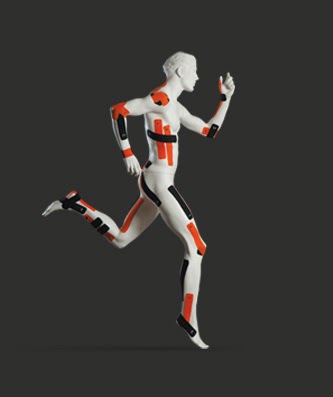
Tape man! (From the KT website.)
Fortunately, this claim is pretty easy to study, and multiple studies were done after the 2008 Olympics, looking at the possible benefits of athletic tape. A review of ten scientific studies published in the journal Sports Medicine in 2012 found little benefit. They reported that 
“The efficacy of KT [kinesio tape] in pain relief was trivial given there were no clinically important results.” 
Other studies looked at other effects, and for these the authors reported “KT had some substantial effects on muscle activity, but it was unclear whether these changes were beneficial or harmful.” Not a slam dunk for the benefits of kinesio tape, apparently.  

Tennis player Li Na was wearing the tape on her knee. What does the science say about tape for knee pain in particular? Here the evidence is not so clear. A small study last year by Marc Campolo and colleagues compared at Kinesio Tape® to another taping method called the McConnell Taping (MT) and to no tape at all. The difference between the tapes is that KT is elastic, while the MT technique uses rigid tape. This study found a small benefit for both types of tape on pain while climbing stairs or doing knee squats. This result is interesting, but the study only had 20 subjects, far too few to say anything conclusive. And it wasn't "blinded" - the subjects obviously knew they had tape on their knees. So they might have been telling the scientists what they wanted to hear, a common phenomenon in these types of studies.

Of course, the company that sells KT tape is not nearly so careful in their claims. Their website says:
“KT TAPE is lightweight, comfortable to wear, and can be used for hundreds of common injuries such as lower back pain, knee pain, shin splints, carpal tunnel syndrome, and tennis elbow, just to name a few.”
This is, to put it mildly, a bit of overstatement.  As the recent review article stated, when it comes to pain relief, the evidence shows “no clinically important results.”

There are a remarkable number of studies looking at various kinds of taping for joint or muscle problems, but the evidence is, on the whole, weak at best. My reading is that elastic tape probably has no more than a placebo benefit. But in sports, a placebo benefit can be significant: if you think it helps, it might really help.  

And think of the other benefits: KT tape comes in lots of cool colors, and for just a few bucks, you’ll look like a pro. A women's pro, that is: I didn't see any tape on Rafael Nadal or Stanislas Wawrinka in the men's final. Maybe that's because removing a big piece of tape from a hairy leg has got to hurt.

The Physics of Golf

[Herman Erlichson was a physicist and a historian of science (he had Ph.D.s in both). He was also an avid golfer, and he was my uncle.  He passed away just over a year ago, and I've been wanting to write this column ever since.  We corresponded frequently when I was a teenager, in a time when hand-written letters were still common.  Here is a small anecdote.]

Everyone who plays golf knows that the driver hits the ball the farthest of any club.  It also has the lowest launch angle, or "loft."  Clubs with high loft, such as a sand wedge, pop the ball very high up in the air, but don't hit it very far.

The universe of people who both play golf and also know college-level physics may not be very large, but everyone in this club has puzzled over this conundrum: why is it that a driver has a loft of only about 10 to 12 degrees?  That seems far too low.

Exactly 30 years ago this month, my uncle Herman Erlichson figured this out.  It's the spin.

He published the answer in a serious physics journal [1], but I'm guessing that most golfers don't read physics journals.  So here is what he found.

Everyone in freshman physics learns that the optimal launch angle for a projectile - the angle that makes a ball fly the farthest - is 45 degrees, in a vacuum.  But in the game of golf, 45 degrees is the angle of a pitching wedge, which (as every golfer knows) hits the ball only a short distance, about half as far as a driver.

Now the physics calculation assumes that the ball is in a vacuum, but still: how come the presence of air makes the optimum angle so much lower?  Or as my uncle put it, in his classic understated style:
"The large discrepancy between the approximately 11 deg of loft for the golf driver club and the 45 deg maximum range angle for a vacuum was the motivation to begin a study of the question of maximum projectile range in the presence of air resistance, with particular application to the flight of a golf ball." [1]
The analysis itself is technically very complex, involving 3 forces: gravity, drag (resistance caused by air friction), and lift, caused by the backspin on the ball.  All three are big factors, but the theoretical result of 45 degrees only accounts for gravity.  

Air friction (or drag) turns out to have a quadratic effect, as my uncle showed.  In other words, the drag increases in proportion to the square of the velocity of the ball.  So hitting it harder causes a very rapid increase in drag.  Here's his graph showing how the angle is affected by quadratic drag:
One consequence of "quadratic drag" is that hitting the ball a lot harder only yields a modest increase in distance.  More important, though, is that if we just consider gravity plus drag, the best angle to launch a golf ball is 35 degrees.  Lower than 45, but still nowhere near the angle of a modern driver.  And the distance here is still too low, only 336 feet (112 yards).

My uncle Hymie figured out that backspin makes a huge difference. Backspin generates lift, keeping the ball in the air much, much longer.  My uncle derived equations that allowed him to calculate how the lift force increases with the rate of spin and the speed of the ball.  This produced a very different picture of how far the ball would carry at different angles, shown here:
After accounting for lift, the optimum angle is 16 degrees, and the ball flies about 200 yards.  (This assumes a typical launch speed by the standards of 1983. The much longer drivers used today create a much greater speed off the tee.)  The remaining different between the actual loft of 10-12 degrees can be explained by the fact that for a drive, the teed-up ball is struck just past the bottom of the swing. This makes the launch angle slightly higher than the loft of the club.

There you have it: when you account for all the forces at play, the optimum angle for a golf driver really is around 10-12 degrees.

My uncle Herman Erlichson loved the game of golf and played often, despite having a seriously weakened leg, the after-effect of a polio infection that he contracted in the 1950's.  He might have struggled to master the game itself, but when it came to the physics of golf, he solved a mystery that had puzzled physicist-golfers for decades.

Reference
H Erlichson. American Journal of Physics 51:4 (1983), pp. 357-362.

For all 95 of Herman Erlichson's scholarly papers, including his paper on the physics of golf, see his Google Scholar page.

Test your kids' genes for sports ability: hype or reality?

A company called Sports X Factor recently announced that it's selling a genetic test that will reveal your potential to be a sports star. They're marketing it as a way to predict what sports your kid will excel at. Is this real, or just another over-hyped attempt to cash in on parents' aspirations for their children?

Sports X Factor, which sells the test for $180, stated in a press release a few weeks ago that the test
"can make workouts more effective, children’s sports choices more appropriate and trainers’ awareness of potential risk factors more precise. It can even save a life."
Wow, sounds impressive. But is it true?

In some ways, this is nothing new. Another company, Atlas Sports Genetics, started offering a similar test in 2008. They make similar promises, claiming that their test
"Gives parents and coaches early information on their child’s genetic predisposition for success in team or individual speed/power or endurance sports."
Unlike some of the rank pseudoscience I often blog about, this claim actually has some real science behind it. Back in 2003, Kathryn North and colleagues at the University of Sydney published a paper in a leading genetics journal about a gene called ACTN3. They found that mutations in this gene were associated with elite sprinters, both male and female. Superficially, it's easy to take this association and turn it into a "speed gene," but it's not.

The science is much more nuanced. (Isn't it annoying when things aren't so simple?) ACTN3, which affects muscle fibers, has three common genotypes. Let's call them Red, White, and Blue.* Elite-level sprinters are usually Red or White: 92% of male sprinters and 100% of female sprinters in the original study were one of these. In the general population, 30% of people are Red and 52% are White. For elite endurance athletes, there tendency is the opposite: slightly more of them are Blue, but the difference isn't significant.

The advice from Atlas Sports Genetics is a gross over-generalization of the science. Here's how they interpret the test results:
Blue: Predisposition to endurance events
White: Equally suited for both endurance and sprint/power events
Red: Predisposition to sprint/power events
The science simply isn't this clear. The only thing you might say is that Blue genotypes are not likely to be Olympic sprinters. But that's true of 99.999% of us anyway. There's no "predisposition" to particular sports.

The newer test from Sports X Factor looks at 9 genes, not just ACTN3. Although a broader test might sound superior, the genes they test include ApoE4, which is associated with a slightly higher risk of Alzheimer's disease. This raises serious ethical questions. Do you really want your child to know that he/she might be pre-disposed to Alzheimer's? As Hank Greely, a Stanford lawyer and bioethicist, said in the Washington Post, “I think this company is a good advertisement for the need for more regulation of genomic testing,”

I suggest that parents save their money, and instead take a test that I'm offering right here, for free, to determine your child's sports potential. Just follow these two easy steps:
  1. Ask your child, "do you want to play soccer?"
  2. If the answer is yes, sign your child up for a kids' soccer team.
Wasn't that easy? And it works for almost any sport! Just replace "soccer" by your kid's favorite sport. Oh, and then you have to go to the games. That's the hard part.

*For science geeks only: the genotypes Red, White and Blue are RR, RX, and XX respectively. The mutation is R577X, where the X is mutation that introduces a premature stop codon at position 577 that shortens the ACTN3 protein. RR means that both copies of the protein are full-length. RX means one copy is shortened, and XX means both are. About 18% of the population is XX ("Blue").