Showing posts with label Russia. Show all posts

A new Russian Covid-19 vaccine looks promising, but did they fabricate some of their data?

Last week, a team of Russian scientists published the results of two phase 1/2 vaccine trials for a new Covid-19 vaccine developed in Russia. The study appeared in The Lancet, one of the world’s leading medical journals.

This vaccine has already received tremendous attention after Russian leader Vladimir Putin announced they would start administering it widely, before any phase 3 trials were under way. As I wrote last month, it’s not a good idea to skip these Phase 3 trials.

Nevertheless, the results from the early stage trials of both vaccines look quite good. Although the trials were small, with just 76 subjects, 100% of the subjects had a strong antibody response, and none of them had anything more than mild reactions to the vaccine. This suggests that both vaccines might be effective, although it’s too soon (after just 76 people) that it will be safe on a large scale.

There’s another problem, though.

Within 3 days of the paper’s publication, Enrico Bucci from Temple University described a series of apparent duplications in the figures presented in the Russian paper. He published his findings on his website as a “note of concern” that dozens of other scientists have signed.

I’ve read the paper and looked at all the figures, and it’s clear that something is wrong with the data.

Let’s look at one example to see what is going on. Here’s a small part of Figure 2A from the paper:
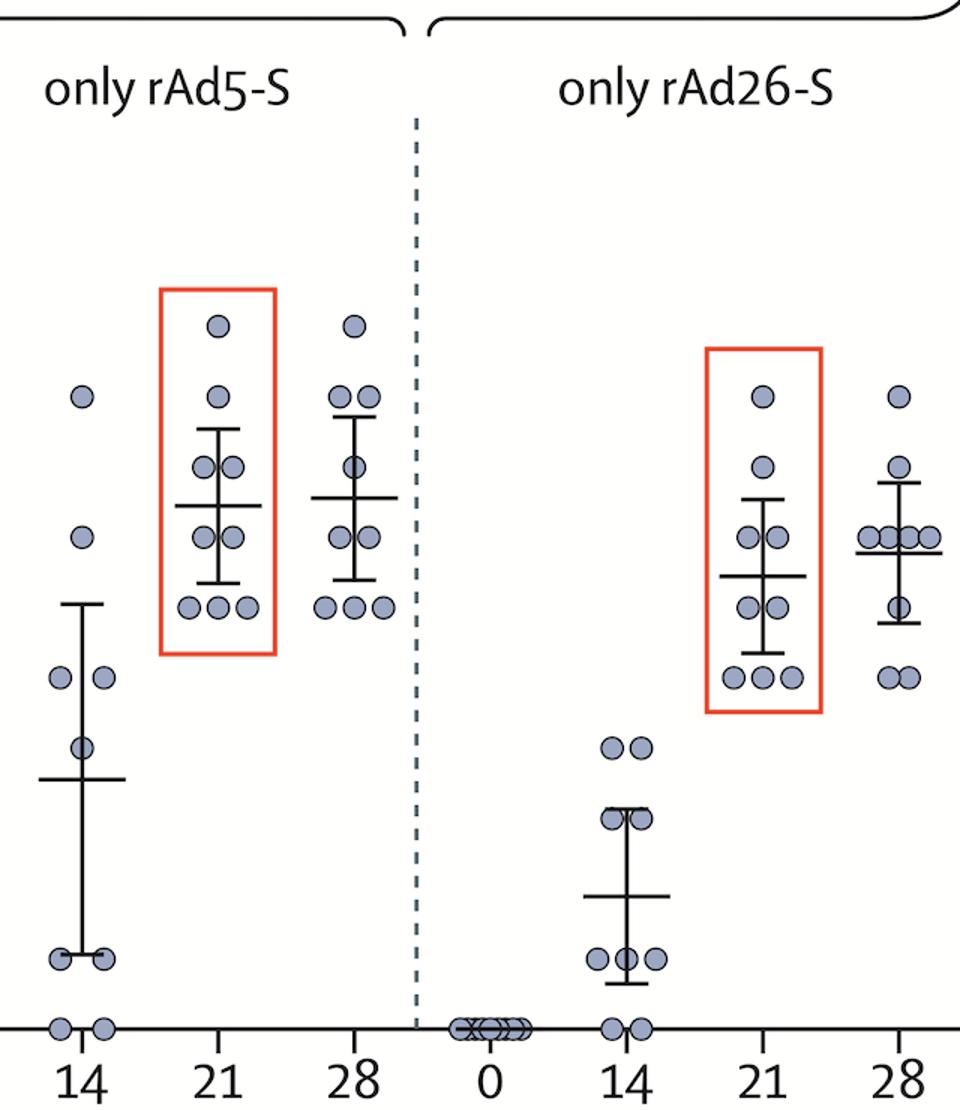
Each little column of dots shows a distinct group of 9 subjects, where the height of a dot indicates the level of antibodies found in that subjects. Notice that the 9 subjects in the red box (boxes added for emphasis) on the left have an identical pattern to those in the box on the right. These are completely independent subjects, and such a pattern is exceedingly unlikely.

It’s possible that this happened by chance, but then the problem is that this isn’t the only apparently duplication. Prof. Bucci identified at least 13 instances where sets of results are identical or near-identical between two different time points or two different sets of subjects. The other duplications look a lot like the one shown here.

The simplest explanation is that the data for some of the experiments were simply copied over from other experiments. As reported in The Moscow Times, the lead author of the study, Denis Lugonov, said there were no errors in the data. Because the authors of the Russian study didn’t provide their raw data, and The Lancet didn’t require it, other scientists can’t really check.

What are we to make of this? The details of the study are clearly explained, and the Russian vaccines use a design (an adenovirus modified to contain the SARS-CoV-2 spike protein) that is similar to other vaccines that so far seem safe and effective. Thus it’s quite possible that this vaccine will work–and it will be good for the world if it does. But the questionable data raise questions about whether the scientists behind this phase 1/2 trial have really done all of the experiments that they describe. The study concludes by noting that a phase 3 clinical trial with 40,000 participants is planned. Let’s hope that one yields positive–and genuine–results.

[Hat tip to Retraction Watch for drawing my attention to this study.]

Russian homeopathy, hiding in plain sight

It turns out that Russia has its very own brand of bogus medicine:"release-active drugs," or RADs. Dozens of scientific articles have been published claiming that these substances can be used to treat or cure a remarkably broad range of illnesses, including:
"... influenza, hemorrhagic fever, meningococcal meningitis, herpes, HIV, diabetes, erectile dysfunction, sleep disorders, obesity, chronic inflammatory joint diseases, attention deficit hyperactivity disorder, ..., alcoholism, allergies, and many other health problems." 
If this sounds too good to be true, that's because it is.

Thanks to a new report published in the journal BMJ Evidence-Based Medicine (provocatively titled "Drug discovery today: no molecules required") we now know that RADs aren't drugs at all, because they don't actually contain anything. As the new study reveals,
"The problem [with RADs] is that typical dilutions of the active ingredient are so high (from 1:1024 to 1:101991) that no molecules of the initial antibodies should be present in the ‘drug’ itself."
In other words, RADs are simply homeopathy by another name. As I've written many times before, homeopathy is one of the most patently absurd forms of pseudoscience, and although it's been debunked countless times, it remains popular due in part to commercial interests that profit handsomely from selling ineffective but expensive sugar pills.

RADs are produced by a single Russian company, with the odd name "OOO NPF Materia Medica Holding." The papers promoting the benefits of RADs are authored by a variety of Russian authors, but they are nearly all co-authored by or associated with one person, Oleg Epstein, who is also the company's founder.

Epstein and his Russian compatriots have been very clever about disguising the fact that their "release-active drugs" aren't drugs at all. Their papers are full of scientific jargon, which has no doubt helped them get their work past reviewers who (as every scientist who has published papers knows) can sometimes be a bit lazy.

They've also taken advantage of–one might say abused–the U.S. clinical trials system, ClinicalTrials.gov, by registering 22 studies of RADs there, such as this one.

The authors of the BMJ report (Alexander Panchin, Nikita Khromov-Borisov, and Evgenia Dueva, all Russian, though Dueva is based in Canada) are unsparingly blunt in revealing how Epstein has manipulated the scientific system in Russia to gain approval (and lucrative sales) of his so-called drugs. For example, Epstein has published 90 papers on RADs in a single journal, including 48 in a special issue that he edited himself.

Panchin and colleagues also took a closer look at 6 papers about RADs that were published in English-language journals, all co-authored by Epstein. They report that
"the articles contained misleading descriptions of active substance concentrations, severe flaws in study design and methodology, as well as concealed conflict of interests.... the authors did not mention that MMH manufactures and sells RADs and holds the corresponding patents. Epstein was not mentioned as the founder and CEO of MMH."
They contacted all of these journals, and only one journal, PLoS ONE, went so far as to retract the bogus science on RADs. Kudos to PLoS ONE for doing so. The other journals, some of them published by reputable scientific publishers including Elsevier, Wiley, and Springer, either didn't respond or refused to take action.

Fortunately for consumers, RADs haven't yet spread into U.S. and European markets, although their manufacturers are trying. In a recent letter published in a the Journal of Medical Virology, Epstein and his co-authors write that
"Currently we are in the process of approving evaluation requirements for our products, taking into account their peculiarities and allowing their potential authorization in the USA and Europe."
Buyer beware. The Russian quacks are coming.

Putin muzzling science in Russia: a return to the Soviet era?

Vladimir Putin looking skeptically at a scientist.
In a surprising development this past week, Russia has notified all scientists at Moscow State University (MSU) that they must submit their research papers to the state security service before they will be permitted to publish them. Nature News reports that Russia is imposing this policy on universities and research institutes throughout the country.

Perhaps this should not be a surprise. Vladimir Putin has steadily imposed ever greater restrictions on the media, to the point where most Russians are not even aware that Russian-backed fighters shot down Malaysia Airlines Flight MH17 last year. This new move towards censorship is just one more step towards imposing Stalin-esque restrictions on all Russians. Requiring scientists to submit their manuscripts to the security services will severely cripple their ability to publish anything even remotely novel or interesting. Why take the chance?

Mikhail Gelfand, a prominent scientist in my own field of bioinformatics, told Nature that:
“This is a return to Soviet times when in order to send a paper to an international journal, we had to get a permission specifying that the result is not new and important and hence may be published abroad.”
Exactly: Putin is returning Russian to the bad old days of the repressive USSR, when the state controlled all media and ordinary citizens were afraid to speak. For now, a few scientists were willing to speak to Nature, but we shouldn't be surprised if even those voices are silenced in the future.

In a bit of absurdist theater, under the new policy Russian scientists who write their papers in English (as is commonly required for publication) must translate them into Russian, because the security service personnel (apparently) cannot read English. I doubt too that the Russian security services have the expertise to understand even a fraction of the papers that they are demanding to see.

Russia has a long history of scientific innovation across all fields of science, particularly mathematics and physics. Under the repressive Soviet regimes of Lenin, Stalin, and their successors, many Russian scientists fled to the West, where they could work without fear of being thrown into a gulag. The U.S. and Europe–and the world–benefitted greatly from their expertise.

Russia’s scientific output has been lagging in recent years, according to an article in Nature earlier this year. There have been a few bright spots, though, such as (in my own field) the recently-created Dobzhansky Center for Genome Bioinformatics at St. Petersburg State University, which has already published some outstanding papers. Now I wonder how long that new center will last.

Ironically, the famous geneticist Dobzhansky, after whom the new St. Petersburg institute is named, left Russia as a young man in 1927 and moved to the U.S., where he went on to do his groundbreaking work in evolutionary biology.

Putin’s obsession with power and control might be an opportunity for the rest of us. Here’s a call to Russian scientists: follow Dobzhansky’s example and come to the U.S. We may have our flaws, but you can publish your work freely, and you can even write a blog criticizing the leaders of your university, or your former university's football policy, or your political leaders.