Showing posts with label clinical trials. Show all posts

These new RNA vaccines are a triumph for science and medicine

This week the FDA approved a second vaccine against SARS-CoV-2, the virus that causes Covid-19. We now have two highly effective vaccines, one from BioNTech and Pfizer, and the other from Moderna. A third vaccine, from Oxford University and AstraZeneca, is very close to approval.

The two new vaccines, both based on RNA, are both remarkably effective. Below I’ll summarize some of the numbers, which have been published for the world to see.

This is a scientific triumph. Less than a year ago, no one outside China even knew this virus existed. The genome of the virus was first released in January, and within a few months scientists had designed the first vaccines. Clinical trials were launched immediately, and larger trials followed, leading us to where we are today: two new vaccines, tested and validated in tens of thousands of people, now being manufactured and shipped to billions.

For anyone who might be skeptical, or who just might want to know more, the test results are being published openly. The New England Journal of Medicine has a dedicated website with dozens of papers and audio summaries, including results from the large-scale (Phase 3) trials of the Pfizer vaccine.

Before getting into the numbers, let’s summarize what these two new vaccines are. (I wrote about this in July, if you want to read my previous explanation.) Both of them are RNA vaccines, which is itself a dramatic breakthrough. RNA vaccines have been discussed for years, but the technology was never employed for human vaccines until now.

Here’s how they work: our immune system (which is super-complicated, as Ed Yong explained in The Atlantic) recognizes microscopic invaders and destroys them. Once you’ve been infected with Covid-19, the immune system swarms over the viral particles and basically learns what they look like. SARS-CoV-2 has a protein all over its surface called “Spike,” so that’s what the immune system recognizes.

Once you’ve fought off the infection, the immune system remembers what Spike looks like. If you’re infected again, it can respond far more quickly, so you won’t get sick. This is what we call acquired immunity.

So for vaccines, the trick is to teach your immune system to recognize Spike. One way to do that is to manufacture lots and lots of the Spike protein, and put that in the vaccine (sort of–I’m greatly oversimplifying here).

But with modern genomics technology, we can use a different approach. Every cell in your body has machinery inside it to translate RNA into proteins. As soon as we had the SARS-CoV-2 genome, back in January, we knew the genetic code for Spike. So rather than make the protein, what if you just made the RNA, which is far easier and faster to manufacture, and injected that into people? Do our own cells then translate the RNA and make the Spike protein?

Well yes, they do. And not only that, but–as the Modern and Pfizer clinical trials have now proven–our immune system recognizes that the Spike protein is foreign (it’s complicated) and launches an attack.

So to make an effective RNA vaccine, you simply have to inject enough RNA so that the immune system responds. That’s what both the Modern and BioNTech/Pfizer vaccines have done.

Now let’s look at the numbers. As reported in NEJM just two weeks ago, the Phase 3 trail for the Pfizer vaccine tested 43,448 volunteers, of whom 21,720 got the vaccine and 21,728 got a placebo. At the time of the report, 162 people who received the placebo had become sick with Covid-19, but only 8 people in the vaccine group got sick. That’s a 95% reduction in illness, a remarkably good result. They also reported that 10 people had “severe” illness, and 9 of those ten were in the placebo group.

How about the Moderna vaccine? This vaccine has almost identical efficacy, published in a preliminary report a few weeks ago as 94.5%. Just a few days ago, an FDA review panel approved the vaccine and confirmed that its efficacy was above 94%. And the Modern vaccine doesn’t need the super-cold freezers that the Pfizer vaccine needs, which makes it easier to distribute.

Both vaccines have minimal side effects in most people, mostly soreness at the injection site, and sometimes headaches or chills, which subside within a day. RNA is quickly degraded in the body, so there’s no reason to expect any lingering side effects from these vaccines.

There’s also growing evidence that immunity lasts for many months, if not years. Another report in NEJM, on the Moderna vaccine, contains some of the latest data, which shows that immunity is still strong after 4 months. Of course, with a brand-new vaccine, we simply have to wait to see if the immunity lasts for years, but all signs are positive right now.

So yes, these are really good vaccines. I will get mine as soon as I can, although I expect I’ll have to wait several months because of short supply.

(The Oxford/AstraZeneca vaccine, a more traditional protein-based vaccine, has also shown positive results, either 62% or 90%, depending on the dosage regimen, but the 90% results are based on fewer cases. Even so, it is clearly effective and it should be approved soon, at least in the UK. So we might soon have 3 vaccines.)

A note to anti-vaxxers: no, you cannot catch Covid-19 from these vaccines. They don’t contain the virus! They only have a fragment of RNA from one protein, and the virus has RNA that encodes 28 other proteins. It’s simply impossible for the virus to self-assemble without the rest of its genome.

But hey, if you don’t want the vaccine, go to the back of the line. Most of the world is desperate for it.

The success of RNA vaccines is a huge win for science, but even more, it’s a huge win for the human population. We’re still many months away from vaccinating the whole world, but with two highly effective vaccines, we can finally have hope to end this pandemic.

New Alzheimer's disease treatment fails, then works, then fails again


 Alzheimer’s disease is one of the most devastating conditions of old age. By recent estimates, more than 5 million people in the U.S. have Alzheimer’s, and managing the disease will cost over $300 billion in 2020. As the population ages, this problem is growing worse, and yet we still have no effective treatment.

You might have seen rosy-looking ads for Alzheimer’s treatments, but nothing really works, not yet at least. That’s why many people were excited about the possibilities of a new drug, aducanumab, that showed early signs of being able to reduce the accumulations of “plaques” in the brain.

Background: in people with Alzheimer’s, a protein called beta-amyloid accumulates in the brain, forming plaques that seem to disrupt brain function. (This hypothesis is not fully proven, but it is widely considered credible.) Thus one way that we might treat Alzheimer’s would be to reduce or eliminate beta-amyloid plaques. That’s what Biogen’s new drug, aducanumab, is intended to do.

Biogen has run two separate trials, called “EMERGE” and “ENGAGE,” to test whether or not aducanumab (ADU for short) worked.

Here’s where things get murky. Back in March of 2019, both trials were halted due to “futility,” because ENGAGE was showing no benefits for the new drug. In EMERGE, the high-dose patients seemed to be getting some benefit, but Biogen had specified ahead of time that if either trial was failing, that would mean the drug wasn’t working. Thus they halted the trials, disappointing as it was.

Fast forward to October of 2019, though, and Biogen had a new story. They went back and looked at a subset of the patients in ENGAGE (the study that had failed), and said that there was a benefit after all, if they looked only at the high-dose patients. This past July, Biogen went to the FDA and applied for approval for ADU.

Just this past week, two very conflicting announcements about ADU appeared. First, on Wednesday, the FDA’s internal scientists released a very rosy report, saying that the data from one of the trials were “robust and exceptionally persuasive.” For the second trial, the scientists said that even though the drug initially seemed to fail, a closer review led them to conclude that overall, ADU did provide a benefit.

Biogen shares rose 45% that day, adding $17 billion to the company’s value.

Then on Friday, a panel of independent, external scientists released their conclusions, which resoundingly rejected the drug. The external panel said that the data from the two trials was unconvincing, and they pointed out “multiple red flags” in the analysis.

(Trading in Biogen stock was halted during the Friday meeting, but at the end of the day it was close to the high it reached on Wednesday.)

So what happened? It appears to be a classic case of cherry-picking: when the data from the ENGAGE study didn’t pan out, the company re-analyzed a subset of the data and found a more-positive picture.

That’s not really kosher, as explained by a separate group of scientists in a paper published just a few days ago in the journal Alzheimer’s & Dementia. In this paper, David Knopman and colleagues, from the Mayo Clinic and Stanford Medical School, analyzed data that Biogen has released from its two trials. (The trials haven’t been published, but some of the findings were released in a publicly-available slide presentation that the authors relied upon.)

Knopman and colleagues explained that after two conflicting trials, there simply isn’t enough evidence that ADU works, and they also offer alternative explanations for the positive findings. They argue that the best Biogen can do is to “perform another trial of high‐dose ADU of at least 78‐weeks duration,” which could determine whether or not the positive results were real or just coincidence.

It’s somewhat mysterious that the FDA’s internal panel released their rosy report about ADU on Wednesday, only to be slapped down just two days later by an independent outside panel of scientists. After reading the negative views of the external panel and the analysis in the paper by Knopman and colleagues, I’m very skeptical that ADU has any clinically significant effect. If it had a truly robust effect, it simply wouldn’t be so hard to tease it out.

So we still don’t have a good treatment for Alzheimer’s, but the world still needs one.

A new Russian Covid-19 vaccine looks promising, but did they fabricate some of their data?

Last week, a team of Russian scientists published the results of two phase 1/2 vaccine trials for a new Covid-19 vaccine developed in Russia. The study appeared in The Lancet, one of the world’s leading medical journals.

This vaccine has already received tremendous attention after Russian leader Vladimir Putin announced they would start administering it widely, before any phase 3 trials were under way. As I wrote last month, it’s not a good idea to skip these Phase 3 trials.

Nevertheless, the results from the early stage trials of both vaccines look quite good. Although the trials were small, with just 76 subjects, 100% of the subjects had a strong antibody response, and none of them had anything more than mild reactions to the vaccine. This suggests that both vaccines might be effective, although it’s too soon (after just 76 people) that it will be safe on a large scale.

There’s another problem, though.

Within 3 days of the paper’s publication, Enrico Bucci from Temple University described a series of apparent duplications in the figures presented in the Russian paper. He published his findings on his website as a “note of concern” that dozens of other scientists have signed.

I’ve read the paper and looked at all the figures, and it’s clear that something is wrong with the data.

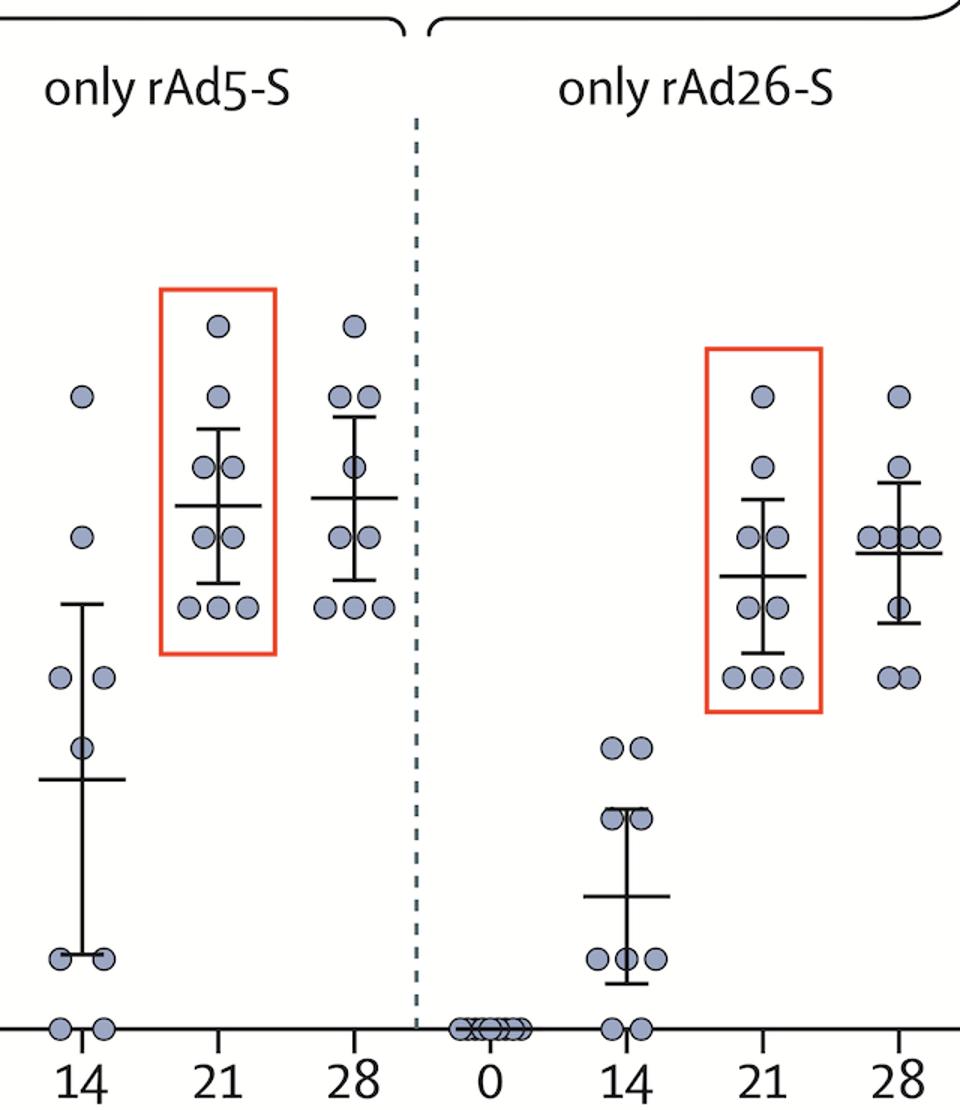
Let’s look at one example to see what is going on. Here’s a small part of Figure 2A from the paper:

Each little column of dots shows a distinct group of 9 subjects, where the height of a dot indicates the level of antibodies found in that subjects. Notice that the 9 subjects in the red box (boxes added for emphasis) on the left have an identical pattern to those in the box on the right. These are completely independent subjects, and such a pattern is exceedingly unlikely.

It’s possible that this happened by chance, but then the problem is that this isn’t the only apparently duplication. Prof. Bucci identified at least 13 instances where sets of results are identical or near-identical between two different time points or two different sets of subjects. The other duplications look a lot like the one shown here.

The simplest explanation is that the data for some of the experiments were simply copied over from other experiments. As reported in The Moscow Times, the lead author of the study, Denis Lugonov, said there were no errors in the data. Because the authors of the Russian study didn’t provide their raw data, and The Lancet didn’t require it, other scientists can’t really check.

What are we to make of this? The details of the study are clearly explained, and the Russian vaccines use a design (an adenovirus modified to contain the SARS-CoV-2 spike protein) that is similar to other vaccines that so far seem safe and effective. Thus it’s quite possible that this vaccine will work–and it will be good for the world if it does. But the questionable data raise questions about whether the scientists behind this phase 1/2 trial have really done all of the experiments that they describe. The study concludes by noting that a phase 3 clinical trial with 40,000 participants is planned. Let’s hope that one yields positive–and genuine–results.

[Hat tip to Retraction Watch for drawing my attention to this study.]

Clinical trials doctors claim they own patients' data, want others to pay for access

Image from "Honoring our promise: clinical trial data sharing"
at the NIH Director's blog.
Earlier this month, a consortium of 282 clinical trials doctors, in an article in the New England Journal of Medicine, threw down the gauntlet against the notion that they should share data. Under the misleading title “Towards fairness in data sharing,” these scientists, who label themselves The International Consortium of Investigators for Fairness in Trial Data Sharing, put forward the breathtakingly arrogant claim that doctors who collect data from patients should control it essentially forever.

I wonder what their patients would think if they knew.

This is the second salvo from NEJM this year. Back in January, the editors of NEJM published an opinion piece that used the derogatory phrase “research parasites” to describe scientists who want to re-analyze data from other scientists’ experiments. This caused an outcry, with many scientists pointing out serious flaws in the editors’ arguments. As I wrote at the time,   
“Drazen and Longo [the NEJM editors] are saying, essentially, that only the people who originally collect a data set can truly understand it, and anyone else who wants to take a look is a parasite.”
Keeping scientific data locked away is a recipe for bad science. In the absence of data sharing, flawed results may go unchallenged for years. If someone has distorted or misinterpreted data, we need someone else–someone not invested in proving the same result–to take a second look. This is how science corrects itself.

Even so, at least Drazen and Longo endorsed some data sharing. The authors of this new article (P.J. Devereaux, Gordon Guyatt, Hertzel Gerstein, Stuart Connolly, and Salim Yusuf, all from Ontario’s McMaster University) and their consortium are vehemently opposed to sharing their data with anyone, ever.

Let’s go through their arguments. First, they point out that it takes years of work to set up and run a clinical trial. Absolutely right–no argument there. But then they explain why they conduct these trials:
“A key motivation for investigators to conduct RCTs is the ability to publish not only the primary trial report, but also major secondary articles based on the trial data. The original investigators almost always intend to undertake additional analyses of the data and explore new hypotheses.”
Oh really? This is why they run clinical trials, in order to publish papers? Somehow I doubt that is what they tell the patients as they are asking for informed consent. Not “we want to figure out what is making you sick” or “we want to find a cure”, but “we want to publish a paper, or maybe several papers!” I’m sure that patients would be lining up around the block to join these studies.

Don’t get me wrong: of course the scientists want to publish their findings, and of course they would like to mine the data for more papers, year after year. That’s what some investigators do now. In this world, doctors running clinical trials would never share data. Why would they, when things are working so well for their careers?

But they seem to have forgotten THE motivation for clinical trials: curing disease. I am honestly dumbfounded that Devereaux and his colleagues don’t mention the words “disease” or “illness” in their article, not even once. Instead they focus on “risks” of sharing data, by which they mean the risk that someone else will make a discovery that they didn’t think of, versus the “benefits,” which in their world means either confirming the original study or possibly testing a new hypothesis. They seem oblivious to the notion that re-analyzing the data to contradict the original claims might actually be a benefit to the rest of the world.

Appalling. Did they feel this way when they first went into medical research? Probably not, but somewhere in the competitive struggle to succeed as researchers, they lost their way.

It gets worse. Devereaux and his consortium go on to lay out what they might be willing to consider:
  • Exclusive use of the data for a minimum of 2 years after the first publication
  • Another 6 months of exclusivity for every year the trial lasted, up to 5 years of exclusivity
  • Anyone who wants the data should pay the original investigators “for their efforts and investments in the trial.”
This last point is the most outrageous of all. Hello? Investigators in clinical trials are already paid for their efforts (though the patients are not), often totaling millions of dollars, and often from taxpayers’ money. Now they want to be paid again by each scientist who wants to look at the data?

These guys need to get over it. The reason we fund clinical trials is to cure disease, not to allow Devereaux and company to publish papers. Publication is the means by which we communicate results, but it’s not the reason that anyone pays for the experiments.

Interestingly, in the same issue of NEJM, U.S. Senator Elizabeth Warren writes about data sharing, expressing quite the opposite view from Devereaux and company. I won’t attempt to summarize her points here, but instead let me quote from one of the public comments published in response to the anti-data-sharing doctors:
“ `This is not working. I just hope that my death will not be in vain and someone learns from it so that others don't have to go through this’ was what my husband said when it became clear that the new drug combination was not working fast enough for us…. My husband died now more than 4 years ago. I have watched his and others' lives been plotted on curves at conferences like ASCO or EMSO and it is deeply upsetting that there are more than 280 researchers who are more concerned about their own careers than the lives of the patients on whom those careers are built. Claiming rights to data paid for with the lives of others has nothing to do with fairness.” Bettina Ryll, M.D., Ph.D., Melanoma Patient Network Europe
I couldn’t say it any better than that. The International Consortium of Investigators for Fairness in Trial Data Sharing–as the 282 investigators called themselves–should be ashamed.

Crestor gets an undeserved boost from the FDA

The FDA planted a big, wet sloppy kiss on AstraZeneca this week. An FDA scientist told reporters that the benefits of Crestor, a cholesterol-lowering drug, outweighed the risks even for otherwise healthy people. Essentially, millions of healthy people with normal cholesterol levels could find themselves taking Crestor, if they listen to this anonymous FDA scientist and to Crestor’s manufacturer, AstraZeneca. This new recommendation was widely reported on Friday, appearing in the Wall St. Journal, in a widely carried AP report, and in a more skeptical Reuters report.

The new report isn’t based on anything new, though. It’s based on a study published a year ago – a seriously flawed study that I dissected at length on this blog in November 2008. The FDA took a year to review this study and then said yep, we agree. I should mention that the 2008 study has one condition before recommending Crestor: that the patients should have elevated levels of C-reactive protein (CRP). I described in earlier blog post the problems with this recommendation – including the fact that they study’s leader has a patent on the CRP diagnostic test.

Does it matter that, as I explained a year ago, the study was funded by AstraZeneca? How about the fact that this huge study found only a tiny benefit? That’s right: the benefit is so small that you’d have to treat 95 patients for 2 years in order to prevent one heart attack. As I wrote last year, and as others have pointed out, when the number needed (NN) to treat is over 50, the result is probably just statistical noise. Or to put it another way, if you take Crestor for 2 years, you have about a 1% chance of getting any benefit. Compare that to, say, taking vitamin C to treat scurvy, where the NN is about 1. With any decent drug, if you take it, you should have a very high likelihood of benefit.

We know who’s going to benefit here: AstraZeneca. Does it matter to them that there is a significantly higher risk of diabetes in people who take Crestor? There was also a higher number of deaths in the placebo group caused by gastrointestinal disorders, but the FDA dismissed this number because it didn’t reach statistical significance. (Kudos to the WSJ and Reuters reporters for highlighting these problems.) And no one besides me (see my Nov 2008 blog post) seems to have noticed some of the other problems with the study, such as the fact that the placebo group contained an excess in the number of patients with conditions that raise the risk of heart disease.

Does it matter that, as the FDA reported in 2005, “Rhabdomyolysis (serious muscle damage) has been reported in patients taking Crestor as well as other statin drugs.” Or that, as the same report said, “Kidney failure of various types has also been reported in patients treated with Crestor as well as other statins”?

So who the heck are these FDA scientists? After considerable searching, I found the lengthy FDA report here. It’s a “briefing document” for a FDA advisory committee that will meet on Dec. 15. It basically reviews the study in great detail and simply repeats the study results. What became clear to me once I downloaded the document, though, was that it was written by AstraZeneca! [Note: thanks to the first commenter on this blog, I also found the separate FDA-sponsored document - see comments.]

The reports from the AP, Reuters, and the WSJ I cited above mention an anonymous FDA reviewer, but apparently this “reviewer” did not want to be named on the record. It's too bad none of the reporters revealed the name of this anonymous FDA scientist, but the roster of the FDA panel reviewing Crestor is here.

It’s a shame that the FDA’s own scientists can’t take a more critical look at the evidence. Look for AstraZeneca stock to go up next week. Let me close with a video from Stephen Colbert, who had a great skeptical spoof of this last year on his show. Skip forward to about the 2-minute mark in this video to see the Crestor segment.

The Colbert ReportMon - Thurs 11:30pm / 10:30c
Cheating Death - Women's Health
www.colbertnation.com
Colbert Report Full EpisodesPolitical HumorU.S. Speedskating


As Stephen says in the video, "this is a great breakthrough in the battle to find things to prescribe to people who don't need them".

Nice.

Parents: ADHD drugs don’t work

If you want to start an argument, try telling a parent – any parent – how to raise their kids. So I'm going to preface this by saying that I'm just trying to make parents aware of something that might concern them. One of the most controversial issues among parents of school-age children today is the shockingly large number of children who are being treated with drugs to control their behavior, especially those children who have been diagnosed with attention-deficit hyperactivity disorder (ADHD). Now it appears that these drugs simply don’t work, except in the short term. The results of a scientific study reported this past week showed that long-term use of drugs to children with ADHD doesn’t provide any benefit over behavioral therapy. Not only that, but children who took medication ended up, on average, one inch shorter than children who didn’t. That’s right: ADHD drugs stunt children’s growth.

This seems to be rather shockingly bad news for the ADHD drug manufacturers. The news was reported on the front page of the Washington Post and in many other media outlets. The study, an 8-year followup of the Multimodal Treatment Study of Children With ADHD (MTA), was reported in the Journal of the American Academy of Child and Adolescent Psychiatry (JAACAP). The study divided children into 4 groups: medication (M), behavior therapy (B), both treatments (M+B), or no treatment. The authors of the study had reported in 1999 – with great fanfare – that children who received drugs (M and M+B) did better than children who only had therapy (B) after 14 months and at 2 years followup. In other words, over the short term, the drugs seemed to work. As the Washington Post reported: “Because children given drugs alone appeared to do about as well as those treated with both drugs and talk therapy, the study skewed treatment in the direction of medication.”

However, over longer time periods, the drugs (including Adderall and Concerta, two of the most commonly prescribed drugs for ADHD) didn’t help at all – and they stunted growth. Children who took ADHD drugs for 3 years or longer were an average of one inch shorter than children who didn’t take drugs. The study looked at “grades earned in school, arrests, psychiatric hospitalizations, [and] other clinically relevant outcomes,” and found no differences in children given drugs compared to children given only behavioral therapy.

What should be even more disturbing is that this isn’t really news at all – it was reported two years ago, in 2007. The same authors reported then, in a 3-year followup study, that “treatment groups did not differ significantly on any measure at 36 months.” In other words, the benefits of drugs disappeared by 3 years after treatment started. Some of the scientists involved have downplayed these results, but one, William Pelham, was quoted in the Post saying his colleagues are “embarrassed to say they were wrong and we led the whole field astray.”

Another scientists leading the study, Peter Jensen, shot back that Pelham was biased against drugs. However, Jensen has been pushing drug therapy quite publicly for years. In the press release from the National Institute of Mental Health after the 2007 report, he said that “medication can make a long-term difference for some children if it's continued with optimal intensity.” This despite the fact that the 2007 results indicated that medication was not providing any benefit over behavior therapy, results that appear even stronger now. In contrast, William Pelham was already saying in 2007 that ADHD drugs were “all risk and no reward.”

It’s worth noting also that NIMH heavily promoted the initial results of this study back in 2000, and its website still states that “combination treatments as well as medication-management alone are both significantly superior to intensive behavioral treatments and routine community treatments in reducing ADHD symptoms.”

Reporter and blogger Maggie Mahar tried to draw attention to the story in 2007, but the U.S. media simply didn’t pick up on the story. Mahar also pointed out that “drug manufacturers have a serious interest in keeping the U.S. discussion on ADHD married to the medical-disease model.”

All of this made me wonder if Peter Jensen, who seems determined to continue to support the use of drugs to treat ADHD, might have ties to pharmaceutical companies. It took me only a few minutes to discover that he has received funding or grants from: UCB-Pharma, Cephalon, Novartis, McNeil Consumer & Specialty Pharmaceuticals, and Janssen Pharmaceutica. I found confirmation of these ties here. Novartis and UCB-Pharma are manufacturers of ADHD drugs (Ritalin or methylphenidate), and Cephalon makes Provigil, which they attempted to promote as an ADHD drug for years until the FDA rejected it.

Far too many of our children – primarily boys, who are diagnosed with ADHD 3-4 times more often than girls – are being medicated for ADHD. There is ongoing controversy, which I won’t get into here, over whether ADHD is grossly overdiagnosed. Whether ADHD is correctly diagnosed or not, though, it now seems clear that putting children on drug therapy might cause them long-term harm (stunting their growth) while only providing temporary, short-term changes in behavior.