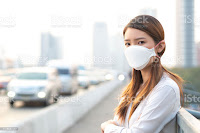
 The use of masks to prevent the spread of Covid-19 has been controversial almost since the beginning of the pandemic, two years ago.
The U.S. Surgeon General made a huge early blunder, in February of 2020, when he recommended against masks, tweeting that
“masks are NOT effective in preventing general public from catching #Coronavirus, but if healthcare providers can’t get them to care for sick patients, it puts them and our communities at risk!”
That self-contradictory tweet was later deleted, but it caused a tremendous amount of confusion. After all, if masks don’t work, then why is it so important that healthcare workers have them?
Masks do work. The evidence is overwhelming that masks, if properly worn, “substantially reduce exhaled respiratory droplets and aerosols from infected wearers and reduce exposure of uninfected wearers to these particles,” as described in a CDC publication last year.
The idea that masks should help prevent infections is intuitively obvious: Covid-19 spreads through the transmission of viral particles from an infected person. These particles travel through the air, as numerous studies have shown, just like many other infectious diseases. If you can stop the spread of the viral particles themselves, then (obviously) you stop the virus from infecting people.
However, evidence emerged early on in the pandemic that cloth masks and standard surgical masks were not very effective, because they allowed viral particles to leak out (and in). The SARS-CoV-2 virus is really tiny, and it can slip through the gaps in these masks.
In other words, some masks work better than others.
In June of 2020, a large study published in The Lancet reported that N95 masks were far superior at preventing transmission of Covid-19. That study found that “face mask use could result in a large reduction in risk of infection, with stronger associations with N95 or similar respirators compared with disposable surgical masks.” They reported an overall risk reduction of 85%, with N95 masks conferring a 96% reduction but surgical masks just 67%.
It’s easy to find studies showing how to make masks even more effective: make sure they fit very snugly, tightening them around the head or ears if necessary. Medical professionals who follow these guidelines have had very few infections, despite being exposed daily to sick patients. (Johns Hopkins Hospital, part of my own university, has reported almost no infections among its medical staff caused by exposure to patients.)
This all makes perfect sense. After all, if masks didn’t work, then doctors and nurses would have to be unbelievably self-sacrificing (even more than they are already) to treat Covid-19 patients. Fortunately, though, a properly worn N95 mask does an excellent job at protecting the wearer against infection.
One problem that often goes unmentioned, though, is that the better the mask, the harder it is to breathe. This too is pretty obvious: if you make it harder for tiny particles to get in or out, then of course it’s harder to breathe. Snug-fitting N95 masks are, simply put, uncomfortable.
Mask policies are the real problem. Even though masks work, getting millions of people to wear them, and wear them consistently and properly, is a far greater challenge. A casual stroll through any indoor space where masks are required–and we’ve all done this–will reveal many people whose masks don’t cover their noses, or whose masks are clearly very loose, or who might not be wearing masks at all, despite the rules.
Why don’t people wear their masks? This too shouldn’t be a mystery. Many people, young and old, simply don’t like being told what to do, so when a local government says they have to wear masks, they resent it. And governments (or large companies) have a habit of creating one-size-fits-all policies that are don’t make sense for some people. The simplest mask mandates (simplest to explain and enforce, that is) say that everyone should wear a mask all the time, or that everyone should wear a mask indoors.
For example, in Baltimore everyone has to wear a mask indoors, but restaurants are open. Thus diners must wear a mask from the entrance to their table, and then they can eat their dinner, mask-free, for as long as they wish. This doesn’t make much sense.
And what about people who are vaccinated and free from any Covid-19 symptoms? Nope, no exceptions, according to every mask mandate I’ve heard of. Naturally, that is frustrating to some people. No one should find this surprising.
In reaction to mask requirements, many people, particularly on the political right, have proclaimed that “masks don’t work.” While some of them might believe this–in which case they are just wrong–what they might really be talking about is masking policies, and in that sense they are right. If you can’t get nearly everyone to wear an N95 mask, then you can’t realistically control the spread of the virus.
We’ve seen how this works in the U.S.: despite widely varying mask policies, the Omicron variant has swept through every single state in the country, including those with strict mandates. Some places, like New York City, were hit earlier despite having fairly strict mask policies. States with no masking requirements and those that banned mask mandates (such as Florida, Georgia, South Carolina, and Tennessee), were hit later and just as hard.
One reason that masking policies don’t work–although masks themselves do work–is that it’s just really inconvenient to wear a mask all the time.
So people continue to wear masks badly, or to refuse to wear them at all. Does this mean we should give up? No, not exactly. But we might have to limit strict masking rules to places where truly vulnerable people are present, such as hospitals and senior care homes. Large-scale mask mandates are just not working, and there’s probably little we can do to change that in a free society.
A far, far more effective way to control the virus is through vaccination. As Eric Topol pointed out recently with an elegant graphic: “How to reduce your chance of dying from Covid by 99%? Get vaccinated and a booster.”
