Showing posts with label Fox News. Show all posts

Ivermectin doesn't work for treating or preventing Covid-19, even if your favorite FoxNews host says it does

Recently the world has been treated to a flood of misinformation about ivermectin, an anti-parasitic drug that some people thinks can treat or prevent the Covid-19 virus.

It can’t, but that hasn’t stopped a variety of Fox News hosts, including Sean Hannity, Tucker Carlson, and Laura Ingraham, from pushing it for months. As a result, prescriptions for ivermectin have increased like crazy. Here’s a chart just released by the CDC, showing the weekly number of prescriptions over the past two years:
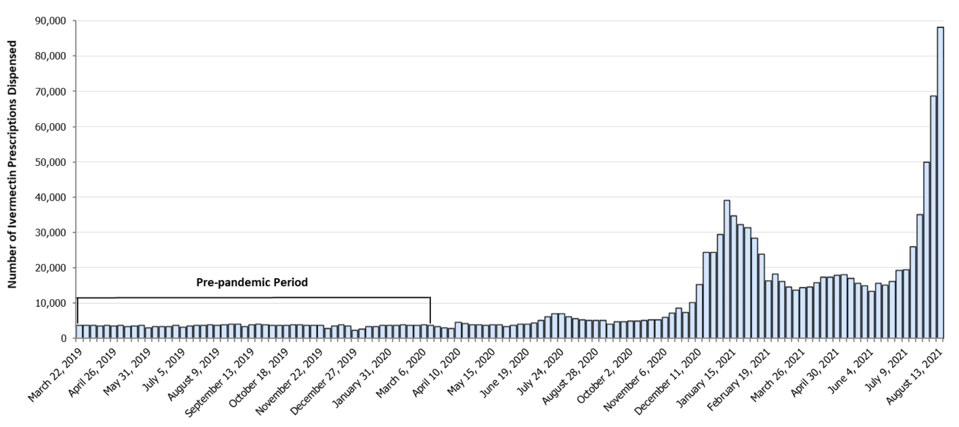
As you can see, the numbers shot up at the beginning of this year, to 40,000 prescriptions per week, and this past month they shot up again, to over 80,000 per week. All this ivermectin has had no effect at all on Covid-19 infections, which have continued to rise, but that hasn’t stopped people from desperately trying to get ivermectin.

Ivermectin doesn’t work. It doesn’t prevent Covid-19, nor does it treat it. Unfortunately, the official government response to this misinformation has once again failed to be blunt enough, with a few exceptions. More on that below, but first let’s review what the heck ivermectin is.

Ivermectin is used to treat two relatively rare (in the U.S.) parasites: a nematode called Onchocerca volvulus that causes river blindness, and an intestinal nematode called Strongyloides stercoralis. (Both of these are sometimes called worms, but they are microscopic in size, and unrelated to the worms that most people are familiar with.) Nematodes are not even remotely similar to viruses, and there’s no reason to think that a treatment for nematode infections will cure a virus–unless, apparently, a popular talk show host claims that it will.

Ivermectin also used for de-worming livestock such as cows and horses, which means that veterinarians carry supplies of ivermectin, often in very large doses. The veterinary form is available in a paste that you can feed to animals. This has resulted in a number of people buying and consuming large amounts of ivermectin–or, as one person put it, “eating horse goo from the tractor store.” This does not usually end well.

Here’s an example from the CDC’s latest health advisory:

An adult drank an injectable ivermectin formulation intended for use in cattle in an attempt to prevent COVID-19 infection. This patient presented to a hospital with confusion, drowsiness, visual hallucinations, tachypnea [abnormally rapid breathing], and tremors. The patient recovered after being hospitalized for nine days.

So: not good. This case and others prompted the FDA to tweet, in a rare instance of bluntness: “You are not a horse. You are not a cow. Seriously, y'all. Stop it.”

The FDA also issued a news release explaining why people should not use ivermectin to treat or prevent Covid-19, and especially not to use doses designed for large animals. It’s dangerous, as the case cited by the CDC illustrates.

Where did this interest in ivermectin begin? Just a couple of days ago, NBC News reporter Ben Collins put together an excellent Twitter thread explaining some of the recent history. One of the main sources was a sketchy group called America’s Frontline Doctors, which was founded by an anti-vaxxer named Simone Gold, who as Collins explained “spent the last year barnstorming churches and schools, insisting COVID vaccines cannot be trusted.”

Despite its name, America’s Frontline Doctors is most definitely not working on the “front lines” treating patients, but instead is a right-wing political organization known primarily for spreading Covid-19 misinformation. Last year they promoted hydroxychloroquine as a Covid-19 treatment, which didn’t work. More recently, they have been offering online consultations to people who wanted ivermectin. The consultations cost $90, which didn’t include the cost of the medicine, but they’d connect you to a pharmacy that would deliver it.

(Aside: in an interesting twist, Simone Gold has been indicted and is now awaiting trial for her role in the January 6 insurrection at the U.S. Capitol in Washington, D.C.)

So here we are: 80,000 prescriptions per week for a drug that doesn’t work for treating or preventing Covid-19. Above, I wrote that the government isn’t responding clearly enough to this misinformation: here’s what I mean by that.

Scientists and doctors are trained to speak very carefully and precisely to one another. So rather than saying “X is false” or “Y doesn’t work,” we say “we don’t have evidence that X is true,” or “the evidence doesn’t support the effectiveness of Y.” That’s all well and good when you’re speaking to another scientist, but the general public hears these statements as something more like “X might work but we are still looking at the evidence.”

Uh uh. Not a good way to talk to the public.

Now, there actually have been several studies of ivermectin as a treatment for Covid-19, and here’s where the story might get confusing–but I’m going to try to keep it really clear. Virtually all of the studies showed that ivermectin simply doesn’t work, but one study out of Egypt (by Elgazzar et al.) seemed to show that it worked quite well. That was really surprising, but the story collapsed pretty quickly: it turned out the data was falsified, and parts of the paper were plagiarised. About a month ago, the study–which was still an un-reviewed preprint, was retracted by the publisher, Research Square.

Making things more confusing, several meta-analyses have already been published that relied on the flawed Egyptian study, and some of those papers report that ivermectin is effective. But a meta-analysis doesn’t contain any original data; instead, it’s an analysis that combines the results from a bunch of other studies. Those positive findings from meta-analysis papers rely heavily on the falsified Egyptian study, and (it turns out) on another very flawed study. For a deeper dive into those, see this excellent breakdown by the epidemiologist (and journalist) Gideon Meyerowitz-Katz (@GidMK, aka HealthNerd), who posted a long Twitter thread detailing the reasons why these meta-analyses, and some of the studies they include, cannot be trusted.

So the scientific picture is already clear: multiple studies show that ivermectin does not work. But rather than saying that in simple, direct English, here’s what the CDC states in their August 26 Health Advisory:

“there are currently insufficient data to recommend ivermectin for treatment of COVID-19”

“Clinical trials and observational studies to evaluate the use of ivermectin to prevent and treat COVID-19 in humans have yielded insufficient evidence for the NIH COVID-19 Treatment Guidelines Panel to recommend its use”

“Be aware that currently, ivermectin has not been proven as a way to prevent or treat COVID-19.”

The FDA isn’t much better (except for that one tweet). In a consumer advisory with the title “Why You Should Not Use Ivermectin to Treat or Prevent COVID-19”, they write:

“The FDA has not reviewed data to support use of ivermectin in COVID-19 patients to treat or to prevent COVID-19; however, some initial research is underway.”

See what I mean? This is how you’d explain things to another scientist, but the general public needs much more direct language.

So I’m saying it here: ivermectin doesn’t work in any way for Covid-19. It doesn’t prevent infection, it doesn’t cure the disease, and it doesn’t reduce your risk of anything.

Or, as the FDA’s Twitter account so eloquently put it, “You are not a horse. You are not a cow. Seriously, y'all. Stop it.”

Fox News expert with mail-order degree blames “homosexual impulses” for Santa Barbara mass shooting

Robi Ludwig, media commentator
In the wake of the mass shootings by a disturbed man in Santa Barbara, California last week, Fox News featured comments from Robi Ludwig, a self-described psychotherapist, who blamed the shooting on the “homosexual impulses” of the shooter. Her comments caused an immediate firestorm, and a few days later, real estate company Coldwell Banker, for whom she consulted, announced “we feel it best to part ways with her as our lifestyle real estate correspondent.”

As Salon.com’s Sarah Gray pointed out, it is unethical to diagnose a patient whom you’ve never met. This didn’t seem to stop Ludwig, who also claimed that the shooter might have been in the early stages of schizophrenia. Ludwig later attempted to take back her comments on her Facebook page, claiming she was misunderstood.

Does it matter if Ludwig, who uses the title “Doctor” in all her media appearances, is a real doctor? It's presumably why we are supposed to take her seriously when she diagnoses a mass murderer on television.

The title of doctor also matters to the thousands of people who have spent years of study and research to earn a Ph.D. or an M.D. Robi Ludwig, it turns out, has neither. 

Ludwig previously hosted a reality TV show on TLC where she offered marriage advice. Her listing at Psychology Today shows “School: University of Pennsylvania” and lists her graduation year as 1990. Sounds legitimate, right? U. Penn is an Ivy League school; a doctorate from there is certainly impressive.

Her website reveals a different story.  Her “doctor” title, which she uses in every mention of herself and the name of the website itself (drrobiludwig.com), is based on a Psy. D. degree from Southern California University for Professional Studies, an online-only, for-profit correspondence school,  which changed its name in 2007 to California Southern University. 

Note to readers: an online degree is not a doctorate. Any online, for-profit college that claims otherwise, and this obviously includes Cal Southern, is just trying to fool people.

I’ve known hundreds of scientists and scholars who’ve put in the sweat equity required for a Ph.D.: years of course work, mastery of a specialized area of study, and additional years doing original research and writing a Ph.D. dissertation. The Cal Southern Psy.D. requires nothing more than course work - no dissertation required - and the courses are all online. This falls grievously short of a real doctorate. Taking a bunch of online courses at a third-rate online school does not earn one the right to be called “doctor.”

I checked the American Psychological Association’s site to see if the Psy.D. program at California Southern is accredited. It is not. (Very few Psy.D. programs, which are much less rigorous than Ph.D. programs, are accredited. Most clinical psychologists have Ph.D.s.)

In other words, “Dr.” Ludwig has a mail-order degree from an unaccredited program. Her undergraduate degree is from Cedar Crest College, a small women’s college in Pennsylvania. So how can her Psychology Today profile list the University of Pennsylvania as her only school? Apparently she does have a master’s in social work from U. Penn, but her undergrad and Psy.D. degrees are from far less prestigious institutions. Her Psychology Today profile also lists a license number, without saying what the license is for. Apparently it’s her license as a social worker, not as a clinical psychologist. 

Being called a doctor is obviously important to Ludwig. But it wasn’t important enough for her to spend the years of study required to get a Ph.D.

Let’s return to Ludwig’s Psychology Today profile. Does she claim to be a psychologist there? No: although she uses the title “Dr.”, she is listed as “Clinical Social Work/Therapist.” Psychology Today explains that 
“Clinical social workers commonly hold a master's degree in social work (or the equivalent) and have completed two years of supervised practice to obtain a clinical license. They may use a variety of therapeutic techniques, including psychodynamic therapy or cognitive-behavioral therapy.” 
So Ludwig is a licensed social worker who has an unaccredited Psy.D. from an online university. Not to criticize social workers, who provide valuable services to society, but they are not doctors.

Fox News probably doesn’t care that Ludwig isn’t a real doctor or a licensed psychologist, or what the “Dr.” in her title means. But that’s just a guess.

Having a Ph.D. is no guarantee of competence. Plenty of people with Ph.D.s make stupid comments on television, especially when they are spouting off about subjects outside their expertise. But the Ph.D. degree does mean something, which is why so many people work so hard to earn them. But an online Psy.D. degree from California Southern University isn’t even remotely comparable to a Ph.D. If Ludwig wants to earn the title Doctor, she has a long way to go.

How to predict an election? Ask the math geeks.

Mark Newman's rendering of the 2012 U.S. election,
 weighted by population

It's time for a bit of gloating.  No, not for Democrats over Republicans, though I'm sure that's going on.  It's time for the math geeks to throw a bit of scorn at those insufferable, over-confident frat boys who call themselves political prognosticators, and who spent most of the past two years telling us that they knew how the election would turn out.  They bloviated endlessly on talk shows, explaining why their favored candidate would win, and how he would do it.  

Politicos behave just like promoters of quack treatments when things go wrong: they always have a ready answer, and somehow their "theories" can never be proven wrong.  It seems that the only thing these guys are really expert at is getting themselves onto talk shows. Now that the election is over, let's hope that happens a bit less often.

Instead, pay attention to the math geeks.  The statisticians and analysts who build mathematical models based on multiple polls and other data absolutely nailed this election.  Nailed it!  Nate Silver at FiveThirtyEight blog predicted the winner of the presidential election in all 50 states.  So did Sam Wang , a biophysics professor at Princeton, over at the Princeton Election Consortium blog.  And so did Simon Jackman, a political science professor at Stanford who writes for HuffPo.  Nate Silver first drew everyone's attention in the 2008 election, when he correctly predicted 49 out of 50 states.  Last week's success shows that this is not an anomaly, although it has the mathematically challenged pundits in a tizzy.

Hopkins statistics professor Jeff Leek wrote a nice explanation of how these models work over at Simply Statistics, so I won't explain it here.  Suffice it to say that mathematical models don't work by chattering with their buddies at political rallies.

Mathematics delivered the goods.  And make no mistake, this is the way of the future.

That hasn't stopped the punditocracy yet.   On election night, Republican hatchet man Karl Rove was sputtering on Fox News that Romney could still win, after Fox News itself - which is little more than a media arm of the Republican party -called Ohio and the election for Obama.  Rove, who predicted that Romney would win with 285 electoral voites, also orchestrated the spending of over $127 million on Romney, not to mention his spending on 12 Senate candidates, 10 of whom lost.  Has he admitted he did anything wrong?  Nope.

Rove wasn't the only one wrong.  As Techcrunch pointed out, 
"every single major pundit was wrong - some comically wrong."  
The Atlantic created a detailed score sheet listing all the pundits and their predictions of the overall winner, the electoral college total, and the winner in all the swing states.  And indeed, even those who predicted correctly that Obama would win got most of the swing states wrong.

Here's what needs to happen.  The television networks need to realize that political expertise is meaningless when it comes to making statistical predictions.  Let's treat political forecasting just like weather forecasting, using models that are demonstrably accurate (such as Silver's).  Television stations can hire attractive political "forecasters" (because physical appearance matters on TV, like it or not) who will describe the latest forecasts just like today's weather forecasters do.  Now that I think of it, why not let the weather forecasters do both jobs?  We already have them in place at every local TV station in the country.  Think of all the money the networks will save.

But what about all that air time they need to fill with talking heads arguing about who will win elections?  Well, this makes about as much sense as having two self-proclaimed experts arguing about whether it's going to snow this weekend.  Maybe they can find real experts who will argue about issues rather than about who's ahead in the polls.

Ha ha, just kidding!  Who wants to hear about issues?  But if you must know how the race is going, ask the math geeks.

Why we want to believe chocolate makes us smarter

Eat chocolate, win Nobel Prize?

The New England Journal of Medicine published a study two weeks ago showing, amazingly, that eating chocolate might make you smarter.  To be precise, the author, Franz Messerli, was wondering if chocolate consumption might be correlated with the overall cognitive function of a population.  He couldn't find any data on national intelligence, so instead he used the total number of Nobel prize winners per capita.  The correlation between chocolate consumption and Nobels is remarkably strong, with a p-value less than 0.0001, meaning that the odds that this is due to chance are less than 1 in 10,000.

Ha ha! Dr. Messerli was just kidding.  Or was he?

The article itself reads like almost any science paper.  It includes a straight-faced presentation of the data and scholarly references suggesting that the brain-enhancing effect of chocolate might be due to flavanols, which may be "effective in slowing down or even reversing the reductions in cognitive performance that occur with aging."

In fact the entire article appears to be dead serious until the end, where Messerli makes the wry comment that
"The cumulative dose of chocolate that is needed to sufficiently increase the odds of being asked to travel to Stockholm [where the Nobels are awarded] is uncertain."
And then, in his disclosure of conflicts of interest, he reports "daily chocolate consumption, mostly but not exclusively in the form of Lindt's dark varieties."  Hmmm, this doesn't seem like a serious science paper after all.

Word of this article swept through the halls of academia the day after it was published.  I heard it being discussed among my colleagues, who were concerned that NEJM had published yet another example of misleading statistics.  It took a couple of days for us to realize that it was a joke - based on real data, but a joke nonetheless.

The media reported the story widely, and a few reporters figured out the ruse, but the parody was just too subtle for most.  Reuters wasn't fooled, as reported on their own site and on Fox News. They reached Messerli by phone, who confessed that
"the whole idea is absurd, although the data are legitimate and contain a few lessons about the fallibility of science."
The Associated Press reporters were slightly suspicious, opening with "take this with a grain of salt." But they went on to report it as straight news, and their story appeared on CBS News, the Huffington Post, and elsewhere.

Larry Husten, my fellow columnist at at Forbes, reported it as straight news with the headline "Chocolate and Nobel Prizes Linked in Study." Time magazine fell for it too.

Two medical websites, Medical News Today and WebMD, not only took the story seriously, but also bought into the explanation that the effect is caused by flavanols, which are found not just in cocoa, but also in red wine and green tea.  Sounds like an ideal diet to me.

Slate's Brian Palmer had an interesting angle. He reported the story as straight news, but then investigated why the Swiss eat so much chocolate.  (Answer: innovation in chocolate-making, and wealth.)

Why do we want to believe chocolate makes us smarter?  Well, obviously because we'd love for it to be true.  And as Messerli points out, there have been some serious studies linking flavonoids to better health and cognitive function.  But the notion that chocolate leads to Nobel prizes is a little too good to be true.  I'm reminded of the study that I wrote about back in April that claimed chocolate would help you lose weight - which was little more than wishful thinking masquerading as science.

Still, with Halloween just past, many parents are probably wondering how much to let their kids eat.  Those Nobel-champion Swiss consume about 11 kilograms per year, about 30 g (1 ounce) per day.  That's 3 of those little mini-chocolate bars.  And parents, maybe you should have a few too - just in case Messerli is right.