Showing posts with label ivermectin. Show all posts

You're being duped. Here's how to spot it.

It struck me recently that anti-vaxxers, quacks, dictators, populists, and other would-be autocrats all follow the same playbook. They all want to sell you something for their own personal gain, and all of them are willing to lie to get what they want.

These lies have a purpose, and it’s rarely good.

Let's look at a few of the most damaging lies from recent events, starting with medicine and then moving on to politics. (Lies are in italics.)

If you believe that vaccines don't work, you've been duped.

If you believe that vaccines cause autism, you've been duped.

Vaccines are the greatest invention in the history of medicine. They've saved billions of lives, dramatically increased human life expectancy, and in many ways enabled the growth of civilization itself. The Covid-19 vaccines are more than 90% effective, and without them we'd have no chance to end the pandemic.

And yet many anti-vaxxers claim that vaccines don't work. They also claim there's a massive conspiracy to hide the (extremely rare) harms caused by vaccines. 

The anti-vax movement is led by people like Andrew Wakefield, Robert F. Kennedy Jr, Joe Mercola (whom I wrote about  in 2010, in 2014, and last year), and other members of the Disinformation Dozen who use social media to spread vaccine misinformation. They make a great deal of money selling books, seminars, and (in the case of Mercola) bogus treatments for the diseases that vaccines prevent. These people simply make stuff up and then demand that scientists devote time to disproving it. 

Science doesn’t work that way. If you make a claim, you first have to prove it, by producing evidence and rigorously-done studies that go through peer review. You can't just throw out garbage claims and insist that other people do the work of disproving them. Nope.

If you believe that ivermectin is a cure for Covid-19, you've been duped. 

As I’ve explained in this column, ivermectin doesn’t help at all in treating Covid-19, and it’s dangerous if you take too much of it. But if you prefer to get medical advice from right-wing zealots like Tucker Carlson, go ahead.

If you believe that hydroxychloroquine is a cure for Covid-19, you've been duped.

The misinformation about hydroxychloroquine started with an egocentric French microbiologist, who posted an over-the-top video claiming he had the solution to Covid-19, a claim that was quickly debunked. That didn’t stop politicians and right-wing television pundits from promoting it, even as evidence emerged that it was nonsense.

Hawkers of ivermectin, hydroxychloroquine, and other fake Covid-19 cures have profited by claiming, first, that the government is lying and that vaccines don't work, and second, that they have a truly effective treatment that they can sell you. This is a double lie, but a necessary one, because if they can't convince you that vaccines don't work, then they won't be able to sell your their snake oil. 

For instance, a sketchy right-wing group called America’s Frontline Doctors (which is not, despite the name, a group of doctors working on the front lines of any disease) was selling $90 online “consultations” where they provided prescriptions for ivermectin. The $90 didn’t include the cost of the drug: it’s just a fee that went straight into their pockets.

By the way, if you've been duped about a Covid-19 cure, you’re in good company. Early in the pandemic, doctors at Yale Medical School were duped into believing that hydroxychloroquine was an effective Covid-19 treatment, as I explained at the time. They figured out their error eventually, but not before they boldly advertised their treatment protocol on their website and via Twitter.

Now let’s look at a few examples in the political realm.

If you believe that Trump won the 2020 election, you've been duped.

This is utterly false, of course: Biden won by over 7 million votes, and he won the Electoral College 306-232. Trump is a loser, and his Big Lie is possibly the worst case of being a sore loser in the history of politics. And yet, according to some polls, 60% of Republicans believe his latest lie (or at least that's what they tell pollsters). They’ve been duped.

Trump lied over 30,000 times during the course of his presidency, as was documented, painfully, by the Washington Post, and he's still doing it. This frequent lying is part of a strategy to "flood the zone with shit," as Trump minion Steve Bannon openly boasted a couple of years ago. The idea is to make up lies far faster than the opposition can shoot them down. After all, it's easy to make up a claim when you don't have to produce any evidence, and it takes much longer to disprove it. If you take these people seriously and try to play their game, they will always win–because by the time you debunk one lie, they've produced ten more.

If you believe that Ukraine is threatening war against Russia, you've been duped. 

As I write this, Vladimir Putin is flooding his own citizens with a huge lie, trying to convince them that Ukraine is threatening war against Russia, when just the opposite is true: Russia has sent over 100,000 troops to its border with Ukraine, while Ukraine has done nothing of the sort.

If you don't believe that Russians helped shoot down Malaysia Air flight MH17 in 2010, you've been duped.

A few years ago, after Putin's soldiers near the Ukrainian border shot down a civilian Malaysian Airlines plane, killing hundreds of innocent civilians, he used the Russian media to publish multiple confusing theories, all of them simply made up, to convince his audience that Russian soldiers had nothing to do with it. An independent investigation concluded that a Russian missile, shot from a base in Russia, downed the plane. And yet many Russians today are still unaware of this.

If you believe any of Putin’s claims about Ukraine, you've been duped. 

And yet because Putin controls all the media in Russia, it is likely that many Russians do believe him. He's also claiming, falsely, that many Ukrainians actually want Russia to take over their country.

Politicians, quacks, and pseudoscientists are all con artists. They lie to gain money, power, and fame. Some of them lie without any sign of discomfort whatsoever, a trait that is characteristic of sociopaths. To people who find lying uncomfortable–which is most people–the boldness of these lies in itself is convincing.

In skeptical circles, this strategy is called the "Gish gallop," named after a creationist who used this strategy in debates where he challenged the theory of evolution. His idea was to put out so many lies and half-truths that his opponent would simply be overwhelmed. In a live debate, this tactic can be particularly effective when the audience doesn't know the topic well. 

One way to combat con artists is to expose how much they’ve gained at other people’s expense. Vladimir Putin is not only powerful, but he’s also incredibly wealthy, as a result of stealing many of his own country's assets. Putin’s biggest political foe, Alexey Navalny, released a video that showed a $1.35 billion palace that Putin built for himself, paid for with money that Putin had stolen from his own people:

Navalny got very popular in Russia. Putin first poisoned and nearly killed him, and now is holding Navalny in prison. It’s not likely Navalny will survive.

Here in the U.S., Donald Trump profited in countless ways, documented in excruciating detail by the Washington Post and the New York Times, by using the tools of government to direct business to his hotels and resorts. As just one example, hundreds of companies and foreign officials stayed at the Trump Hotel in D.C. during Trump’s presidency, in what was essentially an open bribe to the sitting President.

How can one avoid being duped?

First, always ask what the person has to gain. If they’re making money or gaining power from their claims, we should be skeptical.

Second, look at the reliability of the source. When someone lies constantly, we really can’t believe anything they say. At this point, virtually nothing claimed by some of the people I’ve highlighted in this column (Trump, Putin, Wakefield, Mercola) can be trusted.

Third, question the expertise of the source. When Tucker Carlson spews out claims about ivermectin, you shouldn't believe a word of it. When politicians make claims about science and medicine, they rarely know what they're talking about. (There are exceptions, but they are infrequent.) 

Even when the claims come from a scientists, there are plenty of reasons to be skeptical. Modern science has thousands of specializations, for good reason: biology, medicine, physics, chemistry, and other disciplines are amazingly complex. So if you want to know about global warming, don't ask a doctor. If you want to know about vaccines, don’t ask a biophysicist, even if he has a Nobel Prize, and certainly don’t ask a surgeon who’s running for political office. And for answers to any of these questions, don't ask a politician.

Sorry Tucker, ivermectin still doesn't work

Who knew that Tucker Carlson was a fan of science from Iran, Iraq, and Egypt? It turns out that much of the evidence supporting Tucker’s favorite Covid-19 treatment relies on deeply flawed studies from those countries.

But let me back up for a minute first.

I wasn’t planning to write about ivermectin again. Just two months ago, I explained in some detail that ivermectin simply doesn’t work. I also pointed out that prescriptions for ivermectin have exploded, largely due to relentless promotion of it by conservative media hosts including Tucker Carlson, Sean Hannity, and Laura Ingraham.

Official sources including the FDA and the CDC have been trying to explain that ivermectin is useless, but they have been far too timid, as I explained before, issuing press statements that, while clear enough to trained scientists, sound very wishy-washy to the general public.

So what’s new? Well, two new articles have appeared that explain a bit more about where all the confusion comes from. The first is a scientific paper, still in preprint form (not yet peer-reviewed), by the scientists who published one of the recent studies that initially reported positive results about ivermectin.

In their preprint, Andrew Hill, Manya Mirchandani, and Victoria Pilkington re-analyze the studies that went into their recent meta-analysis–which, I should add, they have already retracted. Let’s look at their new analysis.

In their original study–one that promoters of ivermectin often cite in support of their arguments–Hill and colleagues looked at data from 24 different studies of ivermectin, and concluded that, on average, it did seem to reduce mortality from Covid-19.

But then they found that some of these studies were fraudulent, and others were so heavily biased that they didn’t trust their own findings. They retracted their own study just a month after it was published. Kudos to them!

Now they’ve gone even further. They went back and re-graded those 24 studies based on how biased or otherwise flawed they were. Their new report explains that there’s a very strong correlation between the amount of bias and the apparent benefits of ivermectin. In other words, the more biased the study, the greater the benefit. When they excluded the biased studies, the benefits simply disappeared.

In other words, the data from the high-quality studies show that ivermectin doesn’t work.

The lowest-quality studies were conducted in Iran, Turkey, and Iraq, and the worst of all were two potentially fraudulent studies out of Egypt and Lebanon. (In the Egyptian study, it was revealed that “79 participants were duplicates, some deaths were recorded on dates before the trial had started and instances of plagiarism were identified in the text.”)

So apparently Tucker Carlson, Fox News’s biggest promoter of ivermectin, prefers studies from Iran, Iraq, Egypt, and Lebanon over much higher-quality studies out of, for example, Colombia (Lopez-Medina et al., published in JAMA), India (Ravikirti et al.) or Brazil (Bermejo Galan et al.).

But why the heck is anyone getting medical advice from Tucker Carlson?

The second new article appeared in The Atlantic last week, written by James Heathers, a data scientist who has uncovered flaws in multiple studies of ivermectin. Heathers’ summary of the problems is terrific, and I highly recommend that readers check it out, but I’ll share a few tidbits here.

Heathers describes the process of digging into the details of these studies, which is difficult and thankless. He’s not paid to do this; he’s just a good scientist who cares about the integrity of the literature, and it obviously bothers him when he sees shoddy science that has passed through peer review. “We do it because we feel it should be done,” he writes.

One of his main points is that bad studies get published all the time, and they simply remain out there, because who has time to go through all of them? Most of them don’t matter, and they are quickly forgotten.

In the case of ivermectin, Heathers found flaws in study after study. More tellingly, he observed the same phenomenon that Hill, Mirchandani, and Pilkington found: the biggest benefits of ivermectin appeared in the worst studies. As Heathers explains:

“the studies we are certain are unreliable happen to be the same ones that show ivermectin as most effective.”

Why did this happen with ivermectin? In retrospect, it’s not surprising: some doctors and scientists really wanted it to work, they let that bias creep into their studies. Maybe they ignored the patients who got sicker after ivermectin treatment, or maybe they made sure the sicker-looking patients got the placebo. (These would be big red flags if they happened.) Or maybe they had outside motivations–political pressure, for instance–to produce a positive study about ivermectin.

The peer-review process is supposed to catch these problems, and it’s slowly catching up now, as reflected in the new review from Hill et al. But as Heathers points out,

“Publishing science is slow; highly contagious diseases are fast.”

Meanwhile, the data pretty clearly show that ivermectin is useless against Covid-19. We desperately need effective treatments, and we should stop looking up this blind alley.

Before concluding, I’d be remiss if I didn’t point out (again) that ivermectin is a genuine drug, used to treat infections by two parasites: a nematode called Onchocerca volvulus that causes river blindness, and an intestinal nematode called Strongyloides stercoralis. It’s highly effective against these nematodes, which are sometimes called worms because they are worm-shaped, even though they are microscopic.

Unfortunately, people continue to take ivermectin, so let me say it again here: ivermectin does not work. It doesn’t treat Covid-19, it doesn’t prevent Covid-19, and it doesn’t reduce your risk of severe illness from Covid-19.

Oh, and one more thing: if you’re looking for medical advice, don’t get it from Tucker Carlson.

Ivermectin doesn't work for treating or preventing Covid-19, even if your favorite FoxNews host says it does

Recently the world has been treated to a flood of misinformation about ivermectin, an anti-parasitic drug that some people thinks can treat or prevent the Covid-19 virus.

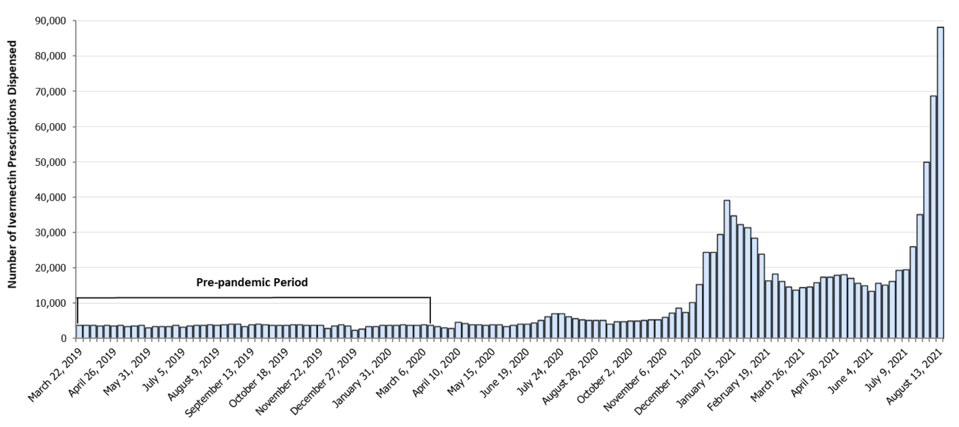
It can’t, but that hasn’t stopped a variety of Fox News hosts, including Sean Hannity, Tucker Carlson, and Laura Ingraham, from pushing it for months. As a result, prescriptions for ivermectin have increased like crazy. Here’s a chart just released by the CDC, showing the weekly number of prescriptions over the past two years:

As you can see, the numbers shot up at the beginning of this year, to 40,000 prescriptions per week, and this past month they shot up again, to over 80,000 per week. All this ivermectin has had no effect at all on Covid-19 infections, which have continued to rise, but that hasn’t stopped people from desperately trying to get ivermectin.

Ivermectin doesn’t work. It doesn’t prevent Covid-19, nor does it treat it. Unfortunately, the official government response to this misinformation has once again failed to be blunt enough, with a few exceptions. More on that below, but first let’s review what the heck ivermectin is.

Ivermectin is used to treat two relatively rare (in the U.S.) parasites: a nematode called Onchocerca volvulus that causes river blindness, and an intestinal nematode called Strongyloides stercoralis. (Both of these are sometimes called worms, but they are microscopic in size, and unrelated to the worms that most people are familiar with.) Nematodes are not even remotely similar to viruses, and there’s no reason to think that a treatment for nematode infections will cure a virus–unless, apparently, a popular talk show host claims that it will.

Ivermectin also used for de-worming livestock such as cows and horses, which means that veterinarians carry supplies of ivermectin, often in very large doses. The veterinary form is available in a paste that you can feed to animals. This has resulted in a number of people buying and consuming large amounts of ivermectin–or, as one person put it, “eating horse goo from the tractor store.” This does not usually end well.

Here’s an example from the CDC’s latest health advisory:

An adult drank an injectable ivermectin formulation intended for use in cattle in an attempt to prevent COVID-19 infection. This patient presented to a hospital with confusion, drowsiness, visual hallucinations, tachypnea [abnormally rapid breathing], and tremors. The patient recovered after being hospitalized for nine days.

So: not good. This case and others prompted the FDA to tweet, in a rare instance of bluntness: “You are not a horse. You are not a cow. Seriously, y'all. Stop it.”

The FDA also issued a news release explaining why people should not use ivermectin to treat or prevent Covid-19, and especially not to use doses designed for large animals. It’s dangerous, as the case cited by the CDC illustrates.

Where did this interest in ivermectin begin? Just a couple of days ago, NBC News reporter Ben Collins put together an excellent Twitter thread explaining some of the recent history. One of the main sources was a sketchy group called America’s Frontline Doctors, which was founded by an anti-vaxxer named Simone Gold, who as Collins explained “spent the last year barnstorming churches and schools, insisting COVID vaccines cannot be trusted.”

Despite its name, America’s Frontline Doctors is most definitely not working on the “front lines” treating patients, but instead is a right-wing political organization known primarily for spreading Covid-19 misinformation. Last year they promoted hydroxychloroquine as a Covid-19 treatment, which didn’t work. More recently, they have been offering online consultations to people who wanted ivermectin. The consultations cost $90, which didn’t include the cost of the medicine, but they’d connect you to a pharmacy that would deliver it.

(Aside: in an interesting twist, Simone Gold has been indicted and is now awaiting trial for her role in the January 6 insurrection at the U.S. Capitol in Washington, D.C.)

So here we are: 80,000 prescriptions per week for a drug that doesn’t work for treating or preventing Covid-19. Above, I wrote that the government isn’t responding clearly enough to this misinformation: here’s what I mean by that.

Scientists and doctors are trained to speak very carefully and precisely to one another. So rather than saying “X is false” or “Y doesn’t work,” we say “we don’t have evidence that X is true,” or “the evidence doesn’t support the effectiveness of Y.” That’s all well and good when you’re speaking to another scientist, but the general public hears these statements as something more like “X might work but we are still looking at the evidence.”

Uh uh. Not a good way to talk to the public.

Now, there actually have been several studies of ivermectin as a treatment for Covid-19, and here’s where the story might get confusing–but I’m going to try to keep it really clear. Virtually all of the studies showed that ivermectin simply doesn’t work, but one study out of Egypt (by Elgazzar et al.) seemed to show that it worked quite well. That was really surprising, but the story collapsed pretty quickly: it turned out the data was falsified, and parts of the paper were plagiarised. About a month ago, the study–which was still an un-reviewed preprint, was retracted by the publisher, Research Square.

Making things more confusing, several meta-analyses have already been published that relied on the flawed Egyptian study, and some of those papers report that ivermectin is effective. But a meta-analysis doesn’t contain any original data; instead, it’s an analysis that combines the results from a bunch of other studies. Those positive findings from meta-analysis papers rely heavily on the falsified Egyptian study, and (it turns out) on another very flawed study. For a deeper dive into those, see this excellent breakdown by the epidemiologist (and journalist) Gideon Meyerowitz-Katz (@GidMK, aka HealthNerd), who posted a long Twitter thread detailing the reasons why these meta-analyses, and some of the studies they include, cannot be trusted.

So the scientific picture is already clear: multiple studies show that ivermectin does not work. But rather than saying that in simple, direct English, here’s what the CDC states in their August 26 Health Advisory:

“there are currently insufficient data to recommend ivermectin for treatment of COVID-19”

“Clinical trials and observational studies to evaluate the use of ivermectin to prevent and treat COVID-19 in humans have yielded insufficient evidence for the NIH COVID-19 Treatment Guidelines Panel to recommend its use”

“Be aware that currently, ivermectin has not been proven as a way to prevent or treat COVID-19.”

The FDA isn’t much better (except for that one tweet). In a consumer advisory with the title “Why You Should Not Use Ivermectin to Treat or Prevent COVID-19”, they write:

“The FDA has not reviewed data to support use of ivermectin in COVID-19 patients to treat or to prevent COVID-19; however, some initial research is underway.”

See what I mean? This is how you’d explain things to another scientist, but the general public needs much more direct language.

So I’m saying it here: ivermectin doesn’t work in any way for Covid-19. It doesn’t prevent infection, it doesn’t cure the disease, and it doesn’t reduce your risk of anything.

Or, as the FDA’s Twitter account so eloquently put it, “You are not a horse. You are not a cow. Seriously, y'all. Stop it.”