Showing posts with label DNA. Show all posts

Do telomeres measure our true biological age, and can we do anything to maintain them?


Telomeres are one of the keys to aging. We’ve known this for decades, and the scientists who first figured it out won the Nobel Prize in 2009. (One of them was my former colleague at Johns Hopkins University, Carol Greider.) Not surprisingly, many people have been trying, ever since, to use this discovery to slow down or reverse the aging process.

No luck so far, but that doesn’t mean you can’t spend money on your telomeres.

Over the past decade or so, a number of companies have started offering to measure your telomere length, which they suggest will tell your true, biological age. Sometimes, along with these measurements, they will offer to sell you something that they claim maintains or even lengthens your telomeres, thereby making you younger. What’s all the fuss?

Well, let’s start by explaining what telomeres are. Every cell in your body contains your DNA, arranged into 23 pairs of chromosomes. (That’s the origin of the company name for 23andMe, by the way.) Your chromosomes are very long strings of DNA letters (usually written A, C, G, and T). Through a quirk of biology, the very tips of our chromosomes are special: they contain thousands of copies, repeated end-to-end, of the 6-letter sequence TTAGGG. These are the telomeres, and they are a common feature in all animals, plants, and pretty much every living thing except for some single-celled microbes.

What’s fascinating about telomeres is that they provide a molecular “clock” that you can use to tell how old a cell is–sort of. You see, each time your cells divide, they have to copy all of that DNA, and sometimes they don’t quite copy the entire telomere. Over time, your telomeres get shorter.

This means that, in theory at least, your telomere length can tell you something about your age.

When humans are still infants, our telomeres are about 10,000 DNA letters long, and they slowly get shorter. By the time we’re in our 80s and 90s, our telomeres might be only 4000-5000 letters long–but this varies enormously. Telomere length varies from tissue to tissue–even your blood has many different types of cells in it, with different telomere lengths–and from person to person. Thus it’s entirely possible for a healthy 40-year-old to have telomere lengths that are typical of 80-year-olds, and vice versa. Here’s a graph from a scientific study that looked at telomeres in over 800 people, showing how they get shorter as you age. Length is on the vertical axis, measured in thousands, versus age on the horizontal axis:
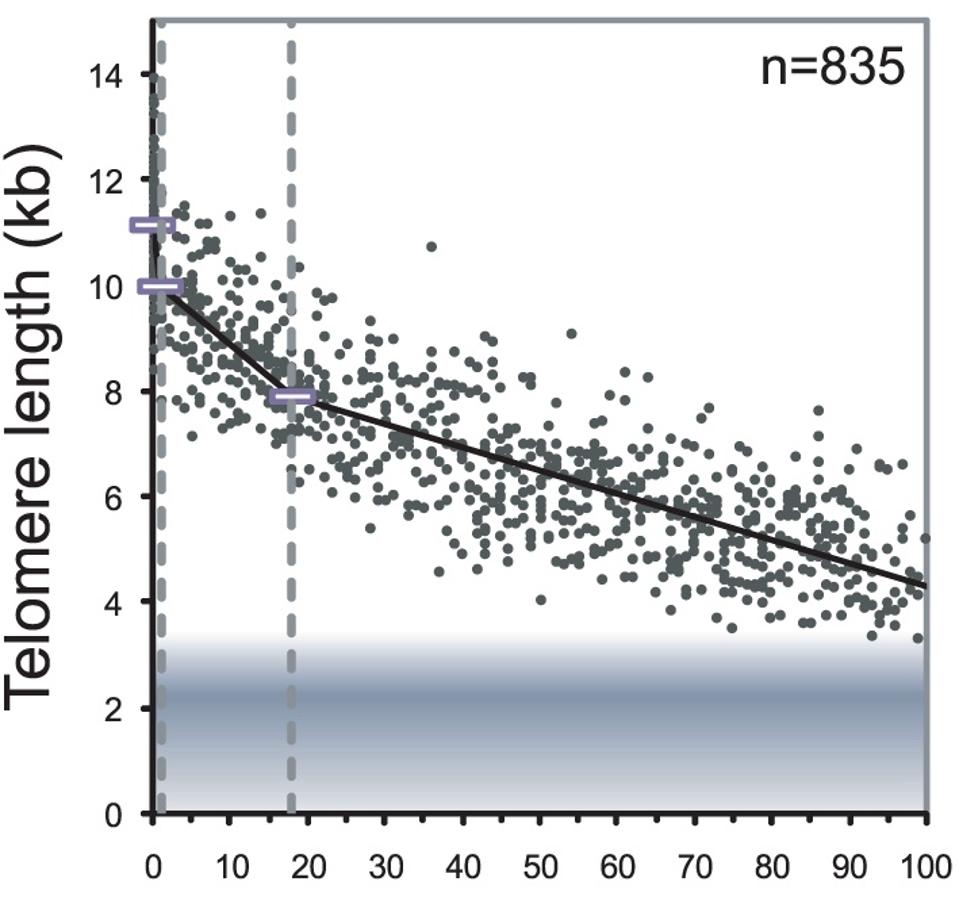
As you can see, telomeres decline from about 10,000 letters (bases) at birth to about 5,000 in 80-year-olds, but many people have telomeres that are thousands of bases shorter or longer than the average.

When its telomeres get too short, a cell will die. So the reasoning goes, if we can keep our telomeres nice and long, we’ll live longer! It might seem simple, but it’s not.

First, it’s not clear that there’s anything we can do if we know the length of our telomeres. As my Hopkins colleagues Mary Armanios explained, “Within the normal telomere length range, it is not possible to determine a person’s exact biologic age, nor is it a good marker of a person’s ‘youthfulness.’”

The other problem is that it’s not clear that we can take any action to make our telomeres longer, or even to prevent them from getting shorter. But there are a couple of things you can try:

Exercise regularly. There is some evidence that regular exercise is correlated with longer telomeres. A study in 2017 concluded that “adults who participate in high levels of physical activity tend to have longer telomeres, accounting for years of reduced cellular aging compared to their more sedentary counterparts.”

Avoid stress. Another study in 2016 found that stress tended to make telomeres shorter.

Even if both of those studies are wrong about telomeres, the general advice to exercise and avoid stress is good for all sorts of reasons, so I’m happy to endorse these recommendations.

In addition, there are companies (like this one) that claim you can take supplements that will maintain telomere length, but I couldn’t find any solid evidence to back up those claims. So no, you can’t take a supplement or a pill that will restore your telomeres to the lengths they had when you were a baby.

Finally, there is some promising early research that uses mRNA technology–the same technology used to develop the new COVID vaccines–to deliver enzymes that rapidly increase telomere length in human cells. A huge caveat is that this only works in cells growing in a laboratory culture, and no one knows if it’s possible to do this in a living human. But it isn’t a crazy idea, so I’ll keep an eye on this research.

So what about companies that offer to measure your telomere length? Well, they really can do it, although the accuracy of various technologies will vary. Given what we know today, it seems unlikely that these tests will provide anything of value, unless you’re among a very small cohort of people who have a telomere-related genetic disorder. So my advice is, don’t waste your money. But it can’t hurt to exercise regularly and avoid stress, and both of these pieces of advice might help maintain your telomeres as well.
DNA is safe to eat. RNA isn't bad either.


Have you eaten any DNA lately? My bet is that you’ve eaten lots of it. DNA is not only safe to eat, it’s present in many truly delicious foods.

For example, chocolate has loads of DNA. Ice cream also has DNA, plenty of it. And lest you think DNA is only in desserts, it’s also found in hamburgers, cheese, bread, all kinds of sushi, and a very long list of other foods. Want to know which foods are DNA-free? Keep reading.

(Aside: why am I explaining that DNA is safe? Scientists reading this might say of course it is, what’s the big deal? If you’re among those, you don’t need to read any further. But many people are afraid to eat DNA because they don’t know what it is, and the name sounds a bit scary. In fact, a study in 2016 found that 80% of Americans thought that foods containing DNA should have a warning label.)

DNA contributes pretty much nothing to the taste of your food, which is sort of obvious given that it’s found in so many different-tasting foods. That’s because flavors are a very complex combination of many, many ingredients, and DNA is just one small part of most foods. If you were to purify DNA and taste it all by itself, it would taste slightly salty. If you want to watch someone trying this for himself, check out this video:


So how do we know that DNA is present in so many different foods? The explanation goes like this: all living things–plants, animals, fungi, bacteria, and others–are composed of cells. Almost every cell in a plant or animal contains a copy of its genetic code, and that code is captured by DNA molecules. Think of DNA as a very, very long string of chemicals, or “bases.”

In rice, to choose just one example, each cell contains 12 chromosomes, and each chromosome is a long DNA molecule. The DNA strings in rice add up to about 430 million bases. So when you’re eating rice, you’re eating all of this DNA in every bite.

The wheat we use to make bread has even more DNA: every cell has about 16 billion bases. That’s 5 times more DNA than human cells have! But interestingly, the wheat we use to make pasta, called semolina or durum wheat, has only about two-thirds as much DNA as bread wheat (and only 14 chromosomes instead of 21). But I digress.

Thus any food that is derived from a plant or animal is almost certain to contain DNA, unless the food is processed so much that every cell from the original plant is removed or pulverized to bits, and the DNA is somehow removed (which normal food processing or cooking does not do). There’s no reason to remove the DNA, though, because it’s completely safe.

Pretty much every food that has DNA in it will also have RNA. RNA is safe to eat too! Some people have been concerned lately about RNA, which has been in the news frequently because it is used in two of the most effective Covid-19 vaccines, the ones from Pfizer/BioNTech and Moderna. Of course, injecting RNA into your arm is different from eating it, but both are very safe. (For more about RNA vaccines, see the article I wrote just a month ago, here.)

Now let’s answer a question I posed at the top: what foods don’t have DNA? The list is remarkably short:

  1. Salt
  2. Sugar*

Yep, that’s it. Salt is a mineral, so it doesn’t come from living things. And sugar is a simple molecule, C12H22O11, produced by plants such as sugar cane and sugar beets. The asterisk (*) next to sugar is there because unless the sugar is very pure, some DNA from the original plants is probably present, so even "pure" sugar might not be DNA-free.

And if you want to wash down that salt and sugar with a DNA-free drink, you can’t use coffee, tea, wine, beer, or fruit juice. All of them contain DNA.

Before I close, I should add that DNA stands for deoxyribonucleic acid. To some, the name is cause for concern: after all, “acid” can’t be good, right? Maybe we should call it “nuclein” instead; that was the name given to it by Friedrich Miescher, the Swiss scientist who first discovered DNA, in 1871.

Bottom line: DNA is in almost everything you eat, you’ve been eating it all your life, and there’s nothing to worry about.

The NY Times is far too worried about 23andMe's genetic test

The New York Times decided to publish an editorial this weekend warning people to "be careful about 23andMe's Health Test." What are they worried about?

Although the NY Times article is accurate, the warning suggests that 23andMe misleading its customers somehow. Is it? I decided to take a look.

 I'm a customer of 23andMe, and I'm also a researcher in genetics and genomics, so I know quite a bit about how their technology works and about what it can reveal. I've looked at 23andMe's latest genetic health reports, and they are remarkably clear and accurate.

Let me illustrate by revealing part of my own genetic test results. First I looked at my results for BRCA1 and BRCA2, the two genes that the NY Times article discusses.

I don't have any of the harmful mutations in the BRCA genes, which 23andMe reports like this:
Notice that they immediately provide the caveat that more than 1,000 other variants in these genes have been linked to cancer risk, and they make it abundantly clear that they didn't test any of those. Here's what the NY Times article said:
"The 23andMe test can miss other possible mutations.... there are more than 1,000 other BRCA mutations that contribute to your breast cancer risk. The 23andMe test doesn’t look for any of them."

A reader of the Times might think, upon reading this, that 23andMe somehow hides this fact. But the Times article's warning is little more than a paraphrase of what 23andMe's website states.

The Times editors also caution that
"Just because you test negative for the few mutations that 23andMe screens for doesn’t mean that you won’t get breast cancer."
Duh. 23andMe explains this as well, and much more, such as:
"This test does not take into account other risk factors for breast, ovarian, prostate, and other cancers, such as personal and family health history." [from 23andMe]
23andMe also provides a wealth of information about the BRCA genes, including links to the scientific papers describing the genes and their link to cancer. I was very impressed by how thorough they are.

The Times editors focused only on the BRCA genes, but 23andMe also tests a handful of others (9, in my case). I looked at the APOE gene report, which has a mutation that has been linked to Alzheimer's disease. The bad variant is called Îµ4, and fortunately I don't have it.

Once again, the 23andMe site was very clear about what this means, providing a detailed table showing the risks for people with and without the mutation. In my case, they tell me that:
"Studies estimate that, on average, a man of European descent has a 3% chance of developing late-onset Alzheimer's disease by age 75 and an 11% chance by age 85."
Looking at the detailed table, one learns that if you have one copy of APOE ε4 variants, your risk of developing Alzheimer's by age 75 is 4-7%, and if you have 2 APOE ε4 variants–the worst case–then your risk jumps to 28%. The website provide links to 10 scientific papers with far more detail, for those who want to know the basis of these numbers. This is far more than most people will want to know, and I couldn't find any flaws in 23andMe's description of the science.

The Times editorial concludes with this:
"23andMe has said that its health tests can raise awareness about various medical conditions and empower consumers to take charge of their health information. But doctors and geneticists say that the tests are still more parlor trick than medicine."
That last statement is the most egregious misrepresentation by the Times editors. Who are these geneticists who call DNA testing a "parlor trick"? The genetic tests run by 23andMe, which use technology that is run daily at thousands of labs around the world, are nothing of the sort. They are a highly accurate assay that has been repeated millions of times and validated by hundreds of peer-reviewed studies. Usually the NY Times is one of the most thorough and accurate sources in the media, but they really dropped the ball this time.

The fact is, genetics is not fate. Identical twins, who share identical DNA, rarely die of the same causes. Thus even if you knew your genetic risks perfectly, for every mutation in your DNA, you might not find anything to change in your behavior. At most, you might learn that you should get mammograms or colonoscopies slightly more often. It's legitimate to argue that you won't learn anything useful from the 23andMe tests, but you will learn something about genetics.

As far as changing your behavior to reduce health risks, you don't need a sophisticated genetic test for that. Just eat more leafy greens.

[Note: although I'm a customer of 23andMe, I have no financial relationship with the company and I'm neither an advisor to nor an investor in them.]

European Union gets it wrong on GMOS. Again.

Teosinte on the left, modern
corn on the right, a hybrid in
the center.
A European Union court just issued a new decision about GMOs. Disappointingly, this decision is likely to confuse rather than clarify this complex and contentious issue. The court announced that plants whose genomes have been modified with CRISPR technology, a very precise form of genome editing, are subject to the EU's very strict restrictions on genetically modified crops.

More specifically, the Court of Justice of the European Union (ECJ) decided that:
"Organisms obtained by mutagenesis are GMOs."
If we take this literally, then here’s a list of all the foods that have never been subjected to mutagenesis, and are therefore NOT GMO:
  1. Salt
  2. Wild boar
  3. Wild blueberries
That’s it. (OK, maybe there are a few others.)

We have been modifying the genes of the foods we eat for millenia. Every loaf of organic, non-GMO bread is made from wheat that humans have modified since ancient times. Every glass of milk from your grass-fed, bovine-growth-hormone-free cow comes from a cow that humans have bred for centuries. All cows are genetically modified. Those delicious croissants you bought at the organic bakery? Sorry, those are GMOs, no matter how organic you think they are.

And corn? Have you seen what ancient corn, called teosinte, looks like? I encourage you to Google it (or see the image on this blog, above). Modern corn is the result of many generations of human-driven genetic modifications.

To be fair, the EU court recognized that many of our foods have been genetically modified for a long time, and that it might be impractical to remove all of them from our food supply. So they carved out an exception:
"varieties [of plants] obtained by means of mutagenesis techniques which have conventionally been used in a number of applications and have a long safety record are exempt...."
What's ironic here–though I'm confident that the EU court didn't mean this–is that by this definition, virtually all of the GMO crops in the U.S. are exempt. You see, we've been eating them for decades, and they have a phenomenal safety record.

Two years ago, the US National Academies of Sciences, Engineering, and Medicine issued a massive report that reviewed over 1,000 studies of GMOs. The bottom line: there are no health risks whatsoever from eating genetically modified foods.

Earlier gene editing technology sometimes added foreign genes to an organism, such as adding a bacterial gene to a plant. The EU court's new decision is intended to clarify that even if a foreign gene is not involved, plants bred using the newest form of gene editing (CRISPR technology) are nonetheless GMOs.

Banning GMOs doesn't make sense, and it never did. Genetic technology is just a tool, one that can be used for countless purposes, some of them highly beneficial–such as golden rice, which has the potential to prevent blindness in countries where many people depend on rice as their main staple food. If someone objects to a particular use of GM technology, such as Monsanto's use of it to create herbicide-resistant plants, that's something we can reasonably debate. But banning all GMOs is throwing out the baby with the bathwater.

Now if you'll excuse me, I've got to go out to my grill and see how my wild boar is doing. It might need a bit more salt.

The new Star Trek series gets biology terribly, terribly wrong.

The new Star Trek: Discovery series is based on a massive scientific error. Can it survive?

It didn't have to be this way. Those of us who have followed Star Trek through its many TV series and movies, including the excellent trio of recent moves (2016's Star Trek Beyond is the latest) were eager to jump on board the newest show, Star Trek: Discovery.

Despite some rather uneven acting in the pilot, I was willing to give it a chance. So were millions of other Star Trek fans.

But alas, the writers have stumbled into a scientific error so egregious, and so entangled in the entire plot line, that I fear the new Star Trek cannot recover. (Note: a few mild spoilers ahead.)

Episodes 4 and 5, released on October 8 and 15, revealed that the USS Discovery, the ship that the series revolves around, has an advanced form of transport that allows it to travel anywhere in the universe instantaneously. Unlike all previous Star Trek transport tech, this one uses a biological mechanism, based on mushrooms.

Yes, you read that right. The DASH (Displacement Activated Spore Hub) drive uses mushroom spores as its power source. They've discovered a special fungus whose root system extends "throughout subspace" all over the galaxy. Using spores from this fungus, the ship can jump into subspace (or something like that) and jump out somewhere else in real space, light years away, in a matter of seconds. As bizarre and this sounds, the worst is yet to come.

To power its DASH drive, the Discovery maintains a large greenhouse full of spore-producing mushrooms. (Mycologists might love this, but how big a fan base can they be?) The problem for the Discovery, in the first few episodes, is that the experimental drive will only let them jump short distances.

Then they discover the tardigrade. Tardigrades are a real thing: they are microscopic animals, only 0.5 millimeters long, that live all over the planet. Here's a picture of one:
Electron microscope image of Milnesium tardigradum,
from E. Schokraie et al., PLoS ONE 7(9): e45682.

They are also surprisingly cute for a microscopic animal, and they are colloquially known as water bears, moss piglets, or space bears. "Space bears" comes from their ability to survive in extreme environments, possibly including interplanetary space.

Star Trek Discovery's tardigrade is, shall we say, rather different. It looks a bit like the picture shown here, but it's the size of a large grizzly bear, incredibly strong, and extremely fierce. On the show they call it a "giant space tardigrade."

But that's not all. Thanks to a unique biological property that the show's writers apparently misunderstood, the space tardigrade can access the mushroom network to travel throughout the universe, wherever and whenever it chooses.

Here's how the space tardigrade accomplishes this remarkable feat of interstellar travel, as explained by Michael Burnham, the show's central character (in Episode 5, "Choose your pain"):
"Like its microscopic cousins on Earth, the tardigrade is able to incorporate foreign DNA into its own genome via horizontal gene transfer. When Ripper [the space tardigrade] borrows DNA from the mycelium [the mushroom], he's granted an all-access travel pass."
And just like that, not only the tardigrade but the entire spaceship jump across the galaxy. Is this sounding a bit crazy? It should.

Horizontal gene transfer (HGT) is a real thing. It's a process through which bacteria sometimes take up DNA from the environment and integrate it into their own genomes. Animals can't do HGT, but rather infamously, a paper was published in December 2015 that made the bold claim that tardigrades had a unique ability to absorb all kinds of DNA. That paper was instantly controversial in the scientific community, and not surprisingly its findings were being disputed in the Twittersphere within days of its appearance. Surprisingly, the same journal (PNAS) that published the bogus HGT claim published a second paper just a few months later showing that tardigrades do not absorb foreign DNA into their genome. That plus a third paper showed that the original paper had mistakenly identified contaminating DNA as part of the tardigrade's own genome. This rapid correction of the record was a win for science; I've used this example to demonstrate to my undergraduate class how sloppy science (the first paper) can lead one astray.

So: a minor scientific controversy, quickly debunked.

Until, that is, one of the Star Trek writers got their hands on it. Apparently one of them heard the tardigrade story, perhaps someone who'd had a bit of biology in college (I'm guessing here), and got so excited that they turned it into a wildly implausible premise for an intergalactic space drive.

The idea of using horizontally transferred DNA for space travel is so nutty, so bad, that it's not even wrong. Even if tardigrades could absorb foreign DNA (they can't), how the heck is this supposed to give them the ability to tap into the (wildly implausible) intergalactic spore network? DNA that's been taken up through HGT isn't connected to the source any longer. This is no more plausible than asserting that people could connect to the mushroom network by eating a plate of mushrooms. And how would the space-traveling tardigrade take the entire ship with it? Are we supposed to assume it's creating some kind of mushroom-DNA field?

Star Trek has had faster-than-light warp drives for 50 years. Although physically implausible, warp drive isn't laughably ridiculous. The DASH drive is.

And now the entire series seems to be based on a combination of magic (an intergalactic mushroom network in subspace) and scientific errors (horizontal gene transfer by tardigrades).

I can't watch this nonsense. I'm willing to suspend disbelief for the sake of a good story (warp drive!), but I can't accept obviously bogus claims. I don't know how the Star Trek writers can get themselves out of this one, but if they don't, then Star Trek Discovery is finished. If they're reading this, here's my plea: ditch the DASH drive and find something to replace it–and for god's sake, hire a competent science consultant.

Better diagnosis of infections

This week I'm not posting an article here because I wrote a piece for BloombergView, the online magazine published by Bloomberg, the company founded by Michael Bloomberg. The article is titled "Make Way for Better Germ Tests." Check it out here.

Jurassic World fact check: can we clone dinosaurs?

One of this summer’s biggest hits was the movie Jurassic World, which earned a record $209 million on its opening weekend back in June. It's so popular that it’s still showing in theaters now, more than two months later.

Like its predecessors, the fourth movie in the Jurassic Park series features a theme park filled with dinosaurs that were created by cloning dinosaur DNA. In the movie, the dino DNA was collected from mosquitos preserved in amber, which (in the fictional movie world) had sucked the blood of dinosaurs 65 million years ago.

The success of the movie spurred YouGov.com to conduct a poll, asking Americans if they believed it was currently possible to create dinosaurs from DNA found in fossils. 28% said yes.

It makes for a fun story, but is there any science behind it? Well, yes and no.

Can we clone a living organism entirely from scratch, just from its DNA sequence alone? Yes! Not only can we do it, but it has already been done. Genome scientists Craig Venter and Hamilton Smith, both former colleagues of mine, achieved this at least twice, creating bacteria by synthesizing the necessary DNA and then “booting up” a new bacterial cell, which went on to replicate itself and grow into colonies of brand-new bacteria. Very impressive work, although bacterial genomes are quite small, only a few million nucleotides long.

Moving up a step, just last year, Hopkins scientist Jef Boeke (who is now at NYU) and his team synthesized an entire yeast chromosome. Yeast are single-celled like bacteria, but they're eukaryotes, evolutionarily closer to humans and dinosaurs than bacteria. Eukaryotes keep their DNA sequestered inside a nucleus, which in turn makes them way harder to clone from scratch. Synthesis of the remaining yeast chromosomes is under way, and it’s entirely feasible that we’ll have artificial yeast in just a year or two.

As of today, though, no one has even come close to synthesizing a multi-cellular creature like a dinosaur–or a chicken, or a frog, or a human. But in principal, it is possible to create a living animal just from its DNA, though it might take a few more decades to do it.

So yes, we might someday create animals from DNA. But dinosaurs? Alas, this half of the Jurassic World question gets a big “no.”

The problem is, despite the compelling story in the movie, there is no dinosaur DNA left on the planet. None at all, despite what you might have read. Dinosaurs went extinct about 65 million years ago, mostly likely because of a massive asteroid impact in the Yucatan peninsula, and DNA simply doesn’t last that long.

But wait, you might ask: what about all these stories about Neandertal DNA, or woolly mammoth DNA, or other ancient species? These studies are true and are very exciting. Scientists have reconstructed the genome of our Neanderal relatives from very old bones, around 30,000-40,000 years old. We can extract DNA from bones that old, although the DNA is badly degraded. I worked on an ancient DNA project myself, using an 11,000 year old mammoth thigh bone to reconstruct part of its genome. We were able to recover quite a lot of mammoth DNA from that bone.

Other work on ancient samples has demonstrated that in the most extreme conditions, where the bones have been continuously frozen in the Greenland ice sheet, DNA may survive as long as 1 million years. However, dinosaurs lived in temperate climates where DNA degrades far more quickly, and virtually all dinosaur DNA was probably gone within a few thousand years after the dinosaurs became extinct.

(By the way, that same YouGov poll that asked about cloning dinosaurs also asked "Do you believe that dinosaurs and humans once lived on the planet at the same time?" 40% of Americans said yes, demonstrating once again that Americans are woefully misinformed about evolution and the history of the planet.)

So alas, a mosquito that sucked the blood of a Tyrannosaurus rex, and then got swallowed and preserved in tree sap, would not yield any T. rex DNA for present-day cloning experiments.

This doesn’t mean we’ll never have a Jurassic Park, but if we do, we’ll have to guess at what that dino DNA looked like, perhaps using the DNA of birds. Perhaps, though, we should focus on saving the species we have left, which we are rapidly wiping out, before worrying about reviving long-lost dinosaurs.

Massive genetic sharing effort shows power but also shows how little we know

Your genes are not your fate. 

Nonetheless, genes can tell us a lot about our risk for disease, and sometimes they can tell us how to lead healthier lives.

The landscape of the human genome is vast and mostly unexplored. There is far, far more that we don’t know than we do know. This is why it’s so important that as we test people for genetic mutations, we share information as much as possible. Genes have different effects on different people, and a mutation that is harmful in one group might be harmless in another. If we’re ever to fill in all the gaps in our knowledge, we have to pool our resources by sharing data.

This is the goal of ClinGen, a new project described in this week’s New England Journal of Medicine. ClinGen relies on a public database called ClinVar, where researchers, clinical labs, clinicians, and patients can deposit information about genetic variants and their effect on disease. 

What makes this effort so complex is that many disease-causing mutations are quite rare. If two patients share the same disease and the same genetic mutation, and if we’ve never seen that mutation before, can we claim that the mutation cause the disease? Not really: we might have to wait until we’ve seen many more patients before we can have any confidence in the cause-and-effect relationship. This is why sharing data is so important: more data means more power to discriminate between real effects and coincidences.

ClinGen has already shown us that our knowledge has flaws: perhaps 17% of the disease associations that clinicians have reported might be incorrect. More precisely, the NEJM paper reports that out of more than 118,000 mutations that have a clinical affect, almost 13,000 were reported by more than one lab. Of those, 17% were interpreted inconsistently, with some labs calling mutations "pathogenic" while other labs calling them benign.

I disagree with the headline of an AP report headlined “flaws in gene testing,” which reported that 
“The first report from a big public-private project to improve genetic testing reveals it is not as rock solid as many people believe.”
This is a straw man argument: experts in the field don't think genetic testing is “rock solid”, and the 17% rate of disagreement in disease-mutation association is not that surprising. What's more, these conflicts don’t always represent flaws, but rather holes in our knowledge that we just haven’t filled yet. 

Disagreements over the effects of a genetic mutation represent opportunities to clarify and improve our genetic knowledge base. And as the ClinGen authors emphasize, it’s only by sharing our findings that we can discover and correct these flaws. This is why clinicians, scientists, and labs need to adopt a culture of sharing results, as the ClinGen project has emphasized (see their “Wall of Fame” of labs and institutions that have shared data).

All of us have mutations in our DNA; geneticists estimate that each of us carries perhaps 30 new mutations that even our own parents don’t share. The vast majority of these, fortunately, are harmless. Even mutations that do affect our health usually only have a small influence, changing our risk for disease but not actually causing it.

I'd be remiss if I didn't point out that sometimes, your genes are your fate. If you have certain mutations in the CFTR gene, you will have cystic fibrosis, and some mutations in the HTT gene will inevitably cause Huntington’s disease. 

As geneticist Luke Jostins cogently wrote, identical twins usually don’t die from the same thing. So even though genes may influence our fate, we still have control over it. Knowing your genetic risks can be valuable, but we have a lot more to learn about how our genes influence our health.

DNA testing offers a far better way to detect Down syndrome

The results of a new study offer very good news for expectant parents: a remarkably accurate prenatal genetic test for Down syndrome that requires only a blood sample from the mother.

Expectant parents have a lot to deal with. What can a mom-to-be eat, drink, or do to ensure the health of the baby? There is plenty of advice out there, both good and bad, but one area that has advanced rapidly in recent years is prenatal genetic testing. We now have tests that can identify a small but growing number of genetic disorders early in pregnancy.

Until recently, the only way to test the genetic makeup of a fetus was through amniocentesis ("amnio"), an invasive procedure in which a doctor inserts a long needly directly into the womb and collects a sample of amniotic fluid. This test is not only uncomfortable, but it also carries a small risk of miscarriage. Fortunately, it may soon become completely unnecessary, thanks in part to advances in DNA sequencing.

It turns out that small amounts of fetal DNA are circulating in the mother's blood from a very early point in pregnancy, just 10 weeks along. New technology allows us to take a simple blood sample from the mother and use that to examine the baby's DNA to look for trisomy–the presence of 3 copies of a chromosome rather than two. The new study primarily looked at trisomy 21, which causes Down syndrome, but it also looked at the ability of DNA screening to detect other trisomies.*

The new study by Mary Norton and colleagues, by far the largest of its kind to date, involved almost 19,000 women at 35 locations in 6 different countries, all of whom were undergoing routine prenatal screening. The study compared the standard blood test, the "triple screen", to a new cell-free DNA sequencing (cfDNA) test from Ariosa Diagnostics (recently acquired by Roche). I wrote about a similar study involving 1914 patients last year, which used the same kind of DNA testing. The new study is ten times larger, and the results are even better. All of the participants had both standard screening and DNA testing.

What did they find? First, the number of mothers who had both standard and cfDNA testing was 15,841. (For technical reasons, some of the 19,000 participants didn't get both tests.) Out of all pregnancies, there were a total of 38 fetuses with trisomy 21. Standard screening detected 30 out of 38, while cfDNA detected all 38. Much more impressive–startling, really–was the difference in false positives. The standard screen had 854 false positives, while cfDNA testing only had 9. This is nearly 100 times better.

Or to put it another way: among all the mothers, standard screening reported 884 "positive" results, of which only 30 were correct. Thus if you were a mom who got the standard screen, and you had a positive result, there was only a 3.4% chance that your baby would have Down syndrome. Nearly all of these mothers would probably elect amniocentesis to confirm, and go through the anxiety as well as risk of miscarriage that amnio entails.

The cfDNA test reported only 47 positive results, of which 38 were correct. Thus there was an 81% chance (38/47) that the baby will a positive result would have Down syndrome.

Although the numbers were smaller, cfDNA testing was also far more accurate for detecting trisomy 13 and 18, rarer conditions that cause health problems so severe that most infants die before reaching their first birthday.

With a false positive rate nearly 100 times lower than the standard blood test (9 versus 854 false positives), the superiority of DNA testing for prenatal screening is clear. Let's hope that we can soon replace the older blood tests and spare parents-to-be the anxiety and unnecessary follow-up testing caused by thousands of false positive results under the current standard of care.

*For those who want to understand the technical details, this paper by Sparks et al. (2012) explains the sequencing and statistical methods.


Does a standing desk lengthen your lifespan?

Standing desks are all the rage lately. These desks allow you to stand up while working on your computer. Some standing desks can be raised and lowered, so you can alternate during the course of the day between sitting and standing. The principal argument for these desks is that they provide health benefits.

Proponents of standing desks claim, plausibly, that they give you more energy and improve posture. The CDC has found that standing desks (or “sit-stand” desks) reduce upper back and neck pain and improve moods. At Smithsonian.com, Joseph Stromberg reported that standing desks reduce the risk of obesity and type 2 diabetes. And a 2012 Australian study found that prolonged sitting increased the risk of death. In other words, standing up more and sitting less can help you live longer. All this makes me want to stand up right now.

The newest claim is that standing up lengthens your telomeres. If true, this would provide a mechanism to explain how standing up might lengthen your life. The new study, led by Swedish scientist Per Sjögren, appeared this month in the British Journal of Sports Medicine.

Telomeres are special DNA “caps” on the ends of everyone’s chromosomes. As we age, these caps gradually get shorter, and if they get too short, the cell dies. They function as a kind of molecular clock, telling a cell when it’s old. A substantial body of scientific evidence shows that if you can maintain telomere length, cells—and their owners—will live longer.

But how could merely standing more, or sitting less, shorten our telomeres? Being skeptical, I read the paper.

Here’s what Sjögren and colleagues did: several years ago, they conducted a study measuring the effect of exercise on weight, cholesterol levels, and a few other characteristics. That study included 101 people, all 68 years old. They randomly chose 49 people (14 men, 35 women) to study the effect of exercise on telomere length. They used blood samples taken 6 months apart, both before and after the exercise regimen. This was all completed back in 2011.

Previously, they reported that there was no difference in telomere length between the “exercise” group and the control group. So how can they publish a new study that seems to reach the opposite conclusion? It turns out there isn't a new study at all, but a re-analysis of the original data.

In the early study, the exercise program did have some significant effects: it increased the amount that people walked around by 1663 steps per day, and decreased their sitting time by 2 hours per day. However, people in both groups spent less time sitting over the course of the study. So the scientists re-analyzed the data and looked at telomere length as a function of four more measurements. For one of these measures, change in sitting time per day, telomere length was reduced enough that the relationship showed a p-value of 0.02.

Unfortunately for Sjögren, this new finding is based on just 12 individuals. That's a tiny number for a scientific study. And when I looked at the key figure in the paper, it’s pretty clear that the effect depends critically on just 2 of those 12 individuals who had both reduced sitting time and longer telomeres. Take those 2 people out, and the effect vanishes. The authors admitted that
“The study sample is small and we cannot rule out that the findings are a chance phenomenon.”
We've seen this sort of thing before: a small study with a minimally significant effect. Usually these types of results never get replicated. As much as I’d love to believe I could lengthen my telomeres by standing up a bit more each day, this rather implausible findnig is simply unconvincing. It’s based on a sub-group of only 12 people—and furthermore, this is a re-analysis of previous data, which feels an awful lot like cherry-picking. If there is any effect, it’s very small.

Nevertheless, other studies do show health benefits from spending more time walking and less time sitting. A daily walk probably confers the same benefit as a standing desk, but a standing desk isn’t a terrible idea either. Just don’t count on it to lengthen your telomeres.

Should we test all women for breast cancer-causing mutations?

In this week’s Journal of the American Medical Association, famed geneticist Mary-Claire King argues that all women over age 30 should be tested for cancer-causing mutations in the BRCA1 and BRCA2 genes. King, who made the original discovery of the link between BRCA1 and breast cancer, is one of the world’s leading experts on how mutations in these genes cause cancer.

But her proposed new universal testing policy, which fellow Forbes contributor David Shaywitz calls “audacious,” goes far beyond what other experts recommend. Earlier this year, the highly regarded U.S. Preventative Services Task Force (USPSTF) recommended testing BRCA genes only in women with a family history of breast or ovarian cancer. 

Although there’s no question that King is an expert on BRCA gene testing, I think she’s gone much too far with her latest proposal. She has the science right, but she is far too optimistic about how her recommendation would actually play out. The policy might save some lives, but it would also cause a great deal of pain.

First, it’s worth explaining why King thinks universal BRCA testing is a good idea. In her JAMA article, King and colleagues describe a new study they conducted in Ashkenazy Jews that showed, somewhat surprisingly, that 
“50% of families found to harbor BRCA1 or BRCA2 mutations had no history of breast or ovarian cancer that would have triggered clinical attention." 
In other words, under current policy guidelines, 50% of people who have a damaging mutation in one of these genes will not have their genes tested. Many of them will eventually get breast or ovarian cancer—as King explains, women with harmful BRCA1 mutations have a 60% risk of cancer by age 60, and for BRCA2 the risk is 33% by age 60. That’s a very high risk, though it’s important to keep in mind that many women with these mutations will never get cancer.

With modern DNA sequencing technology, any large-scale genetic BRCA testing program is likely to uncover thousands of mutations that have no harmful effects, and thousands more whose effects are simply unknown. (Aside: each BRCA gene spans about 80-90 thousand nucleotides of DNA, and each of those letters can mutate in 4 ways, changing into one of the other 3 bases or just being deleted. This means there are at least 400,000 mutations possible in each gene, not counting larger deletions. A colleague and I published an article in 2010 describing one such BRCA test.) King is clearly aware that such reporting these mutations to patients would only sow confusion, and she recommends that:
“Testing for BRCA1 and BRCA2 should focus solely on unambiguously loss-of-function mutations with definitive effect on cancer risk…. A VUS [variant of unknown significance] can increase confusion and compromise clinical management; for population-based screening, these variants should not be reported.”
Herein lies one of the biggest problems with King’s idea. We don’t have universal agreement on which mutations have no significance, and even if we did, most physicians are not experts on cancer genetics. In our lawsuit-prone medical culture, there exists an unfortunate tendency to over-treat and over-report everything. 

Thus I fear that if we had wider BRCA testing, clinical labs would report all mutations back to physicians (how could they not?), and physicians in turn would report everything to the patients. The result would be that millions of women would be told "you have a mutation in BRCA1, and we don't know what it means." What's a patient supposed to do with that?

The other problem is that the only treatment to prevent breast and ovarian cancer is surgery to remove a woman’s breasts and ovaries. We don’t have a pill you can take, or lifestyle changes you can adopt, that will dramatically reduce your risk of hereditary cancer. But unlike a cancer diagnosis, the discovery of a BRCA mutation does not mean you have cancer. It simply means you have a risk, possibly a high risk, of getting cancer at a young age. We know from decades of research that people are not very good at evaluating risk. We tend to over-estimate the danger of events that seem very dramatic or visible to us, as cancer is to many people. 

By King’s own estimates, widespread BRCA testing would detect cancer-causing mutations in 250,000 to 415,000 women in the U.S. This estimate assumes the test doesn’t have false positives, which it almost certainly would. All of these women would then be faced with an extremely difficult dilemma: should they have both their breasts removed, or live the rest of their lives in fear of breast cancer? 

This dilemma was famously on display last year, when actress Angelina Jolie revealed in a New York Times article that she’d had a double mastectomy, after discovering that she carried high-risk BRCA mutations. Jolie’s mother died from cancer at the age of 56, and she explained in her article that as a result of the surgery, “ I can tell my children that they don’t need to fear they will lose me to breast cancer.”


King’s proposal is audacious, and it’s well worth debating. But without a better treatment option, telling hundreds of thousands of women that they have a high risk of breast and ovarian cancer carries a potentially enormous cost, both physical and emotional, for these women. Rather than putting huge numbers of women under the surgeon’s knife, we should instead double or triple our investments in research on treatments that may eventually make surgery unnecessary. 

A DNA Sequencing Breakthrough for Pregnant Women

DNA sequencing has made its way to the clinic in a dramatic new way: detecting chromosomal defects very early in pregnancy.  We've known for 25 years that traces of fetal DNA can be detected in a pregnant women's blood. But these traces are very small, and until now, we just didn't have the technology to detect an extra copy of a chromosome, where the DNA itself is otherwise normal.

Last week, in a study published in The New England Journal of Medicine, Diana Bianchi and colleagues showed how DNA sequencing can detect an extra copy of a chromosome with remarkable accuracy. This report heralds a new era in prenatal DNA testing.

First, some background: three copies of chromosome 21 causes Down syndrome, a genetic disease that causes intellectual disability and growth delays. Down syndrome is also called trisomy 21, where trisomy = 3 copies of a chromosome instead of the normal 2 copies. Much less common is Edwards syndrome, caused by three copies of chromosome 18. Edwards syndrome, or trisomy 18, has much more severe effects, with the vast majority of pregnancies not making it full term. Having an extra copy of any other chromosome almost always causes an early miscarriage. For many reasons, prospective parents want to know if a fetus carries any of these abnormalities.

The accuracy of the new test is remarkable. Out of 1914 young, healthy pregnant women, there were just 8 pregnancies where the fetus had an extra chromosome, and the test detected all 8. What was most impressive was its low false positive rate: in total, the new DNA-based test had just 9 false positives (for either chromosome 21 or chromosome 18 trisomy).  By contrast, the conventional screening test, which also identified all 8 true cases, produced 80 false positives, nearly 9 times as many as DNA sequencing.

Why does this matter? In most cases, women with a positive result on one of these tests will opt for amniocentesis ("amnio"), an invasive procedure where a doctor inserts a long needle directly into the womb and collects a sample of amniotic fluid. Amnio almost always gives a definitive answer about Down syndrome. With the conventional method, its false positive rate is so high that even with a positive test, over 95% of amnios will be negative, versus 55% with the new DNA sequencing test. Or to put it another way, as Bianci et al. wrote:
"if all women with positive results had .. decided to undergo an invasive procedure, there would have been a relative reduction of 89% in the number of diagnostic invasive procedures."
89% fewer invasive procedures is a huge reduction, not only in costs but in stress for the parents and risk to the baby (because amnio carries a small risk of miscarriage).

With DNA sequencing getting faster and cheaper every year, it might be surprising that we are only now seeing it used to detect trisomy. The difficulty with detecting an extra copy of a chromosome is that the DNA sequence itself is normal. If you sequence the genome, you won't find any mutations that indicate that the fetus has an extra chromosome copy. This is where the remarkable efficiency of next-generation sequencing comes in.

In a matter of hours, modern sequencing machines can sample millions of small fragments of DNA. We can use computational analysis to determine which fragments come from the fetus, and how many came from each chromosome. If any chromosome has three copies, we'll see a 50% increase in DNA from that chromosome. The power of sequencing lies in large numbers: because we can sequence many fragments from each chromosome, a 50% increase is easy to detect.

The method that Bianchi used to detect trisomy was published in 2011 by Amy Sehnert and colleagues from 2011, some of whom are contributors to the new NEJM study. [Side note: they use a software program called Bowtie, developed by my former student Ben Langmead, to do the analysis.] The method is likely to get even better over time, further reducing the false positive rate.

The American College of Obstetricians and Gynecologists has already recommended DNA testing for pregnant women at high risk of fetal aneuploidy (an extra chromosome). To be precise, they recommend that high-risk pregnant women be offered fetal DNA testing as an option, after they get genetic counseling. This new study, which was conducted in a low-risk population, shows that the benefits of prenatal DNA testing should offered to all women.

Supreme Court bungles the science in DNA patent decision

[This is slightly modified from my post 2 days ago at Forbes.]

The Supreme Court ruled this week that Myriad Genetics doesn't own your DNA after all.  Myriad holds patents on the BRCA1 and BRCA2 genes, which are linked to an increased risk of breast and ovarian cancer, and they charge exorbitant fees for their DNA diagnostic test of those genes.  As I've written before (such as this 2012 Clinical Pharmacology article), Myriad didn't invent the genes, and the patents should not have been granted.  So in large part the Supreme Court got it right.

But they got the science wrong, as any geneticist reading today's decision will realize immediately. In the very first paragraph, they make no less than three errors of fact.  First, they write:
"The nucleotides that code for amino acids are 'exons,' and those that do not are 'introns.' "
Not correct.  Here's the facts: when making DNA into a protein, the cell copies DNA into RNA.  Big chunks of the RNA are spliced out and discarded.  Those are "introns."  What remains is "exons."  That's it.  The nucleotides that code for amino acids are contained within the exons, but they are not the same thing. It's not unusual for 25% or even 50% of the nucleotides in the exons to be ignored when stringing together amino acids to make a protein.

Error number 2 comes next, when the Court writes:
"They [scientists] can also synthetically create exons-only strands of nucleotides known as composite DNA (cDNA)."
Wrong again.  cDNA stands for complementary DNA, because the DNA produced is the complement of the original strand. This means that each nucleotide is replaced with its complement: A and T are complementary, and C and G are complementary.  The court gets this right later on in the ruling.

Just after this, they write:
"cDNA contains only the exons that occur in DNA, omitting the intervening introns."
Ouch! Wrong again.  cDNA simply means a complementary copy of DNA, which doesn't have anything to do with exons.  If you make a cDNA from a mature messenger RNA transcript, then yes, it will contain only the exons.  But you can make cDNA from other parts of the genome, and from other types of RNA transcripts.

There are more errors further down in the decision. For example, they write that "Nucleotides that do not code for amino acids, in contrast, are known as 'introns.' "  This just compounds one of the errors above.  They also used the term "pre-RNA" instead of the correct term "pre-mRNA."  I could go on.

It's troubling that the highest court in the land can't get even the basic facts of molecular biology right when writing a decision that has such fundamental importance to genetic testing, the biotechnology industry, and health care.  I cannot pretend to know who they got to do their biology background research, but any genetics graduate student could have done far better.