Showing posts with label RNA. Show all posts

DNA is safe to eat. RNA isn't bad either.


Have you eaten any DNA lately? My bet is that you’ve eaten lots of it. DNA is not only safe to eat, it’s present in many truly delicious foods.

For example, chocolate has loads of DNA. Ice cream also has DNA, plenty of it. And lest you think DNA is only in desserts, it’s also found in hamburgers, cheese, bread, all kinds of sushi, and a very long list of other foods. Want to know which foods are DNA-free? Keep reading.

(Aside: why am I explaining that DNA is safe? Scientists reading this might say of course it is, what’s the big deal? If you’re among those, you don’t need to read any further. But many people are afraid to eat DNA because they don’t know what it is, and the name sounds a bit scary. In fact, a study in 2016 found that 80% of Americans thought that foods containing DNA should have a warning label.)

DNA contributes pretty much nothing to the taste of your food, which is sort of obvious given that it’s found in so many different-tasting foods. That’s because flavors are a very complex combination of many, many ingredients, and DNA is just one small part of most foods. If you were to purify DNA and taste it all by itself, it would taste slightly salty. If you want to watch someone trying this for himself, check out this video:


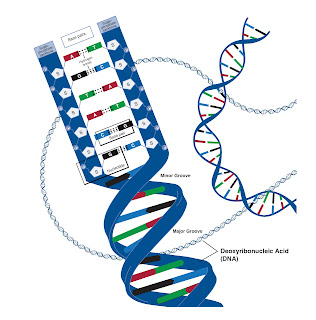
So how do we know that DNA is present in so many different foods? The explanation goes like this: all living things–plants, animals, fungi, bacteria, and others–are composed of cells. Almost every cell in a plant or animal contains a copy of its genetic code, and that code is captured by DNA molecules. Think of DNA as a very, very long string of chemicals, or “bases.”

In rice, to choose just one example, each cell contains 12 chromosomes, and each chromosome is a long DNA molecule. The DNA strings in rice add up to about 430 million bases. So when you’re eating rice, you’re eating all of this DNA in every bite.

The wheat we use to make bread has even more DNA: every cell has about 16 billion bases. That’s 5 times more DNA than human cells have! But interestingly, the wheat we use to make pasta, called semolina or durum wheat, has only about two-thirds as much DNA as bread wheat (and only 14 chromosomes instead of 21). But I digress.

Thus any food that is derived from a plant or animal is almost certain to contain DNA, unless the food is processed so much that every cell from the original plant is removed or pulverized to bits, and the DNA is somehow removed (which normal food processing or cooking does not do). There’s no reason to remove the DNA, though, because it’s completely safe.

Pretty much every food that has DNA in it will also have RNA. RNA is safe to eat too! Some people have been concerned lately about RNA, which has been in the news frequently because it is used in two of the most effective Covid-19 vaccines, the ones from Pfizer/BioNTech and Moderna. Of course, injecting RNA into your arm is different from eating it, but both are very safe. (For more about RNA vaccines, see the article I wrote just a month ago, here.)

Now let’s answer a question I posed at the top: what foods don’t have DNA? The list is remarkably short:

  1. Salt
  2. Sugar*

Yep, that’s it. Salt is a mineral, so it doesn’t come from living things. And sugar is a simple molecule, C12H22O11, produced by plants such as sugar cane and sugar beets. The asterisk (*) next to sugar is there because unless the sugar is very pure, some DNA from the original plants is probably present, so even "pure" sugar might not be DNA-free.

And if you want to wash down that salt and sugar with a DNA-free drink, you can’t use coffee, tea, wine, beer, or fruit juice. All of them contain DNA.

Before I close, I should add that DNA stands for deoxyribonucleic acid. To some, the name is cause for concern: after all, “acid” can’t be good, right? Maybe we should call it “nuclein” instead; that was the name given to it by Friedrich Miescher, the Swiss scientist who first discovered DNA, in 1871.

Bottom line: DNA is in almost everything you eat, you’ve been eating it all your life, and there’s nothing to worry about.

The mRNA vaccines are defeating COVID. Let's use them for the flu.


The last year has been a story of triumph in the vaccine world, with the rapid development of two highly successful vaccines for Covid-19, one developed by Moderna and the other by Pfizer and BioNTech. Now that flu season is approaching, why are we still using 50-year-old technology for the flu vaccine?

The reason the Covid-19 vaccines were developed so quickly is that they used a new, much faster and easier-to-create type of vaccine technology, based on messenger RNA, or mRNA. What’s even more exciting is that we now have an overwhelming amount of evidence, from real-world experience, that these vaccines are remarkably safe and effective.

Now, anti-vaxxers and the “vaccine hesitant” are claiming they don’t trust the vaccine because it was developed too fast. That’s ridiculous: the real reason they don’t trust the vaccine is because they’re consuming a steady diet of anti-vaccine nonsense, promoted by a combination of right-wing media and the Disinformation Dozen (who include left-wing as well as right-wing zealots). But let’s not go down that rabbit hole today.

So what is an mRNA vaccine? Here’s a brief explainer, and then we’ll look at the flu vaccine. (Note: feel free to skip ahead if you already understand the technology.)

Messenger RNA vaccines have been under development for decades, since long before Covid-19 appeared. The technology required a series of breakthroughs over the years, as described in a recent Nature news story, and many scientists contributed. It wasn’t used in vaccines in part because it wasn’t ready, but also because we rely on private companies to develop vaccines, and few of them were interested in investing in a new, not-yet-approved technology. But I digress.

Messenger RNA is the stuff that all of your cells use to translate your genes, which are encoded in DNA, into proteins. The basic process is that the DNA for a gene is copied into pieces of mRNA, where the DNA letters, ACGT, are replaced by slightly different (chemically) RNA letters, ACGU.

Every cell in your body is filled with mRNA, all the time. It’s the stuff of life, so of course it is totally safe. Each cell uses mRNA to make proteins, which do most of the actual work that keeps you alive.

Here’s the brilliant thing about mRNA vaccines: all they do is introduce some mRNA into your cells that encodes a single protein from the virus, which is called “Spike” in the case of the Covid-19 vaccines.

Your own cells then make the Spike protein, but they don’t make very much! They just make a few copies, because mRNA doesn’t last very long. And because there is no DNA copy of the Spike protein in your genome, once the mRNA in the vaccine breaks down, it’s gone forever.

The other brilliant thing is that your own immune system recognizes Spike as a foreign protein, and it generates cells that will recognize any future infections where the Spike protein is present. If you’re later infected by SARS-CoV-2 (the Covid-19 virus), your immune system is primed and ready, and in a large majority of cases it attacks and destroys the virus before you get sick.

So that’s it: an mRNA vaccine is simply a little package made of fat molecules (called liposomes) that contains a few copies of mRNA encoding a viral protein. There’s nothing to prevent us now from creating similar vaccines for the flu, or for other viruses where we need new vaccines. (In the case of flu, we can use mRNA for a gene called hemagglutinin, but again I digress.)

We make new flu vaccines every year, because the flu is constantly mutating. Most years, the flu vaccine isn’t a great match for the circulating strains of the virus, and therefore the vaccine isn’t very effective. In a good year it might be 60-70% effective, but in bad years it might be much worse. A big part of the problem comes from how we create the vaccine.

In the U.S., we make most of our flu vaccines by growing influenza viruses in chicken eggs. No, I’m not making this up. Around February of each year, a panel of experts selects 4 strains of the virus that they think will most likely match the viruses for the following flu season, which usually ramps up in November or December. (Here are this year’s choices.)

Once the experts have selected the vaccine strains, the manufacturing process begins, first by checking to see if all 4 strains will grow robustly in chicken eggs. If they don’t, the panel may have to switch to different strains that are less likely to work. No, I’m not kidding: the success of the flu vaccine depends on how well it grows in eggs. That’s one reason why, in some years, the flu vaccine is a flop. This would simply never happen if we used mRNA technology.

With mRNA vaccines, we don’t have to grow any viruses at all. The mRNA from a single gene–hemagglutinin for influenza–can simply be synthesized in large quantities, just as we’re now doing for the Spike protein in SARS-CoV-2. Or for an even more effective vaccine, we might add the gene for neuraminidase, the other protein in influenza that our immune system can “see.”

An mRNA vaccine for flu would be far cheaper to manufacture, not requiring huge chicken farms. (This year, 82% of flu doses in the U.S. were made this way.) Even more important, though, is that an mRNA vaccine for flu would likely be far more effective at controlling the severity of the infection itself.

Why aren’t we doing this already? Simply put, it’s because we rely on private companies to take the initiative, and it’s not worth it to them to test and validate an entirely new vaccine, which requires a substantial investment. There’s also a simple solution, the same one we used for Covid-19: the government should take the lead.

We’re now at the beginning of flu season, which almost disappeared last year thanks to our social distancing and masking behavior. I’ve had my flu shot, and millions more are being administered around the world. Just last week, an early report out of Europe indicated that the flu season this year might be “severe,” which is the last thing we need with Covid-19 still raging.

We don’t yet know if this year’s flu shot will be effective or not, but odds are, based on past performance, that it won’t be great. (It’s still much better than nothing, I should add.) If we want a better flu vaccine, now is the time to start developing a new one using mRNA. If private industry doesn’t step up, any one of dozens of countries have the expertise to do so instead.

RNA vaccines have arrived. Let's starting making them for influenza, right now.

The race to end the Covid-19 pandemic will be won by vaccines. We now have at least four approved vaccines, and the first two–the fastest to be developed and approved–were both RNA vaccines, a new technology that has never before been used on a large scale.

As I’ve written before, these RNA vaccines are a scientific triumph. Both the Moderna vaccine and the Pfizer/BioNTech vaccine are 95% effective against the virus. Both were developed in a matter of days–days!–after the genome sequence of the Covid-19 virus, SARS-CoV-2, was first revealed.

Now that we know that RNA vaccines work, what’s stopping us from designing and deploying this technology for many other infections that we don’t yet have under control? Simply put: nothing. We just need to have the will to do it, and it will happen. By which I mean, we need the government to pay for it.

Once Covid-19 fades, as it will, we’ll still have to deal with influenza, which sweeps through the population every year, often mutating significantly from the previous year. That’s why we need a new flu vaccine every year: the flu itself mutates to escape the protection we have from last year’s vaccine.

(Aside: we’re in the midst of the mildest flu season in decades, perhaps ever, thanks to the Covid-19 restrictions. The CDC reports fewer than 100 confirmed cases of influenza in the entire country, at a time when we’d usually be seeing thousands of cases per week.)

RNA vaccines are remarkably easy to design, and they’re much cheaper than conventional vaccines too. We should be thinking about making them for a raft of illnesses now: not just flu, but malaria, HIV, and others. But let’s start with the flu.

We already know that we need a new flu vaccine every year, so here’s a not-so-radical proposal: let’s create an RNA vaccine for the flu, right now, paid for by the government. It’s almost certain to work, and it will likely work far better than the current vaccine. Here’s why.

For the current flu vaccines, we create a new vaccine every year based on what’s currently circulating among humans. For the Northern hemisphere, we choose the vaccine strain right around now (late January or early February), because it takes 6 months to prepare the vaccine for the following fall.

The flu vaccine production uses a crude, decades-old process. After choosing a vaccine strain, the manufacturers (GlaxoSmithKline is one) isolate the virus and then inject it into chicken eggs, where they let it grow for 4-5 days. The virus is then extracted from the eggs, killed, and stuck into a syringe. That’s basically it. (This is why people who have egg allergies are sometimes warned not to get the flu vaccine.)

There are loads of problems with this process. First, it often turns out (and this is not widely known) that the first choice for a vaccine strain doesn’t grow well in eggs. In those years, the manufacturers move on to a second, third, or fourth choice, until they find one that grows in chicken eggs. These inferior choices, in turn, lead to vaccines that are less effective at conferring immunity.

Second, the process requires huge, messy chicken farms, which means it is slow and costly. Third, even though the virus is a killed virus, there’s always a small chance that some live virus will survive and infect people.

RNA vaccines, in contrast, can be manufactured precisely to match the virus that you wish to target. There’s no need to grow it in chicken eggs. And it’s far cheaper to make. In addition, you only need a fragment of a virus to make the vaccine, so there’s zero chance that anyone can ever be infected from the vaccine. And we know exactly what to target on the influenza virus: the hemagluttinin and neuraminadase proteins that cover the surface of the virus.

If RNA vaccines are so good, one could argue, why not allow the free market to produce them? Because it just won’t happen: the flu vaccine is not very profitable, and getting an entirely new vaccine approved is very expensive. Private companies just aren’t going to do it; on the contrary, several past flu vaccine manufacturers dropped out of the business because it just wasn’t profitable.

(Interesting story: about 15 years ago, I attended a talk by Anthony Fauci about influenza. At the time, I was leading a large-scale effort to sequence thousands of influenza viruses, a project that continues to this day and that is run by Dr. Fauci’s institute, NIAID. At the end of his talk, I asked Dr. Fauci why the NIH itself couldn’t sponsor flu vaccine development. He answered that it just wasn’t done that way–that NIH handled the basic research, but left vaccine development to industry. Well, Covid-19 has changed all that.)

We don’t have to create a new government-run facility to make the vaccines in order for this to work. Instead, we can do exactly what we did for Covid-19: pre-purchase a large supply of RNA-based flu vaccines, and provide generous funding to pay for the vaccine development and testing. Then companies like Moderna and Pfizer will have proper incentives to use their technology on influenza.

The health benefits of new, better vaccines are far too important to leave this to private companies, who are motivated more by profits than by an interest in public health. Let’s use the scientific success of RNA vaccines to change the way vaccine development works in a big way. We can save untold numbers of lives if we do.

Some odd truths about viruses, and about the COVID-19 viruse

The virus that has devastated the world this year, SARS-CoV-2, is not a living organism. Viruses are not alive. Think of them instead as biological machines, incredibly small ones.

What, exactly, is a virus? Many people outside the world of science and medicine don’t really know, so today I’m going to describe just a few of their essential features.

Viruses have, in general, just two functions: they invade your cells, and then they borrow your own cells’ machinery to copy themselves. (Note: for simplicity I’m describing viruses that infect humans, but in reality they infect pretty much every living thing, from bacteria to plants to animals.) After making many copies, they break out, usually destroying the cell they’ve invaded, and do it again.

Here’s a weird thing about viruses. All living things on this planet are made from instructions encoded in DNA. Some viruses are also made of DNA, but many are made of RNA instead. RNA is a lot like DNA, but it doesn’t have that famous double-stranded helix structure; instead, it’s just a single strand.

Now consider how small they are. The Covid-19 virus, SARS-CoV-2, has just 29 genes that are encoded in just under 30,000 letters of RNA. Other viruses can be even smaller: the influenza virus has just 10 genes, encoded in 13,588 letters of RNA. In contrast, the human genome has about 3 billion letters of DNA, and over 20,000 genes. In other words, our genome has 100,000 times more information encoded in it than the Covid-19 virus.

And yet these simple machines with a handful of genes can destroy us. Think of it like throwing a wrench into a running engine: the wrench is simple, but that doesn’t mean it can’t gum up the works of a far more complicated device. So too with viruses and their hosts.

It’s not just that they have a small genetic code: viruses are also physically small. So small, in fact that they cannot be seen under a normal microscope. Bacteria are huge compared to viruses; in fact, bacteria suffer viral infections just like humans do.

(Aside: the exciting new technology known as CRISPR is actually a mechanism created by bacteria to fight off viral infections!)

One consequence of virus’s tiny size is that when the 1918 flu pandemic swept the world, no one knew it was caused by a virus. Scientists didn’t have the technology to see a virus at that time. The influenza virus–the true cause of flu–wasn’t discovered until 15 years later, in 1933.

(Another aside: a bacterium called Haemophilus influenzae was given its name because scientists thought it caused the flu. It doesn’t. It does cause ear infections and sometimes-deadly meningitis, though, and for that reason the Hib vaccine, which prevents infection from this bacterium, is a critical part of the childhood vaccine schedule.)

Another odd fact about viruses: they’re not cells. They don’t have a proper cell wall, as such, just a shell made out of a few proteins. The shells encapsulate the tiny genetic code of the virus. We call them “particles” for lack of a better word.

Viruses are everywhere, and they are far more numerous than bacteria. Bacteria, in turn, are far more numerous than plants and animals. Viruses are also devastatingly effective at what they do (infecting living cells and hijacking those cells to make more viruses), which is why we will never rid ourselves of them.

While we can’t get rid of them, we can fight the viruses that cause human diseases like Covid-19. The best way to do that is to prevent viruses from invading our cells. How? There’s only one good way that we know of so far, and that’s to use the human immune system to fight them off at the molecular level. (While viruses are simple, the immune system is really complicated. I can’t possibly explain it here, but check out Ed Yong’s recent story at The Atlantic for an excellent attempt to de-mystify the immune system.)

This is where vaccination comes in. When a virus invades us, our immune system creates custom-designed cells (see that Ed Yong article) that recognize and destroy the virus. Then it becomes a race: if the immune system wins, it destroys all of the viral particles. If the virus overwhelms the host, the result can be fatal.

For Covid-19, most people mount an immune response quickly enough to avoid getting seriously ill. However, for those that don’t, the results are extremely serious. A vaccine works by “showing” the immune system part of the virus, but doing this in a way that isn’t actually an infection. One strategy used by several of the Covid-19 vaccines under development is to just package up one of the SARS-CoV-2 proteins, without the rest of the virus. The vaccine itself will prime the immune system to recognize the Covid-19 virus without actually causing an infection. Then, if that person is actually infected, the immune system swings into action quickly, and fights off Covid-19 before it ever gets established.

So that’s it. Covid-19 is caused by a tiny, sub-microscopic biological machine, a virus with just 29 genes. The virus can be ruthlessly effective, but our immune system can wipe it out if we give it the right clues. Let’s hope we’ll have a vaccine soon.

Disclaimer: the content on this site is my personal opinion and is independent of my affiliation with Johns Hopkins University.

A breakthrough cure for Ebola

Ebola is one of the nastiest, most frightening viruses known to man. Its victims suffer fevers, muscle weakness, and other symptoms that progress to severe bleeding, both internal and external, that eventually causes them to bleed to death. All known strains of Ebola virus have very high mortality rates, ranging from 25% to 90%, and there is no cure. Ebola virus was the subject of a dramatic and frightening 1995 disaster movie, Outbreak, starring Dustin Hoffman, Rene Russo, and Morgan Freeman.

Last week, in what may be the biggest medical breakthrough of its kind in years, a group of scientists published results in The Lancet describing a completely new type of anti-viral treatment that appears to cure Ebola. They report a 100% success rate, although admittedly the test group was very small, just 4 rhesus monkeys.

This is a breakthrough not only because it may give us a cure for an uncurable, incredibly nasty virus, but also because the same method might work for other viruses, and because we have woefully few effective antiviral treatments. We can treat bacterial infections with antibiotics, but for most viruses, we have either a vaccine or nothing. And a vaccine, wonderful as it is, doesn’t help you after you’re already infected.

The scientists, led by Thomas Geisbert at Boston University, used a relatively new genomics technique called RNA interference to defeat the virus. Here’s how it works. First, a little background: the Ebola virus is made of RNA, just like the influenza virus. And just like influenza, Ebola has very few genes - only 8. One of its genes, called L protein, is responsible for copying the virus itself. Two others, called VP24 and VP35, interfere with the human immune response, making it difficult for our immune system to defeat the virus.

Geisbert and his colleagues (including scientists from Tekmira Pharmaceuticals and USAMRIID) designed and synthesized RNA sequences that would stick to these 3 genes like glue. How did they do that? We know the Ebola genome’s sequence – it was sequenced way back in 1993. And we know that RNA sticks to itself using the same rules that DNA uses. This knowledge allowed Geisbert and colleagues to design a total of 10 pieces of RNA (called “small interfering RNA” or siRNA) that they knew would stick to the 3 Ebola genes. They also took care to make sure that their sticky RNA would not stick to any human genes, which might be harmful. They packaged these RNAs for delivery by inserting them into nanoparticles that were only 81-85 nanometers across.

In the key experiment, the scientists infected rhesus monkeys with a dose of Ebola that was 30,000 times greater than the normal fatal dose. They injected the siRNA treatments 30 minutes later, and again each day for 6 days. All the monkeys survived with no long-term effects.

When I read this story in The Lancet, my first reaction was: wow. A brand-new antiviral treatment, and against Ebola? In a commentary in The Lancet, Heinz Feldmann wrote that we are “in desperate need of approved countermeasures against Ebola-virus infections,” and called the new study a “milestone.” That’s putting it mildly.

Somehow, except for the UK Daily Mail, the major media outlets seem to have entirely missed this story, which I think is by far the biggest medical story of the week, if not the year. Ebola virus doesn’t get much attention (notwithstanding the 1995 movie about it), primarily because it occurs in central Africa. But air travel has made our world much smaller, and even a relatively isolated virus could easily get out of control.

There’s still a much work needed to turn the new Ebola treatment into an approved drug, but the prospect of a cure is suddenly very real, and the techniques used to create it are truly remarkable.